
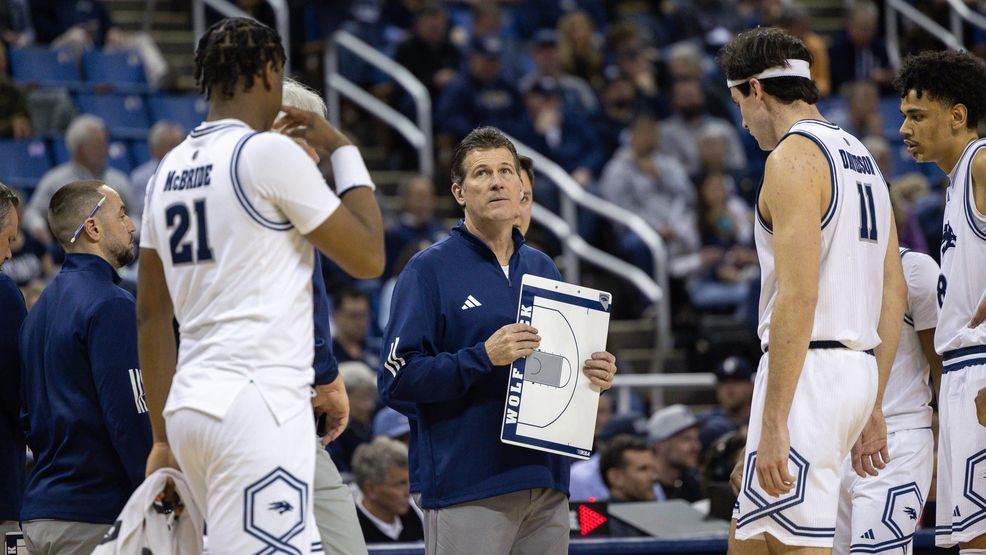
The Nevada men’s basketball team’s 2024-25 season got off to a great season.
The Wolf Pack began the year with blowout wins over power-conferences teams Washington and Oklahoma State; a victory over NCAA Tournament squad VCU; and a 16-point romp over 21-win Santa Clara, which advanced to the NIT. It added up to a 6-1 start with the lone loss by two points to NCAA Tournament-bound Vanderbilt. At that point, Nevada was getting votes in the AP Top 25 and living up to the hype as a Mountain West contender.
“We got off to a really good start,” Nevada coach Steve Alford. “I thought our guys did a lot of good things coming out of Charleston being 6-1 with our only loss a two-point loss to Vanderbilt. I thought we had things going at a really good rate. And in this NIL world, it’s new not just to coaching staffs, but it’s also new to players. For whatever reason, from public numbers — not so much from NSN or media — but those NILs getting out caused a big riff.”
Those name, image and likeness payments leaked within the team after Nevada’s trip to the Charleston Classic. And in its first game thereafter, the Wolf Pack was blown out by Washington State then took a bad loss at Loyola Marymount. It scored back-to-back wins over South Dakota State and Texas Southern but then lost its first four games of the MW season and ended up going 11-15 after the NIL numbers got out.
“It took the better part of a month to just kind of try to educate how this works because a high school player has a certain value in the NIL, a returnee has a certainly value in NIL and then the portal individual has a certainty value,” Alford said. “Not all those things match, and so there was a lot of education going on.”
In modern college basketball, it’s not just about Xs and Os and player development for coaches anymore. Players are now getting paid, either via NIL deals that have to go through third parties outside of the athletic department. Or now through revenue sharing, which will become legal next week and allows schools to directly pay players up to a $20.5 million distribution pot.
That has added another layer to team building, both in recruiting and retention and in keeping players happy while trying to maintain a team-first culture. Whereas playing time, or a lack thereof, used to be a potential point of frustration for players, money is now a factor, too.
“You’re just dealing with a lot of things, and I don’t think our team handled it well,” Alford said. “And then all of a sudden, you lose your opener in league play and then you start 0-4 in league play, and now you’ve been smacked pretty good and we just never recovered. We played basically .500 basketball from there. But I thought our basketball got better.”
After the 0-4 start in MW play, the Wolf Pack won seven of its next 10 league games before going 2-6 down the stretch. That was partially a result of a injuries as Nevada lost veterans Tré Coleman (broken hand), K.J. Hymes (back) and Daniel Foster (ankle) to season-ending injuries. Those players combined for 17 college seasons but were unavailable by season’s end.
“I did think we were better at the end, but losing Tré for the better part of February on and losing Daniel (was big),” Alford said. “Daniel’s best year was a year ago when he was fully healthy. And it’s very unfortunate that our community never really saw Daniel the way we saw Daniel because when he was healthy he was that Swiss Army knife that could do an awful lot of things for us. K.J. was not healthy this year. So, we had to battle a lot of those things, and I give our guys a lot credit. We would have been in the NIT. The guys opted not to play, and I get it. K.J. wasn’t healthy. Tré wasn’t. Daniel wasn’t. I’m not sure we would have had five, maybe six players going to the NIT, so that’s not a good thing.”
This offseason has brought massive roster changes as Nevada returns just four players, including zero starters, with nine newcomers (six transfers, three freshmen), which Alford said are the most he’s added in one offseason. That roster flip should wash away any residual issues with last year’s NIL payments, but those aren’t going away. The money is only growing with revenue sharing now part of the equation. And unlike NIL deals, which are not legally allowed to be dictated by the coaches or athletic department, revenue-sharing money will be determined and distributed by schools. Nevada’s goal is to reach at least $5 million in NIL/revenue share money. How that will be dispersed is undetermined.
Alford said he has leaned on associate head coach Craig Neal when educating his players on NIL. Neal is a former agent and NBA assistant coach with that league dealing with a wide array of salaries for its players. Alford was asked what approach Nevada will take moving forward to ensure a team-first mentality with players now being compensated at different levels.
“I go back to agents,” Alford said. “These guys are getting agents, and they’re charging 15 percent or more. It’s insane. If you’re an NBA player, it’s 4 percent or less. These kids are figuring out that — and they don’t think 15 percent is a lot; yeah, it is — that after taxes, you’re not making the $1 million that these NBA guys are making where they are only taking 4 percent. So, you’re just dealing with a lot of that as well. These kids are going through it for the first time and learning. We’re finding that late in our career we’re doing more communication.
“We always felt like we were a very communicative staff. Now it’s on steroids. It’s daily just investing in these young people’s lives because it’s a whole different deal. It’s different for the parents. They don’t have a good feel or understanding of what it is because overnight the families are getting all this kind of money, which is a positive. It’s a great thing for the families. But learning how to deal with it and handle it and keep it in perspective, those are things that we’re constantly trying to educate.”
Nevada should be faced with less entitlement from players entering this season given its new-look roster, which includes four Division I transfers and one each from the NAIA and junior-college levels. The only returning player for Nevada who has started a game for the Wolf Pack is junior-to-be Tyler Rolison, who has eight starts in two college seasons. That will lead to heated competition for starting jobs.
“I think we’ll have really good competition, which is going to be a good thing,” Alford said.
While paying players is now a huge part of college athletes, Alford said he doesn’t want to lose sight of his job as a coach to develop the overall person.
“It is about the development of the individual, too,” Alford said. “I don’t want these kids now that they’re getting paid to now become entitled and not understand the era that they’re living in is a great era to live in. You’re getting paid. The market value changes. It changes with coaches; it changes with players.”
Offseason conversation with Steve Alford
0:15 — Alford’s son, Bryce, winning an NBA title with the Thunder
1:10 — Kobe Sanders’ draft stock
3:50 — First impressions of 2025-26 roster
5:35 — Offseason trip to the Bahamas
8:00 — What Nevada was looking for in the transfer portal
10:05 — Wolf Pack’s smaller cast of point guards
11:10 — Elijah Price’s addition to the roster
13:00 — Adding players from the NAIA and JuCo level
14:40 — The competition for starting jobs
18:15 — NCAA Tournament expansion
19:30 — Revenue sharing with athletes
20:55 — GSR Arena moving forward with groundbreaking
22:05 — Getting Nevada over the championship hump