
Jeff Weltman promised that the Orlando Magic would be aggressive in trying to upgrade the roster this offseason. By making a major deal, with a lot of moving parts, with the Memphis Grizzlies, the Magic took a homerun swing.
Here are the particulars:
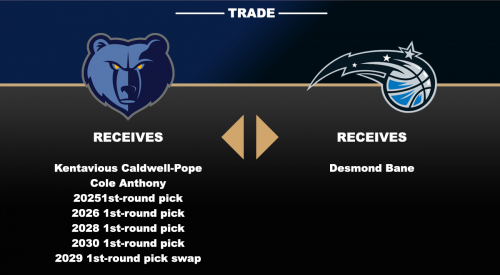
Orlando Magic acquire: Desmond Bane
Memphis Grizzlies acquire: Kentavious Caldwell-Pope, Cole Anthony, 2025 16th overall pick, 2026 first-round pick (likely to be from Phoenix Suns), 2028 unprotected Orlando first-round pick, 2029 top-two protected first-round pick swap, 2030 unprotected Orlando first-round pick
Let’s dive in!
(Note: We’re assuming this trade is being completed as a part of the 2024-25 league year, thus all salary amounts will reflect that.)
Orlando Magic
Incoming salary: $34.0 million in 2024-25
Desmond Bane (SG, four years, $163.2 million)
Outgoing salary: $35.7 million in 2024-25
Kentavious Caldwell-Pope (SG, two years, $43.2 million (player option for final season)), Cole Anthony (PG, two years, $26.2 million (team option for final season))
After his team was eliminated in the first round of the playoffs, Orlando Magic president of basketball operations Jeff Weltman said the Magic would be aggressive in upgrading the roster this summer. With one transaction, Weltman has backed up those words in a major way.
Over the last two seasons, especially in the playoffs, Orlando has desperately needed more shooting and scoring. Desmond Bane solves those issues and then some.
Over the course of his five-year career, Bane has put up 47/41/88 shooting splits, while attempting 6.3 three-pointers per game. Overall, Bane is a 17.8 points per game scorer. If you take out his rookie season, when he had a lesser role as a bench player, Bane has averaged 20.2 points per game.
The sixth-year guard has proven that he can scale his offensive role up and down as necessary. Bane can handle being the primary scorer when called upon, but he’s also terrific playing off others. That’s huge for a Magic team that will have Paolo Banchero and Franz Wagner running the offense a lot. Bane is also a very good passer, which will help when teams key on Banchero and Wagner and someone else needs to create offense.
On the defensive end, the Magic lose a bit, because Kentavious Caldwell-Pope is still a very good defensive player. Caldwell-Pope is showing some signs of slipping, but those showed up far more on the offensive end. That said, Bane is a pretty rugged defender himself. He’s better against bigger, stronger wings than quick, speedy guards but those are the guys that Jalen Suggs will defend. Overall, Orlando isn’t going to see any kind of big drop-off on defense with Bane in place of Caldwell-Pope.
Losing Cole Anthony eats away at Orlando’s guard depth some, but it opens an even clearer path to minutes for third-year guard Anthony Black. Anthony was out of the rotation for large chunks of last season. Now, Black will fully take on the backup role behind Suggs, in a pretty good three-guard rotation with Bane.
On the cap sheet, things are starting to get pretty pricey for the Magic. This season, they’re likely to be a tax team, and possibly pushing up against the first apron. That shouldn’t be an issue, as Orlando doesn’t have a lot of open roster spots. They’ll likely re-sign Moe Wagner and one other veteran minimum deal, barring any other trades.
It’s starting with the 2026-27 season when Orlando will become very expensive. Paolo Banchero will be on at least a 25% max salary starting that season, and possibly a 30% max salary if he makes All-NBA next year. That means in 2026-27, the Magic will have at least $196 million on the books for eight players. If they keep Jonathan Isaac and Jett Howard in the fold, that figure climbs to nearly $218 million. That’ll see Orlando over the first apron and approaching second-apron territory. If Banchero qualifies for the 30% of the cap max, add about $9.5 million to those figures, which pushes the Magic well past the second apron.
On one hand, having a core of Banchero, Wagner, Suggs and now Bane locked in through at least the 2028-29 season sounds great. But that core has to produce at a high level, including playoff success. Otherwise, at least one of that core group will have to be traded to reset around the ones who remain.
As for the future draft capital, Orlando should be ok. They’ve had extra draft picks in several years recently, which meant that roster spots were becoming an issue. They should also feel confident about being good enough that surrendering unprotected picks in 2028 and 2030 and a very lightly-protected swap in 2029 won’t hurt them too much.
Everything is in place for the Magic to make a deeper playoff run next year. And important to note: that’s without making any other moves. Orlando still has the salaries to swing another deal or two, to continue retooling the roster. The Eastern Conference looks pretty wide open, and the Magic have now put themselves in the mix to be contenders for the foreseeable future.
Memphis Grizzlies
Incoming salary: $35.7 million in 2024-25
Kentavious Caldwell-Pope (SG, two years, $43.2 million (player option for final season)), Cole Anthony (PG, two years, $26.2 million (team option for final season))
Outgoing salary: $34.0 million in 2024-25
Desmond Bane (SG, four years, $163.2 million)
The Memphis Grizzlies gave the core group of Ja Morant, Jaren Jackson Jr. and Desmond Bane four years. Those four years returned one playoff series win. It felt like making a change was coming and here it is.
On the court, this move weakens the Memphis offense by a large amount. Bane was their second-best offensive creator behind Morant. Bane’s shooting was a key to opening up the floor for Morant’s whirling dervish drives. Now, the Grizzlies have to figure that out, as well as solving for an additional creator alongside Morant and Jackson.
Kentavious Caldwell-Pope is a decent replacement for Bane. He’s still a very good defensive player, but his offensive production fell off a cliff last season. Maybe it was the Magic curse, where no one shoots well for Orlando. If not, the Grizzlies might be in some trouble on offense. If Caldwell-Pope can get back to his former levels as a shooter, Memphis lost shot creation, but should be ok with spacing.
Adding Cole Anthony could also help juice the offense, but he’s not big enough to play with Morant, and Scotty Pippen Jr. has already proven to be a pretty good backup point guard. Don’t be surprised if Anthony is moved in a subsequent deal, as his fit with the Grizzlies doesn’t seem very clean right now.
Mostly, this deal gave Memphis some long-term salary flexibility, while adding a ton of draft capital for the future. The Grizzlies took on a little money for the upcoming season because of adding the 16th pick in the 2025 NBA Draft (more on that in a bit!), but shed significant long-term salary. At most, Caldwell-Pope and Anthony are on the books for about $7 million less than Bane was alone. At best, Memphis could decline the team option they now hold for Anthony for 2026-27 and Caldwell-Pope could opt out for the same season. And that’s before factoring in the $87 million Bane is owed through the 2027-28 and 2028-29 seasons.
However, in order to make that flexibility worth it, the Grizzlies have to do something with it. Before this trade, Memphis could have created about $7 million in cap space this summer. The idea there was to add to that Jackson’s $23.4 million salary for the upcoming season in a renegotiation-and-extension deal. Memphis then could have extended Jackson off his new $30 million salary.
Now, the Grizzlies can create about $4.5 million in cap space. Bumping Jackson up to about $28 million could still be enough to get a renegotiation-and-extension done, but it’s not nearly as lucrative. However, Jackson and Memphis could have an understanding that they’ll take care of things in the 2026 offseason. If that’s the case, then Memphis can bump Jackson’s salary up even higher and the team should still have a lot of flexibility.
As for this offseason, the Grizzlies can still re-sign Santi Aldama and use the full Non-Taxpayer MLE. They’ve got more than enough clearance under the first apron to do whatever they need to with signings and further trades.
The volume of draft picks Memphis acquired in this deal can’t be overlooked. They got a mid-round first this year, which should help them towards replacing Bane. They’ll have an extra pick in 2026, 2028 and 2030, as well as a potentially nice swap in 2029. That’s huge for the future. Even if the Grizzlies don’t use all those picks themselves, they’ll have a nice chunk of additional draft capital to offer in trades moving forward.
It’s felt like Memphis was going to make a big change since they were swept in the first round of the playoffs. Now, the Grizzlies have made that big change. They have considerably more flexibility moving forward, but undoubtedly gave up the best player in this deal. How Memphis replaces Bane, and what they do with all the flexibility cap- and draft-wise moving forward, will determine how they did in this deal. For a Grizzlies team that’s had a pretty stable future locked in for years, things are now a lot less certain.