
The Portland Trail Blazers carried a 36-46 record through the 2024-25 NBA regular season. It was good enough to make them the “best of the rest”, just south of the NBA Play-In Tournament line, north of nearly all the other teams who will participate in this year’s draft lottery.
Inherent in a middle-ground standing are positives mixed with negatives, grey areas open to interpretation. Few things stand out without caveats, but few are hopeless.
That held true overall when we examined Portland’s offense yesterday. Four or five areas showed promise with a half-dozen languishing behind. Will the same hold true of the defense? Let’s take a look at the season by the numbers.
Each statistic is listed by name, with the raw stat and NBA rank following, the data from last year in parentheses right after.
Doing Well
Blocks Per Game 5.3—8th in the NBA (4.3—27th last year)
Block Percentage 6.0—6th (5.0—27th)
Turnovers Per Game 15.5—6th (14.3—5th)
Turnovers Per Possession 15.0%—5th (14.1%—5th)
Assist-to-Turnover Ratio 1.69—7th (1.90—10th)
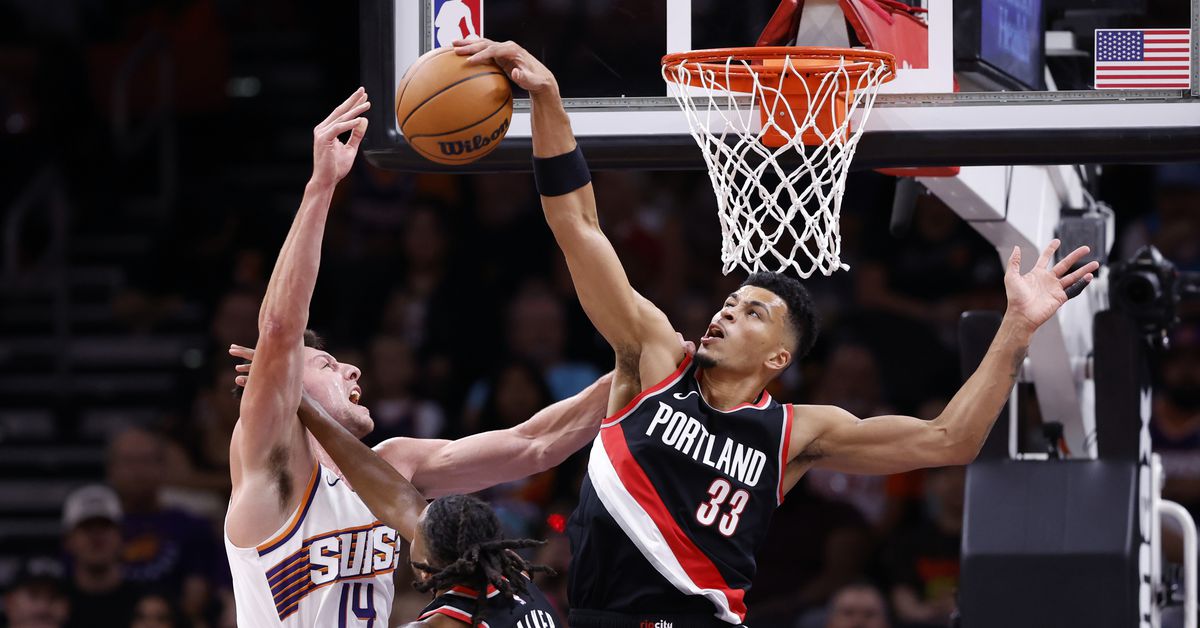
The Blazers excelled in “opportunity” defensive stats, the highlight-play version of defense. Behind Donovan Clingan (110 blocks, 1.7 per game, 3.0 per 36 minutes), Portland morphed from one of the most inconsequential teams in the league in blocked shots to one of the best.
Their perimeter defenders weren’t shabby either, maintaining an emphasis on forcing turnovers that typified the 2023-24 season.
If the NBA were a video game, Portland would be one of the most feared defenses in the league.
The Middle Ground
Points Per Game 113.9—15th (115.4—20th)
Points in the Paint 48.5—13th (53.5—24th)
Free Throws Per Game 22.5—21st (23.6—26th)
Field Goal Percentage 47.1—20th (49.1—25th)
Three-Point Percentage 36.1—15th (35.1—4th)
Effective Field Goal Percentage 54.3—18th (55.8—24th)
Defensive Efficiency 110.6—14th (113.3—23rd)
Steals Per Game 8.3—11th (7.6—12th)
Assists Per Game 26.2—13th (27.1—22nd)
Most of the meat-and-potatoes defensive statistics lie in the middle ground for Portland. There’s plenty of good news to be found here, at least relatively. Last year the Blazers were bottom-third of the league in Points in the Paint Allowed, Field Goal Percentage Allowed, Effective Field Goal Percentage Allowed, Defensive Efficiency, and Assists Per Game Allowed. They’ve improved to an average defense in all those categories (albeit low-end in a couple cases). That is no small feat. It’s enough to say that Portland’s defense was revolutionized this year. Something finally came together for them.
The bad news is, shuffle all those numbers any way you please and you still come up with mediocrity. The Blazers aren’t really a good defensive team yet, or at least they didn’t show it for the entire season. Like almost everything, their defense came in fits and starts. Except defense—especially in the basic categories—can’t be played successfully that way. It’s perfectly OK to go on hot and cold streaks with blocks and steals. You can’t go on hot and cold streaks with opponent field goal percentage and still call yourself good defenders. It’s like pleading your case in criminal court. “Your honor, I didn’t rob banks all the time! In fact I spent most of my time not robbing banks!” Yeah, guilty as charged.
Youth and inexperience, injuries, and shifting lineups all played a role in Portland’s defensive vacillations. There’s reason to hope that next season they can take another step forward, at least in consistency. Right now, that’s still just a hope. The Blazers will need to hold the ground they’ve gained this season, take another leap, and do both while shoring up an offense that’s in much worse shape than the defense is. Can they find the personnel to accomplish all of that at the same time? Despite the improvement, the road is still long before them.
Side Note: Although most of Portland’s defensive stats improved this year, three-point defense dropped from 4th in the league last season to 15th this. That’d be a nice area to excel in.
Bad News
Defensive Rebounds Per Game 31.4—27th (30.1—30th)
Defensive Rebounding Percentage 72.5—28th (74.0—25th)
Fast Break Points 17.5—28th (17.0—29th)
The Blazers showed few glaring defensive weaknesses this season. Defensive rebounding was one. It’s an area of mild concern…one of the easiest to fix and probably one of the least consequential.
Fast break points allowed, though? That one is mildly irritating. The Blazers don’t have strong guard defenders. Their guards are penetrating more than they used to. They commit a ton of turnovers. Those are three of the reasons Portland stands among the worst defensive teams in the league on the break. But some of that is also concentration, repetition, and just plain effort.
Side-eye at allowing 17.5 points per game. The league leaders gave up 4-5 less. Those 4-5 points saved could take pressure off of the Blazers’ flagging offense.
Tomorrow: Summarizing where the Blazers are and what they need next.