
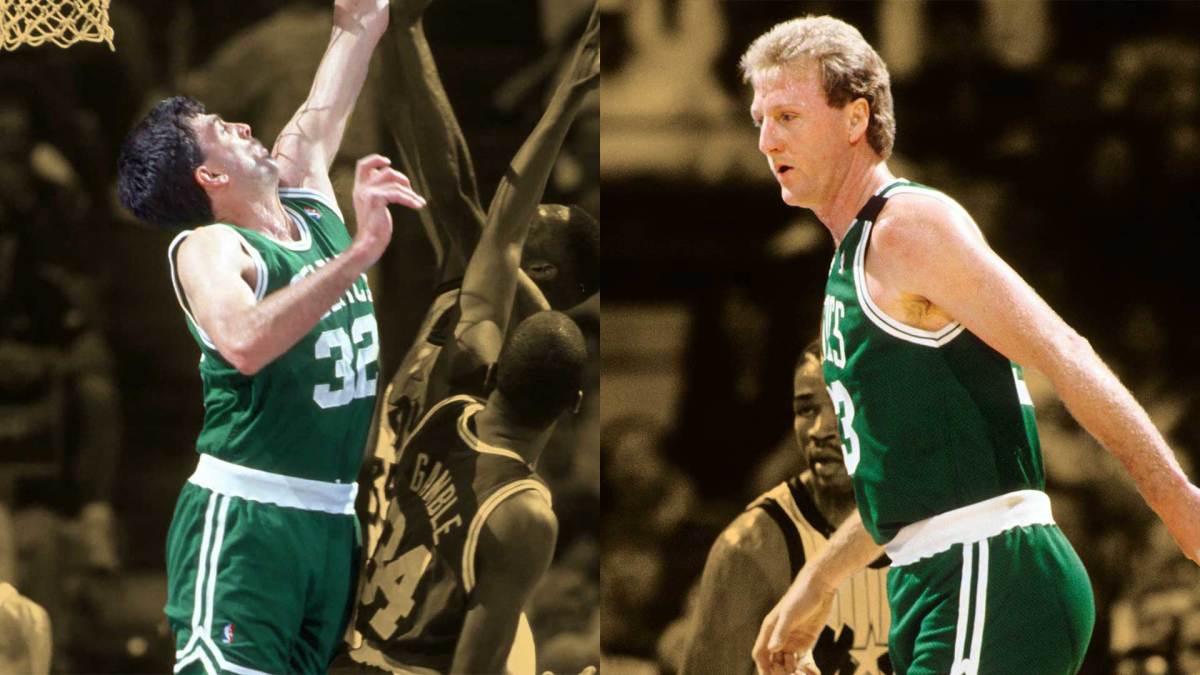
“People don’t know how strong that guy is” – Kevin McHale on Larry Bird’s most underrated trait as a player originally appeared on Basketball Network.
Physically, Larry Bird didn’t come across as the most intimidating presence. But that would be just masking the actual fact. His wiry frame and hunched shoulders gave off the impression of someone who relied purely on finesse, maybe vision, maybe instinct.
Advertisement
Under that humble exterior was a brand of strength that held its own and imposed. Kevin McHale, who spent every day alongside Bird on those battle-hardened Boston Celtics teams of the 1980s, knew exactly what that meant.
Bird’s strength
The league saw Bird as a shooter, a talker and a clutch maestro. McHale saw something else — an absolute brute in the post.
“People don’t know how strong that guy is,” the Celtics legend said. “Larry would just come into you and grab you. I remember the first time I’m gone, I’m like, ‘Damn, that guy’s strong.'”
McHale, a Hall of Famer in his own right and one of the league’s most skilled low-post players, wasn’t easily impressed. But even he remembers that moment of shock when Bird’s physicality made its first impression.
Advertisement
The legendary forward didn’t waste time playing soft angles. He’d seal defenders with his hips, use that iron grip to hold space — and the second they flinched, he’d already be rising up for a clean jumper.
Bird played in an era where elbows flew as freely as passes. But even among the hardwood violence of the 1980s, his strength was dominant. And no place brought that out more than in the rivalries that made his legend what it is today.
The battles with the Detroit Pistons were the truest test of physical resolve. The Pistons were brutal. Their identity on the hardwood, famously dubbed The Bad Boys, turned the court into a battlefield.
Michael Jordan, in trying to get through them, notoriously bulked up by nearly 15 pounds in the early ’90s just to endure the punishment. By 1991, Jordan was a different physical force and it took that version of him to finally push through the Detroit wall.
Advertisement
Battling it out
Unlike Jordan, Bird never needed to bulk up. He didn’t need the weight room transformation or a new training regimen. He walked into those games exactly as he was and still left defenders second-guessing their approach. The Pistons threw Dennis Rodman, Rick Mahorn and Bill Laimbeer at him, but Bird still carved them up.
He did it with the pump fake, with the shot, with the pass, but always with the body. His toughness wasn’t chest-beating or performative. It was functional. It was rooted in leverage, anticipation and an unwavering willingness to get hit and hit back.
Advertisement
In an era before tailored weight programs and personalized trainers, Bird built his core strength on courts in French Lick, Indiana, hauling cement for his dad in the summers and playing ball with men who didn’t believe in calling fouls. He came to the league in 1979 ready-made, because he understood what it meant to be tough before he understood what it meant to be famous.
Bird never led the league in scoring, but he averaged over 24 points per game across a 13-year career that saw three MVP awards in a row and a pair of Finals MVPs. And when it came to the clutch, his numbers only grew sharper. He hit game-winners, pulled down rebounds with three defenders tugging at his jersey and set screens with the kind of impact that left guards dazed.
Strength, in Bird’s game, was the base that held everything else. The passing, the vision, the shooting, none of it worked without the physical resolve to impose. It took until his later years when he was hurt for the Pistons to finally get the better of the Bird-led Celtics in the Eastern Conference finals.
This story was originally reported by Basketball Network on Jun 28, 2025, where it first appeared.