
Looking at NBA Finals odds on FanDuel, you wouldn’t know that the Oklahoma City Thunder just finished one of the greatest regular seasons in NBA history. The Thunder’s odds to win the championship are +175, indicating that their odds of winning the title are around 35%, and just barely ahead of the Boston Celtics at +180.
This is despite Oklahoma City having just finished with a 68-14 record. The only three teams with more wins in the past 50 years featured Michael Jordan or Stephen Curry. In terms of margin of victory, the 2025 Thunder is even more historic—its 54 double-digit wins were the most ever. The Thunder’s net rating (pace-adjusted point differential) is second all-time only to the 1996 Chicago Bulls, and eight of the top 10 teams in league history by that metric won it all.
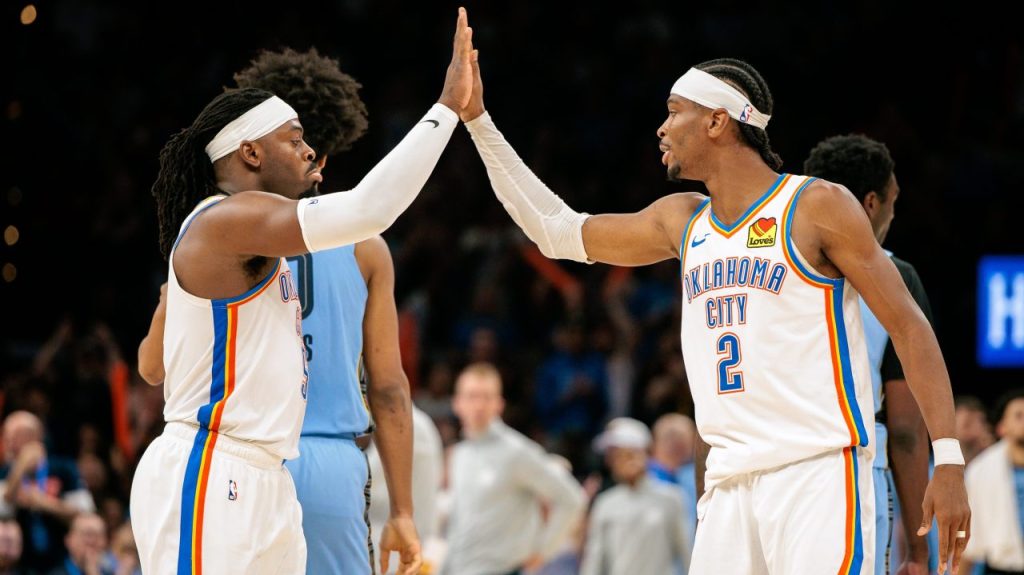
The Thunder began their playoff run on Sunday in typical fashion, crushing the Memphis Grizzlies in the first game of the series, 131-80.
During the season, the Thunder offense, the third best in the NBA, was efficient, and got better over the course of the season, but their defense set them apart. They allowed 107.5 points per 100 possessions, 7.0 points below the NBA average of 114.5. That disparity is tied for 10th among all teams since Bill Russell’s Celtics between 1961 and 1965, who posted five consecutive outlier seasons of elite defense.

Oklahoma City forces a turnover on 17.1% of its opponents’ possessions, per Cleaning the Glass, the best mark in the NBA. On the other end of the floor, they take care of the ball, committing a turnover on only 11.6% of their offensive possessions. That gap between their turnover percentage and their opponents’ is the largest this century. This creates a math problem for other teams—the Thunder attempt nearly six more shots per game than its foes simply via its turnover differential.
The Thunder achieved this level of success much earlier in the organization’s development timeline than is typical. Each of the top 25 regular-season teams of all-time by net rating have had an average age (weighted by minutes played) of at least 25.8 years old. The Thunder’s average age is just 24.8. The only other team since 2000 younger than 25 years old with a net rating of +7.0 or better was last year’s Thunder.
Oklahoma City is young, and built to last. Every single player in the team’s rotation is under contract for next season, and most of them for discounts precisely because they are so young. Their stars are all on rookie deals or rookie extensions, as opposed to veteran max contracts.
MVP frontrunner Shai Gilgeous-Alexander’s salary was $35.9 million this season, the 33rd highest in the NBA. All-Star Jalen Williams and 2022 No. 2 overall draft pick Chet Holmgren earned just $4.9 million and $10.8 million, respectively, each outside of the top 150 most expensive contracts.
During an era when the new rules of the 2023 collective bargaining agreement penalize and restrict teams that overspend, the Thunder payroll ranks just 25th out of 30 franchises, per Spotrac. It is unusual to build a championship-caliber team without shelling out a lot of money—14 of the past 18 teams that won the Larry O’Brien Trophy paid the luxury tax—but Oklahoma City is well under the threshold in 2025 and should be able to avoid the penalty again in 2026.
And the franchise is poised to amass even more cheap players soon. The Thunder has no fewer than 10 first-round picks and 10 second-round picks through 2029, thanks to multiple shrewd trades over the past several years. That draft capital includes three first-round picks in a 2025 draft that is widely considered to be strong: its own (which it can swap with the Los Angeles Clippers), Miami’s and Philadelphia’s (as long as it falls outside the top six in the draft lottery).
Bills will be due in the future. Barring a surprise, Gilgeous-Alexander will sign a four-year extension this summer worth more than $70 million per season, the largest in NBA history. Williams and Holmgren are both up for extensions that could cost just shy of $500 million or $600 million over the lengths of those deals, combined, depending on which incentives are hit.
For now, though, the Thunder organization is in a rare position. Most NBA teams must choose to either contend for a title or hoard assets and cash in down the road. Oklahoma City has somehow done both at the same time.
(This has been updated with the result of OKC’s first-round opener against the Grizzlies.)