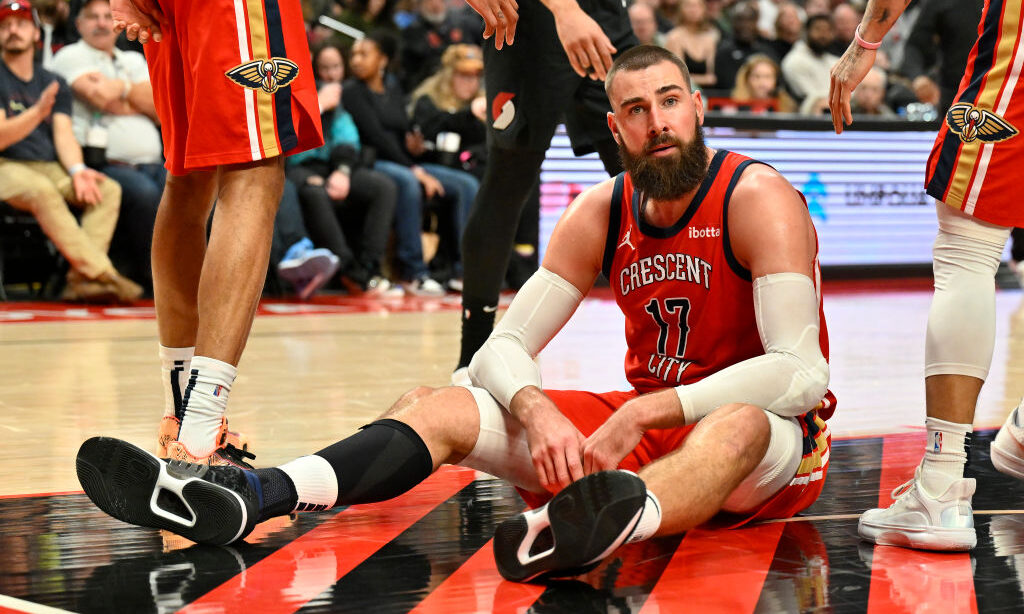
The Denver Nuggets’ long hunt for a good backup center was likely solved this week when the team traded for Jonas Valanciunas. While the deal is being hailed as a haul for the Nuggets, the pickup is even better the closer you look.
Since Mason Plumlee left the Nuggets to become a starter with the Pistons in the 2020 offseason, Denver has had a revolving door of bigs behind the three-time MVP Nikola Jokic. The team has sunk a ton of assets into bolstering the non-Jokic minutes, starting with whichever man takes his place on the court. Basketball Reference estimates 19 guys have played at least a minute at the position since Plumlee left.
Those players range from end-of-career backups like DeAndre Jordan and DeMarcus Cousins, to young players who didn’t quite fit like Isaiah Hartenstein and Thomas Bryant, to power forwards forced to size up like Zeke Nnaji and Paul Millsap to guys who just didn’t work out like Dario Saric and JaVale McGee, to players that just somehow ended up at the position for a few minutes like Hunter Tyson and Michael Porter Jr. The only real solution in this time frame has been asking Aaron Gordon to slide from starting at power forward to playing as a backup big.
But even when Gordon solves many of the issues, and has carried the Nuggets at the spot in the playoffs, the team can still struggle on the glass. While Gordon missed a lot of time last year with injury, the Nuggets were just 17th in the NBA in defensive rebounding rate despite having one of the league’s best glass cleaners in Jokic. Boarding up is so big for the Nuggets for a variety of reasons — the end result is Denver was 42-17 between the season and playoffs when out-rebounding opponents by one or more, and 15-22 when they tied or lost the count.
Last year, Jokic collected about 24% of the Nuggets’ rebounds as a team, and that jumped to 27% during the playoffs. Jokic was fourth in the league last year with 5.4 contested rebounds won per game. He was fifth in second-chance points.
Valanciunas should solve many of the rebounding worries. Among players with over 1,000 minutes last year, Valanciunas’ .41 rebounds per minute was best in the NBA. Jordan actually had the same rate, but the Lithuanian played about 900 more minutes. Just a few seasons ago, in 2022-23, Valanciunas led the NBA in both total rebounding and defensive rebounding rate.
Whereas Jordan has been solid for the Nuggets, mostly as a third-string center but as a second-teamer last year, he’s just not an every-night player at this point in his career. Valanciunas has played in 79 or more games each of the last three seasons. When the Nuggets first got Jordan in their title chase, he was 34. Valanciunas is now 33.
Valanciunas averaged 10.4 points, 7.7 rebounds and 2 assists on 55% shooting last season — and shot 67% near the rim. In the past, he’s shown a propensity to knock down outside shots as well, taking about 1.5 per game over his few seasons between Memphis and New Orleans — hitting at a 35% clip.
Valanciunas has a lot in common with Jokic, from rebounding rates to offensive repertoire. He can allow the Nuggets to deploy a similar strategy with their starters and bench play, unlike the radically different plans they tried to utilize with past players in this position.
Valanciunas can serve as a post-up hub (1.05 points per possession — 75th percentile), a skilled handoff partner and a screen-and-roll threat who can finish or make quick reads out of short rolls. He also fits well into some of Denver’s sets — which can create space for cutters like Christian Braun, Bruce Brown and Tim Hardaway Jr. to attack downhill.
Valanciunas is reliable enough and should be good enough to actually alleviate the pressure on Jokic to play over 36 minutes every night. That was the main goal of the offseason, laid out by Jokic himself, who called for more depth. In trading Michael Porter Jr. and Saric, the Nuggets have done that with Valanciunas, Cameron Johnson, Brown and Hardaway Jr. This balances the team and takes a lot of stress during the season off of the starters as well as allows them to rest a bit more during playoff games.
Schematically, Valanciunas gives the Nuggets a true drop-coverage big: strong, vertical and capable of holding space without overcommitting. Denver can now toggle between switch-heavy lineups around Jokic and more traditional coverages with Valanciunas, making their defense more adaptable to different playoff matchups. Last year, the Nuggets had to sit in a zone against the Thunder; they had no other choice. Valanciunas allows the Nuggets a size-for-size counter that they have lacked since Plumlee.
It’s all about the team not unraveling as soon as the bench comes in the way they did in Game 7 against the Thunder and have done so often for years in the non-Jokic minutes.
The best part of this trade? It’s an extremely low-risk move.
While I even reported that the reason the Kings made the trade was to save $15 million over two years because they needed to clear salary to keep Malik Monk, while adding Dennis Schroder — that’s not exactly true. Yes, the Kings needed to clear $5 million in order to take care of their own business, but they did not save that much money by trading a valuable player for one that barely saw the court for the Nuggets.
The details on Valanciunas’ $30 million contract over three years that he signed with Washington last summer spell out that the 2026-27 season is non-guaranteed. This basically gives the Nuggets a team option next summer on the big man. So if things somehow don’t work out in Denver for Valanciunas, the Nuggets aren’t sunk. Even better, Valanciunas $10 million essentially expiring salary is a valuable trade asset in itself, and the Nuggets could use him in a deal at the deadline if need be.
At worst, there’s no harm done and the Nuggets can make another move; at best, Denver has found their backup center for the next two years.
So Valanciunas gives the Nuggets options on the floor and in their books. This season was all about flexibility for the Nuggets, and it’s the thing that should power them back to parade planning.