
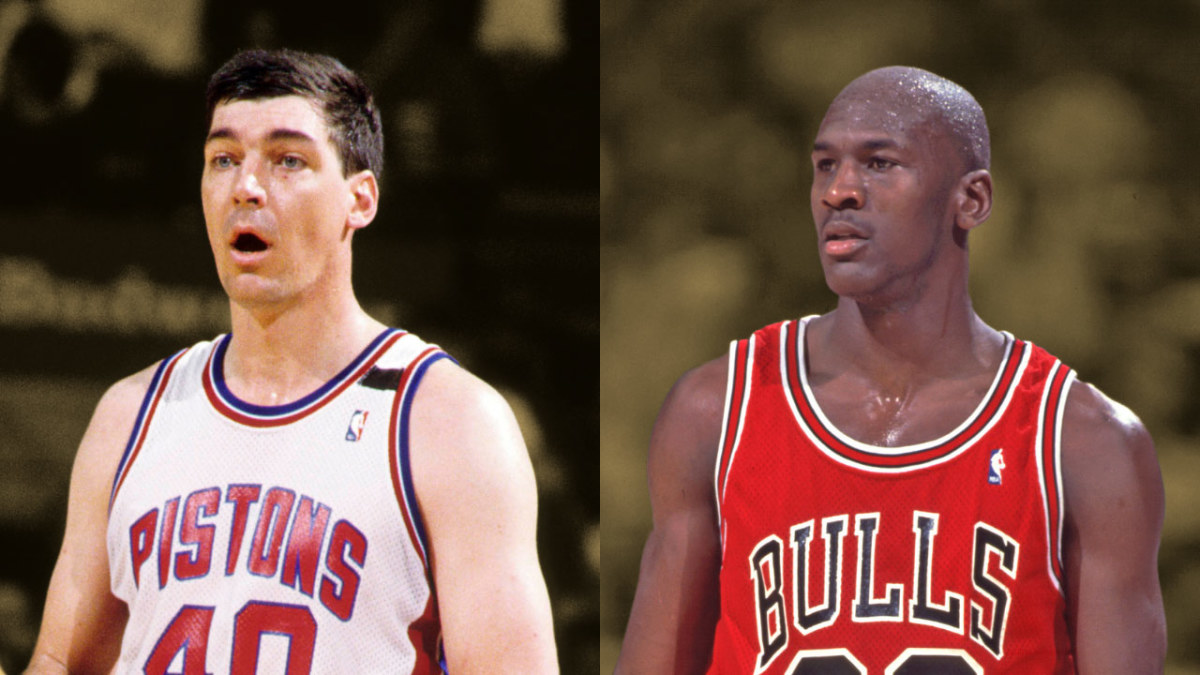
“Who’s he? Who even cares about him?” – Bill Laimbeer once said Michael Jordan gets too much praise for someone with low character originally appeared on Basketball Network.
No team in the late 1980s or early 1990s carried a mythos quite like the Detroit Pistons.
Advertisement
The Los Angeles Lakers were flashy. The Boston Celtics were a legacy. The Chicago Bulls were ascending. But the Pistons’ brand of basketball clashed against the league’s growing thirst for finesse and highlight plays. Even with two championships, the Pistons became an easy scapegoat for basketball’s villains.
And nowhere was that dynamic more heightened than in their fierce rivalry with Michael Jordan.
The NBA needed a golden boy. Chicago had him. And Detroit was cast in the role of the foil, whether they wanted it or not.
Judge of character
The Pistons famously walked out without shaking the hands of Bulls players after being swept in the 1991 Eastern Conference finals. It wasn’t their classiest moment and it didn’t help their image. But for players like Bill Laimbeer, image was never the point. Respect had to be earned, not handed out as consolation.
Advertisement
“To make value judgments on us as individuals and to put them into the public medium in the newspapers or television, who’s he?” Laimbeer said of Jordan at the time. “All he does is play basketball and in the world, he’s this big. He may be up there because he has publicity and the media pumping him up.
“But as an individual down-to-earth person, who’s he? Who even cares about him?”
That quote, as biting as any box-out under the rim, shows where Laimbeer stood. He saw the narrative being spun, how Jordan was elevated not just as a player, but as a model citizen and he called it out for what it was, selective moralizing. In his view, basketball was a sport full of egos, elbows and competition.
Advertisement
Everyone had a dark side if one looked close enough. But somehow, the Pistons were constantly cast as the only team with one. The walk-off in ‘91 became a symbol of bad sportsmanship, but for Detroit’s core, it was simply the final chapter in a years-long war where no handshakes were ever exchanged after bruising battles.
Jordan vs Pistons
Laimbeer, often seen as the baddest of the Bad Boys, leaned into the role with full weight. He racked up six technical fouls in a single postseason (1988), led the league in flagrant fouls at multiple points and was ejected more times than many starters saw playoff games. But off the court, he was known by teammates as calculated, loyal and even strategic player who studied tendencies and knew how to get into heads as much as bodies.
His issue was never with Jordan the player. Laimbeer respected skill. What he rejected was the myth-making that forgave all flaws and rewrote the past. Jordan’s Hall of Fame speech in 2009, his public beefs with former teammates and the notorious leadership style shown in “The Last Dance” docuseries exposed a different side. One not built for team-first glory, but for dominance at all costs. A side that, if worn by someone in a Pistons jersey, would’ve been torn apart in the press.
Advertisement
And that’s the axis of the quote Laimbeer dropped. He wasn’t wrong. Jordan had publicity. He had Nike. He had the NBA front office in his corner. But he was still a man — complicated, ruthless and calculating. The problem, according to the former Piston, was the unequal scrutiny.
This story was originally reported by Basketball Network on Jul 3, 2025, where it first appeared.