
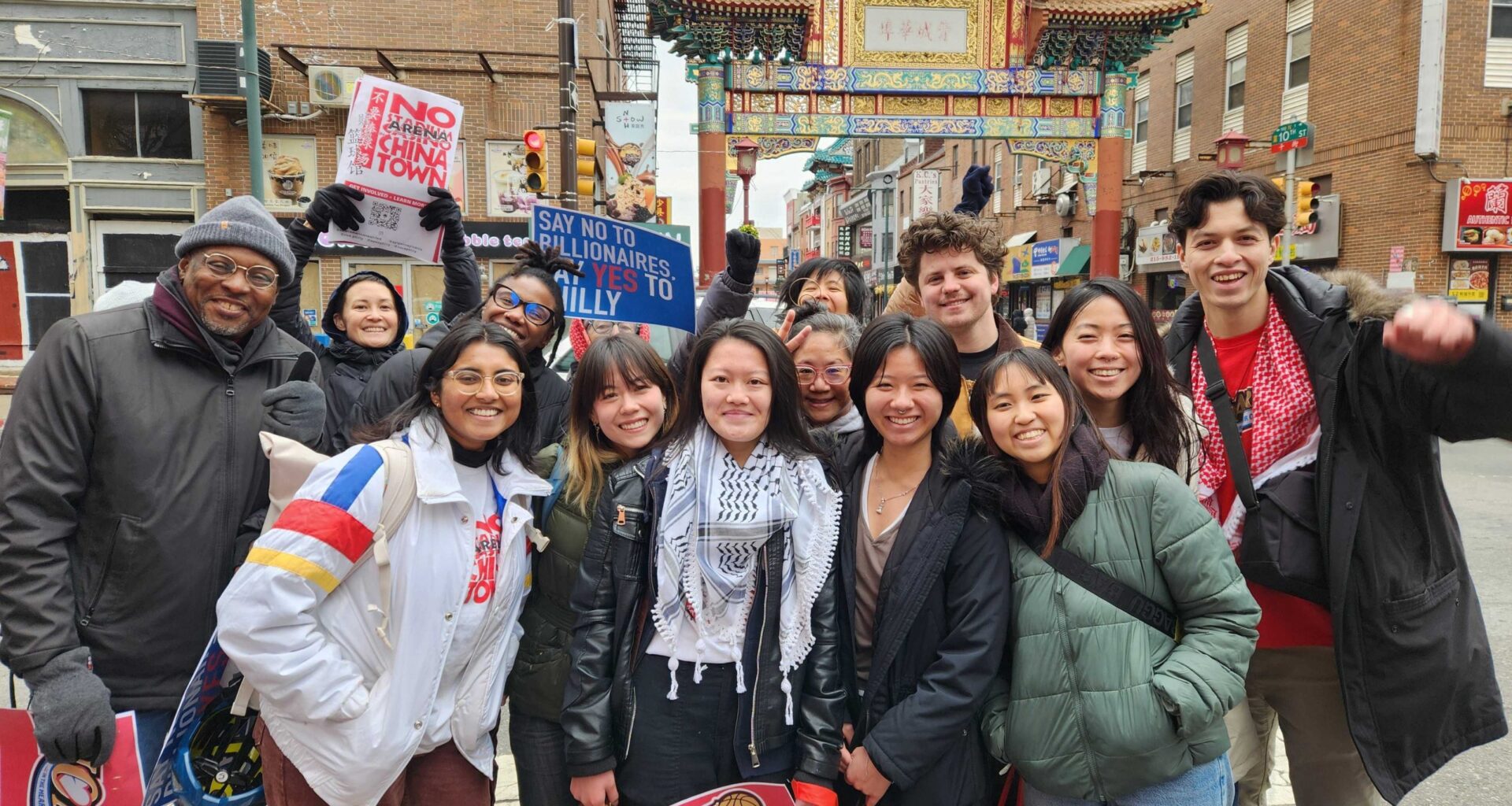
Less than 24 hours after news broke that a Sixers arena would not come to Center City after all, city officials, team owners, and developers confirmed that a new arena would instead be built in the South Philadelphia sports complex, near where the team already leases space in the Wells Fargo Center.
But unlike their current home, the Sixers will have an ownership stake in the new arena, which was the developers’ goal in proposing the move to Market Street.
The facility, a 50-50 joint venture with Comcast Spectacor, is intended to be the new home of the Philadelphia 76ers and Flyers and is expected to open by 2031. It is also hoped that it will be a draw to provide a home for a long-hoped-for WNBA team.
Home.
That word also hung in the air Monday a few blocks away from City Hall, in front of the Chinatown Friendship Gate at 10th and Arch streets, where activists with the No Arena Coalition gathered for their own press conference.
“Chinatown is beyond a commercial area. Chinatown is a home for many people. It’s a community for all of us,” said Wei Chen, civic engagement director with Asian Americans United. “We come here for service. We come here for temple. We come here for celebrations.
“This is our home already. How dare the developers try to throw in a proposal to destroy our community.”
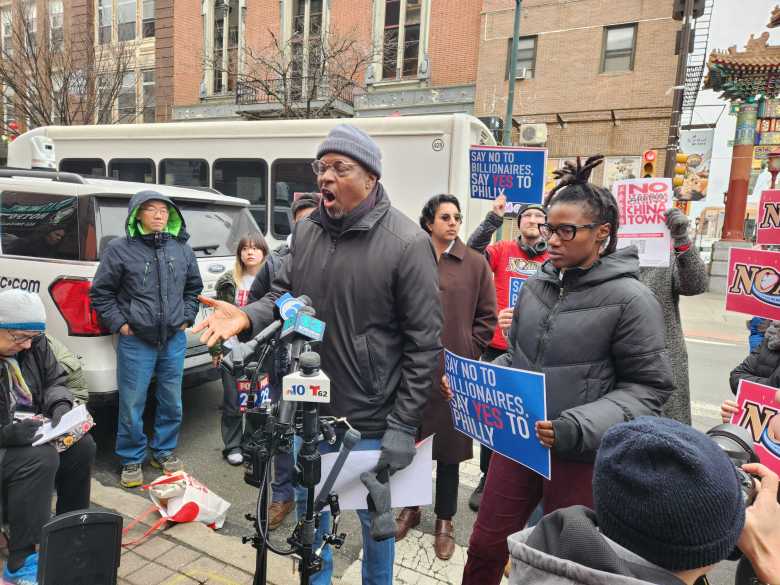 Rev. Gregory Holston of Black Philly 4 Chinatown spoke about community solidarity and the work that still needs to be done to protect Philly neighborhoods at a press conference celebrating the Sixers arena not coming to Center City. (Heather Chin/Billy Penn)
Brittany Alston, executive director of the Philadelphia Black Worker Project and part of Black Philly 4 Chinatown, agreed. “I heard our mayor say earlier today that this wasn’t just about the arena. She’s right,” she said. “We were not just here because of the arena! We were here because we were watching our elected officials bend over backwards for billionaires.”
Instead, they should “bend over backwards for us,” Alston declared. “We have a political imagination for this city that goes beyond what it means to plop an arena in the middle of people’s homes, in the middle of their places of worship, in the middle of their places of service.”
Giving the Sixers a new home, advocates said, should not have led politicians to vote to harm Philadelphians’ existing homes.
“Two-and-a-half years ago, every single person told us that it was a done deal,” said Mohan Seshadri, executive director of API PA, which advocates for Asian Pacific Islanders’ civil rights in Pennsylvania. “And then we talked to our elders and our leaders and communities all across the city, and they said no way is this a done deal. We’re going to fight.”
Philly Chinatown’s history of successful fights against large-scale real estate development is visible in one of their T-shirt designs, which has been reimagined every decade or so: a white shirt with red block lettering opposing first a “stadium,” crossed out and replaced with “casino,” and, most recently, this “arena.”
The over-150-year-old neighborhood also had unsuccessful fights against the construction of the Vine Street Expressway — soon to get a cap park as a form of mitigation — and the Pennsylvania Convention Center, which split and boxed in the community.
Now, that tradition of activism has been passed to the next generation.
“We won’t forget what happened in City Hall last month,” said Save Chinatown Coalition member and Ginger Arts Center volunteer Will Chan. “Especially when it comes to the next Councilmembers’ elections.”
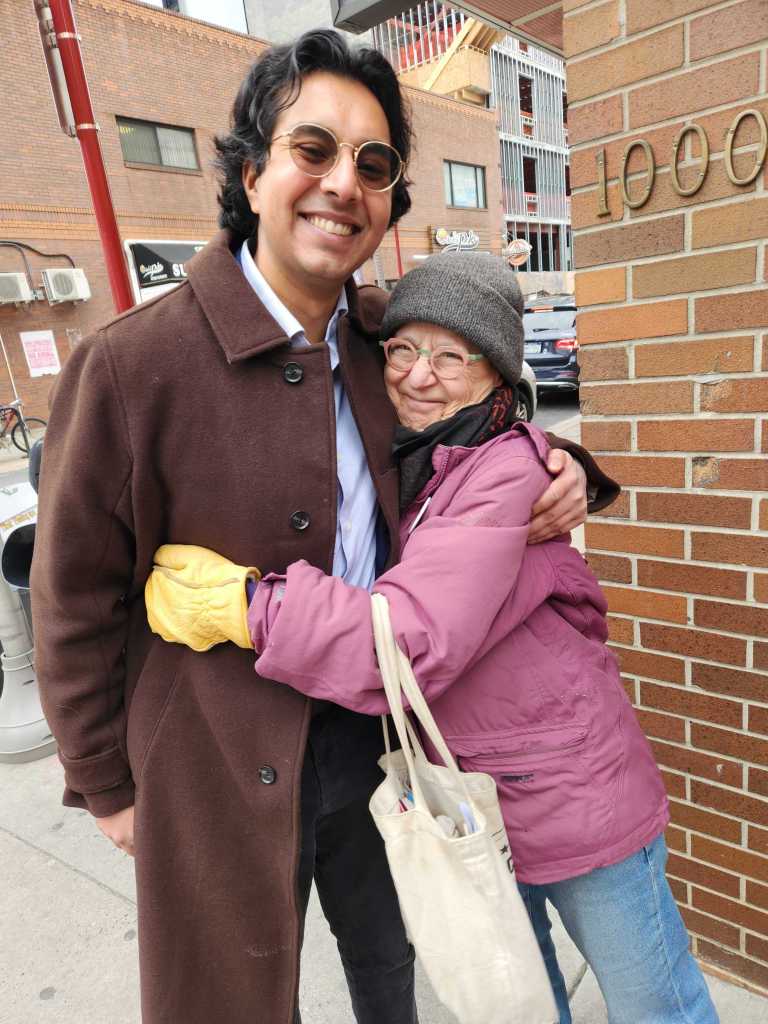 Mohan Seshadri, executive director of API PA, and Debora Kodish of No Arena in Chinatown Solidarity hugged at a press conference celebrating the Sixers arena not coming to Center City. (Heather Chin/Billy Penn)
Chan described being in Council chambers when arrests were being made, including moments when protesters were restrained and removed from City Hall. He reflected on the impact those moments had on the youth present.
“I’m up on one of the balconies, I have a handful of high school kids with me,” Chan said. “And because the police have been so aggressive on the balcony, my kids that I’m with and that I’m looking after and have a duty of care for, they’re crying in their seats and I’m asking, ‘Can I go over to them?’ And I’m being told, ‘No, you’ll be arrested if you do.’”
Of the 12 Councilmembers who voted to approve the arena plan, AAU’s Chen said, “they should be ashamed of themselves. And our community, our next generation will continue, and [will] remember those people who voted yes to destroy our community.”
A movement for change
The atmosphere at the No Arena Coalition press conference was joyous, full of nervous energy, hugs, and honks of solidarity from passing motorists.
Katie Garth of No Arena Washington Square West spotted Katie Low of No Arena Philly Med and bounded in for a hug, while Debora Kodish of No Arena in Chinatown Solidarity (NACS) hugged API PA’s Seshadri.
“As we stand here today in front of Chinatown’s Friendship Arch, our group from Washington Square West is incredibly grateful to have been welcomed into the fight so wholeheartedly and enthusiastically,” said Grath. “Intentionally or not, our politicians have united the city. Our bonds of solidarity are strong and lasting, and we are here for what comes next.”
 Thousands of people from across the Philadelphia region gathered and marched in the rain in solidarity with Chinatown activists against the proposed 76ers arena Saturday, Sept. 7, 2024. (Heather Chin/Billy Penn)
“Now we have a movement for change. Now we have a coalition that is called the Save Chinatown Coalition, but it’s really a Save Philadelphia Coalition,” said Rev. Gregory Holston, of Black Philly 4 Chinatown.
“Don’t believe billionaires got together and found some way to agree,” said Holston. “They made those decisions because the people in this community organized people all over the city to be able to say to them, ‘No.’ ”
Holston cited empathy as being a key driver of solidarity.
“In North Philadelphia, in West Philadelphia, in South Philadelphia, the same process is happening over and over and over again, where people are pushing and displacing people of color out of this city,” he said.
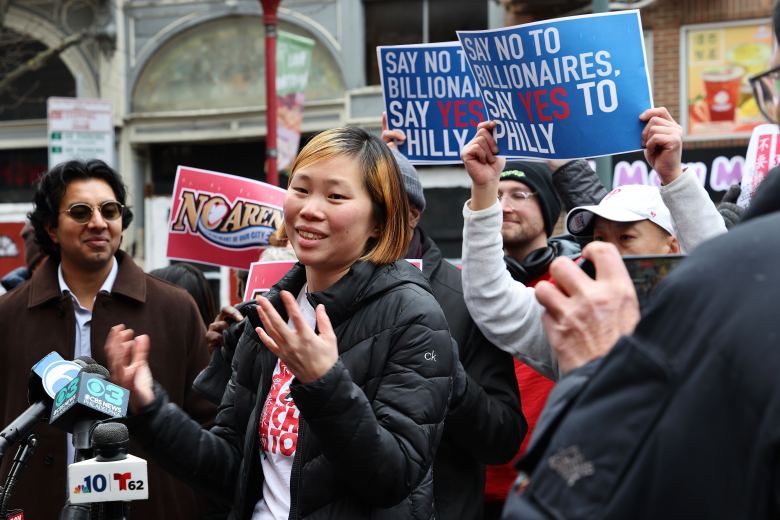 Vivian Chang of Asian Americans United speaks to activists who gathered at 10th and Arch streets in Chinatown after learning that the new Sixers arena will not be built near Chinatown, but in South Philadelphia. (Emma Lee/WHYY)
“Everyone has changed tremendously,” said Claire So of NACS. “I am excited to 1751601795 laugh, cry, sing, eat, have our midnight Lunar New Year parade, and remind people that Chinatown is much more than just streets.”
College freshman and Ginger Arts Center volunteer Celina Seck noted that as difficult as the change and lessons learned have been, “seeing the unity has inspired people to be more critical of developments in the future,” and having newly created third spaces like Ginger Arts provides somewhere to “feel at home” amid adjusting to college and advocacy.
“We and our fellow youth are so happy to celebrate this win, but our work is not done,” said Ginger Arts founders Kaia Chau and Taryn Flaherty, who also founded Students for the Preservation of Chinatown.
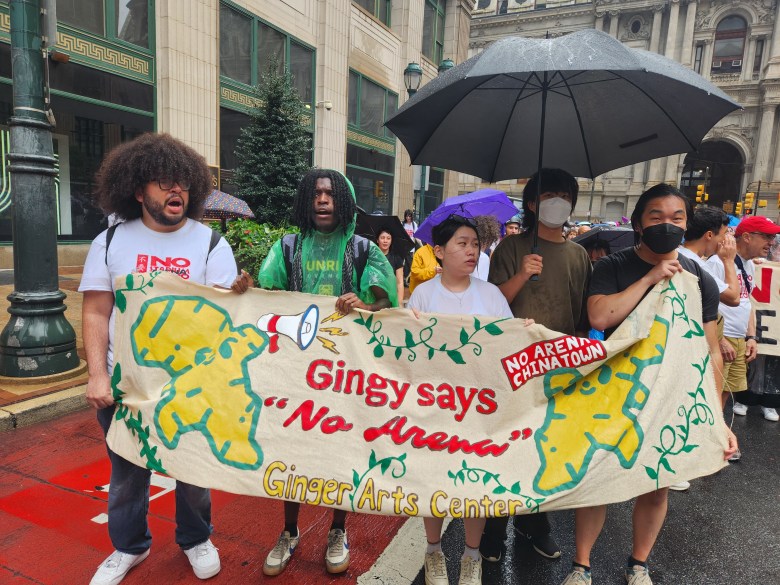 Youth with the Ginger Arts Center helped lead the No Arena Chinatown march and rally Saturday, Sept. 7, 2024. (Heather Chin/Billy Penn)
“Young people like us have been shaped into leaders by this movement. We’ve learned how to lead protests, advocate for ourselves [to] the City Council, educate ourselves and our peers, and create safe spaces for our community,” they said.
“For many young people, this movement was our first organizing experience. We are so grateful to the Chinatown activists and activists across the city, really, who continue the community tradition of passing down methods of resistance to the next generation,” said Chau and Flaherty. “It is because of them that we become stronger. We have built a generation of leaders that will never give up, and have the drive to continue to build the city that we deserve.”
What comes next
Under the Comcast Spectacor-Sixers agreement, Market East development plans are still a part of their long-term plan.
Mayor Parker said the city is still committed to revitalizing East Market Street, and the Sixers — through their owners Harris Blitzer Sports and Entertainment — pledged to reveal new proposals for development in the near future, as they already purchased some properties in the area.
Parker said the city is committed to eventually “fast-track” the development-planning process in the area, though it no longer needs to meet the scuttled arena’s 2031 deadline.
Parker also said she will stand by her earlier promise to provide $20 million for Chinatown support as part of the previous Community Benefits Agreement, although where the funding will come from has not been outlined.
No Arena advocates say that, while this was “a heartbreaking process,” as always, their “door is entirely open to having these conversations” about development along the Market Street corridor.
“We’ve said from the beginning that this is not about no development on Market East. This is about the right development on Market East, that supports local communities, that supports local neighborhoods, that builds up rather than tears down,” said Seshadri. “So we see this as an opportunity to say, “hey, if you’re going back to the drawing board. Let’s be at the table.”
“Let’s be part of the conversation. Let’s make this the win for Philly that you’ve been claiming that the developers have been claiming this would be all along. Let’s do this right and let’s have the conversations that you should have had 2.5 years ago rather than telling us we’re just going to ram this thing through come hell or high water.”