
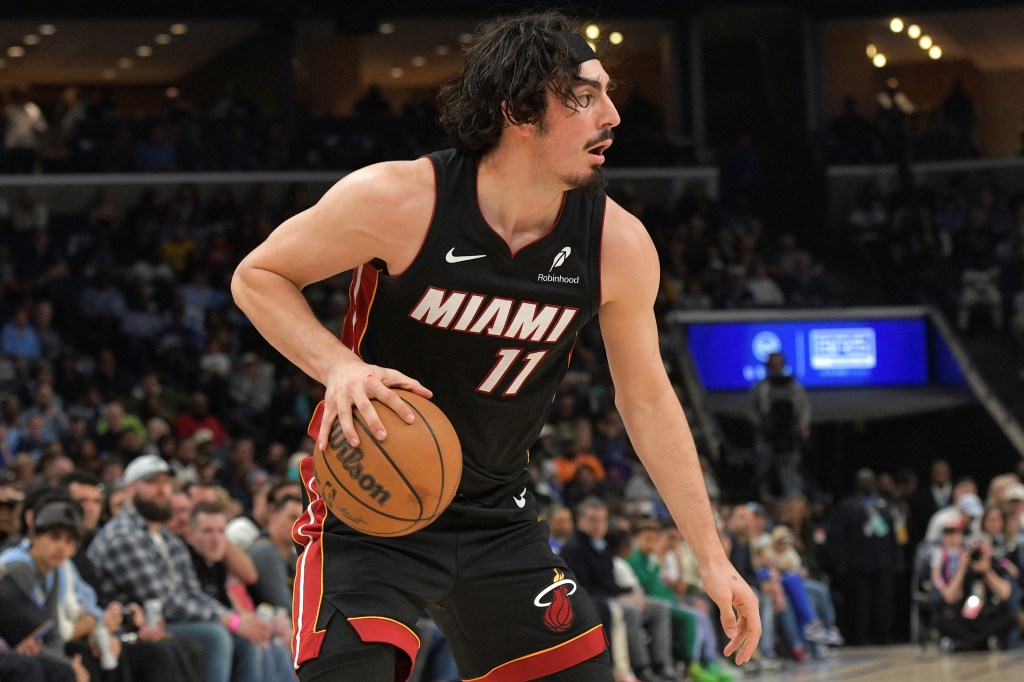
Q: At his year-end press conference, Pat Riley promised personnel changes (Bam Adebayo said they were needed) and now it sounds like they’re running it back. As a fan, this does not seem like a winning formula. I don’t think our young players are exceptionally good, on the whole. Is Pat Riley guilty of being overly loyal to his average young players? Why is this happening? In my opinion this roster doesn’t have the potential to be exceptional, even with a full training camp and great coaching. – Brian.
A: This gets to – or at least questions – the absolute crux of the notion of building with the Heat’s young players: Are they good enough? It is one thing to build with Cooper Flagg or build with Cade Cunningham or at least try to build with Zion Williamson. Ahead of Heat games against emerging opponents, Erik Spoelstra has pointedly and repeatedly cited the multiple lottery picks of the teams on the rise. The Heat, by contrast, largely have a young cast of mid-tier draft picks. So you can talk – or even vow – about going with youth, but it also has to be the right youth. Yes, there is upside in Kel’el Ware, Jaime Jaquez Jr., Kasparas Jakucionis and Nikola Jovic. But there is a reason they also fell, respectively, to Nos. 15, 18, 20 and 27 in their draft years. Yes, sometimes you can mine gold beyond the glitter of the lottery. But striking gold consistently after the lottery is an entirely different story. Even if each of the Heat’s last four first-round picks live up to their draft pedigree, that still means a largely middling mix. So is that what you build around?
Q: The franchise seems very risk adverse. What happened to Pat Riley saying change is needed? The Heat lost by 50 points to the Cavaliers in the playoffs. Even Bam Adebayo said after the loss to the Cavaliers, change is coming. Is a training camp together going to fix the problems against the Cavaliers? Have the Heat become everything Pat Riley disrupted in his early days? – Stuart, Miami.
A: The Heat have been many things in recent years when it comes to their personnel decisions, but I would not include risk averse. Risk averse is not sending out a potential; unprotected lottery pick for Terry Rozier. Risk averse is not selling off Jimmy Butler for pennies on the dollar. Risk averse is not signing Keshad Johnson to a standard contract when there did not appear to be an outside suitor. You can question the decisions, but the reality is that in terms of risk-reward, risk has come, somewhat disappointingly, to rule – and rue – the day.
Q: Ira, I was hoping that The Heat could acquire Damian Lillard when he forced his way out of Portland a couple of years ago. However, assuming that he’s out all of next season, we would be talking about a 36-year-old player who doesn’t play defense, coming off a torn Achilles and who will have averaged playing 50 games a year over the past seven seasons (counting next season). I just don’t see how much he would help The Heat at that point. I would have hoped that The Heat learned their lesson with Kyle Lowry: Stay away from former stars (or maybe current stars), in their mid-to-late 30’s, unless that’s the one missing piece. – David, Weston.
A: But it also comes down to cost. With Kyle Lowry the Heat piled all remaining cap space into one place, on a player who never has been at the level of Damian Lillard. If Damian Lillard can be acquired at a reasonable salary, and without the cost of outgoing prospects, then it is a different calculus, one worth considering. Would it be harpooning a whale? No, but at this point, the Heat need to troll any waters for upgrades.