

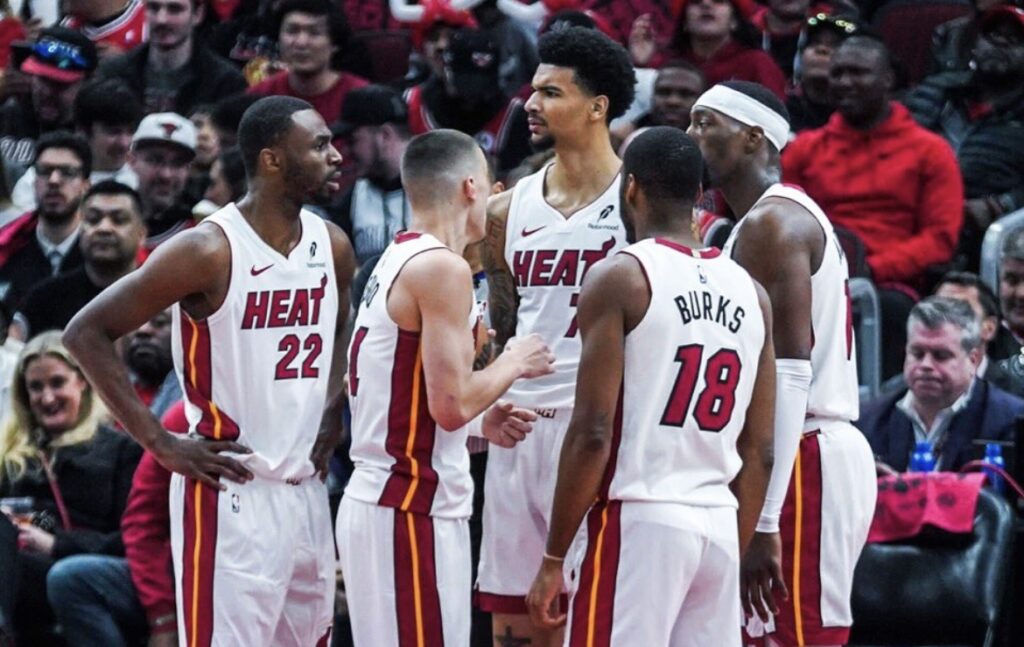
 The Miami Heat must construct a better roster in the short- and long-term. (Mandatory Credit: Miami Heat/Twitter)
The Miami Heat is coming off arguably their worst season since the Big 3 era concluded over a decade ago.
There are a lot of questions for Pat Riley, Andy Elisburg, Nick Arison and Co. to answer this offseason. This summer will be pivotal to the direction this organization’s headed in the short- and long-term, and one thing they must figure out is how to better construct this roster for sustained success.
That will be much easier said than done, but what can they learn and adapt as they transition into this new build? Let’s examine.
Strong two-way depth is at a premium:
This won’t be the first time you hear me say this: Stars win. However, under this new CBA, where winning with only top-end star talent doesn’t work, you need two-way depth. And a lot of it.
The NBA is as talent-rich as it’s ever been and it’s only getting stronger. And each team at the top of their respective conferences is oozing with two-way talent. Looking at the reigning champion Celtics: Outside of Jaylen Brown and Jaylen Brown, they have Kristaps Porzingis, Jrue Holiday, Derrick White, Payton Pritchard, Sam Hauser and veteran big Al Horford.
The Thunder, who possess the likely MVP Shai Gilgeous-Alexander, are an even better example. On any night, they can wield Jalen Williams, Chet Holmgren, Isaiah Hartenstein, Isaiah Joe, Cason Wallace, Alex Caruso and Aaron Wiggins. Miami saw what Ty Jerome and De’Andre Hunter were capable of off the bench against Cleveland. The Nuggets possessed an abundance of two-way role players surrounding Nikola Jokic, a three-time MVP, when they trucked past Miami in 2023; the Warriors had a strong supporting cast outside of Stephen Curry and the Bucks were a legit nine-deep during their title run.
Obviously, all these teams had elite-level star talent–which the Heat don’t have. When you don’t have stars, your margin for error shrinks exponentially. But when you only have stars, your margin for error is just as thin. High-end two-way depth matters. The fewer one-way players or weak links you have in a playoff setting, the better. You can’t be a player who scores 25 but gives up 30, and vice versa.
You need great offense AND great defense:
This goes hand-in-hand with what I mentioned above. Great offense oftentimes beats great defense, but you need to have both if you want to make it deep into the playoffs and consistently contend for an NBA Title. Here’s a look at how each recent champion was on offense and defense in their respective season, according to Dunks and Threes (which factors in strength-of-schedule):
2023-24 (Celtics): Best Offense, 2nd Best Defense
2022-23 (Nuggets): 5th, 18th
2021-22 (Warriors): 17th, 2nd
2020-21 (Bucks): 6th, 10th
2019-20 (Lakers): 10th, 3rd
2018-19 (Raptors): 5th, 6th
2017-18 (Warriors): 4th, 11th
2016-17 (Warriors): 1st, 2nd
2015-16 (Cavaliers): 3rd, 10th
2014-15 (Warriors): 2nd, 1st
2013-14 (Spurs): 7th, 4th
There are exceptions to the rule, but all but two champions over the last 11 seasons have had top-10 defenses and all but two had a top-7 offense. Seven of those 11 had both. Once again, you need stars, but you also need plenty of complementary two-way depth–in addition to size (more on that later), great coaching (which the Heat have, just not this year) and health (which, well, is unpredictable).
This is where the Heat’s lack of having a facilitating guard rears its ugly head. It will be difficult for them to elevate into a top-flight offense until one is found–preferably one who could play both ends. Davion Mitchell was awesome and Tyler Herro has grown as a facilitator, but the lack of a true point guard to organize the offense and make life easier for its best players has been a hole that must be filled for them to take the next step.
Miami’s been a bottom-third offense each of the last three seasons–and that’s a huge reason why. It also needs a top-flight No. 1 option, too.
Being versatile in the frontcourt is important:
I don’t think small-ball is dead. The Warriors and Heat largely adopted those profiles because of how skilled their bigs are. Positional size is required, but I also think you need lineup flexibility–specifically in the frontcourt–if you want to size up or down, depending on the situation and matchup.
Each of these recent champions–and teams at the top of the NBA now–has enough lineup flexibility to size up or size down with the ability to withstand what ensues. The Miami Heat drafted Kel’el Ware No. 15 overall so it could lean into it, but it must continue to get bigger in the frontcourt–at the wing and behind their two big men–that allows them to become more malleable. Size matters, people!
***
To check out our other content, click here.
Follow Hot Hot Hoops on Twitter/X here!
Follow Hot Hot Hoops on Instagram here!
Subscribe to our YouTube channel here!