
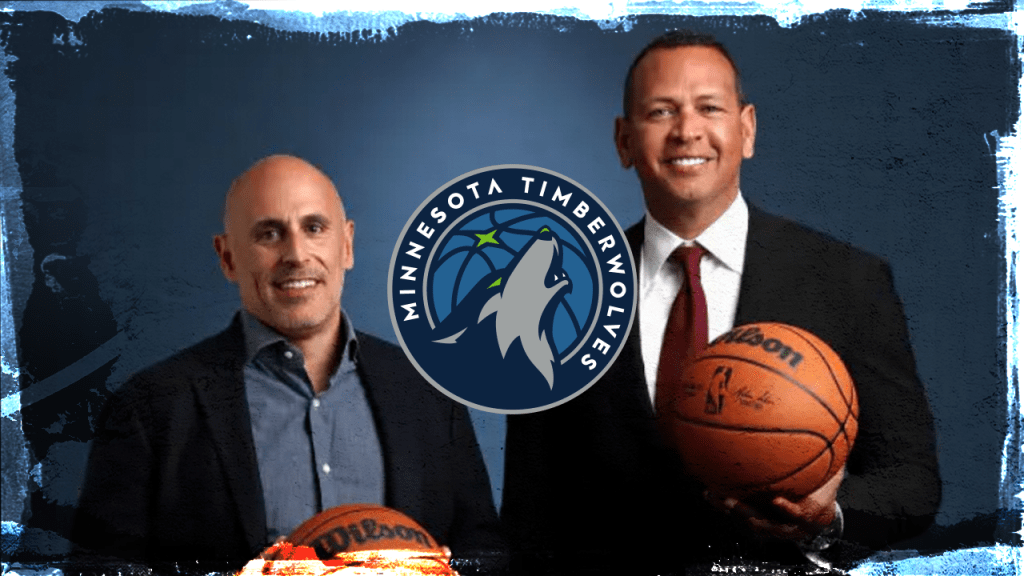
The four-year battle for ownership of the Minnesota Timberwolves and Minnesota Lynx may finally be reaching a conclusion.
On Monday, a three-person arbitration panel ruled 2-1 in favor of buyers Alex Rodriguez and Marc Lore, a significant hurdle in their quest to buy the NBA and WNBA teams from Glen Taylor. The legal fight stems from a unique purchase agreement signed back in 2021, which let the buyers purchase the teams over four separate payments—20%, 20%, 40%, then 20%—over four separate years. Taylor called the deal off last March, accusing Rodriguez and Lore of failing to abide by the terms of the deal; Rodriguez and Lore claimed Taylor had no right to terminate it.
But what exactly does Monday’s ruling mean? What happens next? Why is Tom Brady relevant here? And will the NBA ever do this again? Here are six takeaways from the latest development in one of the longer and stranger franchise sales in modern sports history:
1. A 90-Day Window
The heart of the dispute was whether contractually obligated deadlines were missed. The arbitrators didn’t rule that the teams now belong to Rodriguez and Lore. Instead, the panel ruled that the buyers should have another 90 days to continue the four-part transaction, basically resetting the clock back to where both sides were in early 2024.
In the next 90 days, the NBA undergoes its approval process (more on that below), and if the board of governors votes Rodriguez and Lore in as new control owners, they’ll likely be clear to take over. The arbitration focused on the third payment, the 40% stake that would give the buyers control of the franchises, but Rodriguez and Lore also intend to pay for the final 20%, which is all equity held by Taylor, simultaneously, Sportico has previously reported.
While financing was a concern for Rodriguez and Lore in the early part of the transaction—the buyers were consistently raising money throughout the first few years, and they lost a critical private equity backer in March before Taylor called the deal off—it’s likely no longer a concern for closing. Rodriguez and Lore owe about $942 million for the final two payments, and that money was put into an escrow account held by JPMorgan last October, Sportico previously reported. The purpose of that move was both to signal to the arbitrators that their financing was no longer a concern, and to facilitate a smoother closing process when it comes time to transfer the money.
2. NBA Approval
Lore and Rodriguez were approved as minority owners when the deal was signed back in 2021, but the approval process for control owners is a bit more complex and thorough, including an in-depth look at backgrounds, personal finances and fellow investors. The NBA didn’t start the process during the arbitration, commissioner Adam Silver told Sportico in December, and the league likely wouldn’t hold any formal vote until it knows whether Taylor plans to fight the arbitration decision.
That said, most in the industry would be surprised if they weren’t approved. For starters, the investment group now includes billionaires such as Eric Schmidt, worth $25.1 billion per Forbes, and Mike Bloomberg, who is worth $104.7 billion. Lore’s financial standing has also improved in the past four years. Since signing the purchase agreement, his food startup Wonder raised $350 million at a $3.5 billion valuation and acquired both Blue Apron and Grubhub. Lore reportedly owns about half the company, and is now worth $2.8 billion, according to Forbes.
3. A Financial Steal
Under the terms of the purchase agreement, the first payment was made at a valuation of $1.5 billion, with small 4% value escalators in each of the successive payments. Should the deal close, Rodriguez and Lore would be buying the teams for about half their current value, which Sportico currently estimates at roughly $3.29 billion.
It’s worth noting that the deal was originally struck in 2021, back when the COVID-19 pandemic was impacting franchise revenues, and the buyers have obviously spent heavily on legal fees to support their claim. But the three most recent NBA teams to sell—the Suns, the Mavericks and the Hornets—all did so for $3+ billion.
4. Taylor’s Next Steps
It’s unclear if Taylor wants to push this legal fight any further. In a statement issued Monday night, he said he was “disappointed” with the decision but would “review the decision thoroughly prior to making any further comment.” That decision is likely the next major domino to fall, as the NBA likely wouldn’t conduct its full review until it has clarity that Taylor’s objections are finished.
If he does want keep at it, Taylor could petition a federal judge to vacate the arbitration award. That’s a longshot, given the status of the three arbitrators and the fact that federal law requires high deference to arbitration awards. That said, vacated arbitrations are not unheard of in sports. Tom Brady’s Deflategate experience, in fact, could offer lessons for the Timberwolves matter. When Brady was initially suspended by NFL commissioner Roger Goodell in 2015, he invoked his contractual right to challenge the ruling through arbitration. The league’s labor accord permitted Goodell to serve as arbitrator, which he did, and he ultimately sustained his punishment.
Brady then petitioned a federal court to vacate Goodell’s arbitration award, and U.S. District Judge Richard Berman held a proceeding. Although Berman stressed he was obligated under the law to give Goodell’s arbitration ruling high regard, he nonetheless found the judgment was so defective it should be vacated.
Berman underscored that Brady was denied adequate notice; even if Brady was “guilty” of football deflation, other players punished for equipment infractions were not fined, let alone suspended for four games, so Brady wasn’t on notice he could be suspended. Berman also reasoned that Brady was precluded from rightful access to league investigative files, and Brady was unjustly barred from questioning a lead investigator.
But the NFL appealed Berman’s order to the U.S. Court of Appeals for the Second Circuit and emphasized the high degree of deference owed to arbitrators. Although it may have seemed “unfair” for Goodell to serve as the arbitrator for a matter in which he was also the fact-finder and initial punisher, the Second Circuit held this procedure was permissible because Brady’s union, the NFLPA, had contractually accepted it in a collective bargaining agreement. The fact that Brady believed he was not accorded a fair chance to defend himself from the deflation accusations was not legally problematic, the Second Circuit reasoned, since Brady’s legal rights to defend himself were limited to what his union negotiated in the CBA. Thus far, Brian Flores and Jon Gruden have come up short in court arguing that Goodell should serve as the arbitrator for their disputes against employers with whom they were in contract. The major lesson of these matters is that it’s difficult to unwind an arbitration through the courts.
5. The Deal’s Legacy
It doesn’t appear that anyone is happy with how this Timberwolves saga played out, and that includes the NBA. The league was subpoenaed during the arbitration process—something no league wants—but perhaps more notably, the tiered structure created a strange four-year window during which the buyers kept raising money and the seller ultimately sought to reverse course.
Asked about the deal last year, commissioner Adam Silver said it was “not ideal” and could lead the NBA to rethink which types of sales it approves. “I think once the dust clears on this deal, it may cause us to reassess what sort of transactions we should allow,” Silver said.
Deals like this do happen—former Tennessee Gov. Bill Haslam bought the NHL’s Nashville Predators in a similar fashion—but the NBA’s future willingness may soon be tested. The Boston Celtics are for sale, and current owner Wyc Grousbeck has said his family wants to sell the club in two phases, 51% now, and the rest in 2028, with the provision that he stays in control until the second transaction closes.
6. Rodriguez and Lore as Owners
Should Rodriguez and Lore successfully take over, there’s a trio of major business challenges ahead—luxury tax, arena future and TV home.
The Timberwolves’ big payroll this year puts them on the hook for a significant luxury tax bill estimated at $91 million by Spotrac, second behind the Phoenix Suns at $152 million. Lore and Rodriguez naysayers have voiced concerns that the duo will struggle to fund payrolls that consistently put them over the tax threshold.
But a pair of NBA initiatives over the last 24 months should ease pressure in Minnesota and other small markets when it comes to keeping up with free-spending teams. The 2023 collective bargaining agreement made roster construction much more challenging for teams to blow by the tax threshold. New restrictions were introduced on trades, draft picks and signings—and the effects were on display last summer when perennial top taxpayers Golden State Warriors and Los Angeles Clippers moved on from free agent stars Klay Thompson and Paul George. Those two clubs paid a combined $309 million in tax penalties during the 2023-24 season but are on track to pay just $12 million this year.
The NBA’s new $77 billion TV contract will also help level the playing field between big and small market clubs, as league revenue represents a larger slice of the overall pie versus local revenue driven by tickets and sponsorships. The media agreement moves the NBA closer to the NFL model, where every team received more than $400 million this year from the league, and the salary cap was $255 million.
The new NBA media deal with NBC, ESPN/ABC and Amazon is expected to boost the annual payout to teams by 33% to $137 million in year one, according to three NBA team executives. It then jumps 13.5%, followed by annual 7% increases. The per-team payout in the final season of the contract: $297 million.
The Target Center is the second oldest arena in the NBA, and the buyers have expressed interest in building a new one. They’ll also need to navigate a fraught media market. The Timberwolves are on a one-year deal with FanDuel Sports Networks, but the future beyond this season is far less clear. The buyers have reportedly discussed the possibility of creating their own RSN for the Timberwolves, Lynx and other local teams. The MLB’s Minnesota Twins, for example, recently left the FanDuel Sports Networks and are having MLB produce their television broadcasts in 2025.