
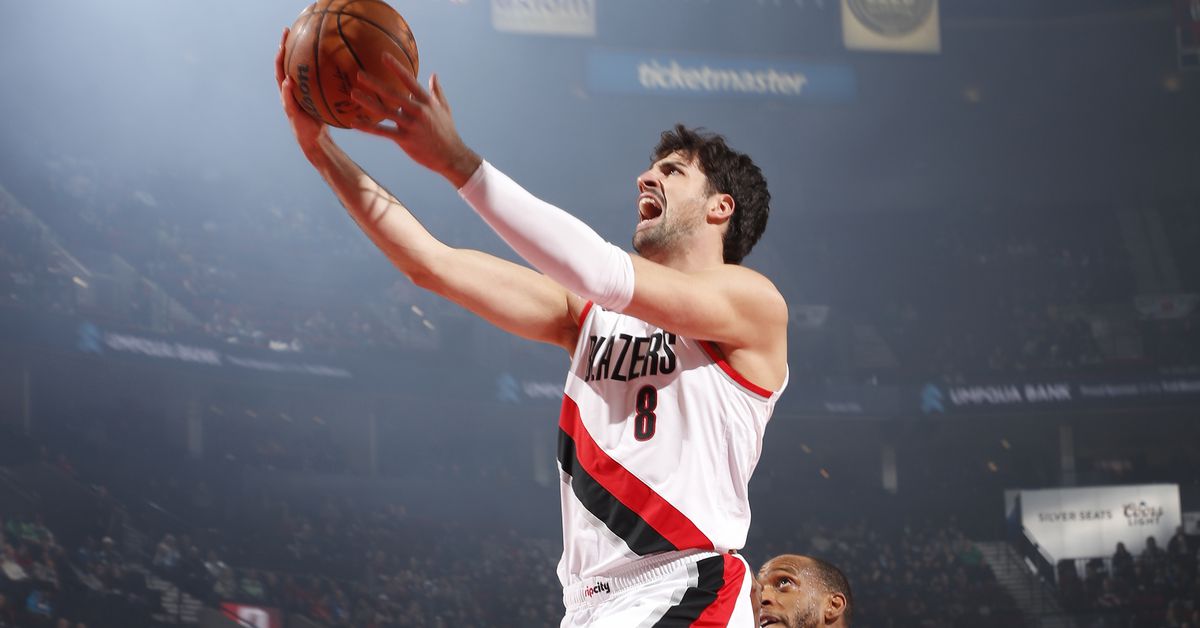
As the 2025 NBA Playoffs chug onward (How’s that “Most Overrated” vote for Tyrese Haliburton looking now?) and the Portland Trail Blazers await their fate in the NBA Draft Lottery, we’re taking a look at the performance of Portland’s current roster during the 2024-25 season. So far we’ve talked about Scoot Henderson, Shaedon Sharpe, Jerami Grant, Deandre Ayton, Anfernee Simons, Toumani Camara, and Donovan Clingan. Today we’re examining fan favorite, Mr. Everything, forward Deni Avdija.
The Good
Avdija’s 16.9 points per game trails Shaedon Sharpe and Anfernee Simons for the team lead, but he scored those points on just 11.7 field goal attempts per game. Nobody on the roster comes close to Deni’s 1.44 point-per-shot ratio. He’s the team’s best non-center in overall field goal percentage, second only to Toumani Camara in three-point percentage among regular rotation players. Per point and per possession, Avdija is right up there with Portland’s best scorers.
This deserves underlining because Avdija is known as a jack-of-all trades, a two-way wing rather than a scoring guard. Even his lesser-heralded attributes are good. His acclaimed strengths are great.
Avdija stands with Camara as a true perimeter defender. He’s also a passer and playmaker. Scoot Henderson obliterates Avdija in assist rate, but Avdija is nearly as good as Anfernee Simons in dimes per possession. But Deni also runs the break, stops opposing dribblers, and rebounds at an impressive 11.7 per 100 possessions clip.
Avdija trailed only Donovan Clingan in net plus/minus per 100 possessions this season, meaning he had the greatest positive (statistical) effect on the team of any starter, better than all the regular bench players besides Clingan as well. Whatever the best version of the Blazers is, it certainly includes Deni.
The Bad
A few minor blemishes followed Avdija this season. Though his 47.6% overall and 36.5% three-point percentages were good compared to his Blazers teammates, they were down from last season’s performance with the Washington Wizards (50.6% and 37.4%, respectively). Avdija’s three-point shot needs to be more bankable. He got open looks. He just wasn’t completely consistent.
Deni also led the team in turnovers, barely trailing Henderson in turnovers per minute and possession, but not producing as many assists as Henderson did. Paring those down would stake his claim to being a true table-setter as opposed to one of the nicer secondary facilitators in the league.
Avdija’s free throw percentage of 78.0% was adequate, but there’s no reason it couldn’t be better. He draws foul shots at a better rate than anybody on the roster. He could take advantage by being better at the line.
The Analysis
Avdija’s strengths and areas to work on both tell the same story: he’s really good, on the verge of greatness. It wouldn’t take much to tip him over the edge to true stardom. A few more points per game is the first key, a little better discipline in the halfcourt offense is the second.
Shooting percentages will solve half of the issue. If Deni can hit threes at a near-40% level while shooting 85% from the line, he’s going to stake his claim to more shots and possessions. A few more shots at a better percentage would up his scoring from 17 to 21 per game. Add the 7 rebounds he’s already getting, 5 assists instead of 4, and 2.2 turnovers instead of 2.7—tossing in his defensive prowess—and you have a player everybody in the league would want and the Blazers would not trade for any amount of compensation.
We need to see if Avdija will make that leap, though. He’s valuable either way, but there’s a huge difference between becoming the franchise’s second star and becoming a great role-player whose weaknesses you tolerate. The ball is in Deni’s hands, both literally and figuratively. Nobody’s going to stop him from being everything he can be. He just needs to show us what that is.
What’s Next?
The next two seasons will tell a lot about Avdija’s career arc. It’ll also show a lot about Portland’s commitment to him. He’s on a declining contract. He made $15.6 million this season, but that will slide to $14.3 million next, then $13.1 and $11.9 million. Even the original rate is only a mid-level exception in today’s NBA. That’s clearly inappropriate to Avdija’s production and trajectory.
The Blazers do have the option of riding out the deal until its conclusion in the Summer of 2028. Even if Avdija takes no further steps forward, they’d have gotten a steal with that deal. They could also try to renegotiate and extend Avdija, in essence giving him a raise early. Because of arcane CBA rules, they’d need to be under the cap to do that. That would likely mean jettisoning some of their current stars in order to bank on, and secure, Deni.
This is where the, “What kind of player is Avdjja, exactly?” question comes into play. If he’s looking like a star-level player next season, some of their decisions become easier.
In a perfect world, Avdija trims up his offensive game and alleviates Portland’s eternal point guard question by becoming, in essence, a second point guard himself. Add a high-profile scorer via internal development, draft, or trade and the Blazers are in business. If that doesn’t happen, his diverse skillset will allow him to fit into whatever team and schemes develop around him. As a third starter or a super-sixth-man, he’ll always be useful.
Either way, Deni Avdija has proven himself one of the bright spots for the Blazers in an otherwise mixed-feelings year. They’re going to shine a spotlight on him as next season rolls around. Let’s see if he can outshine it.