
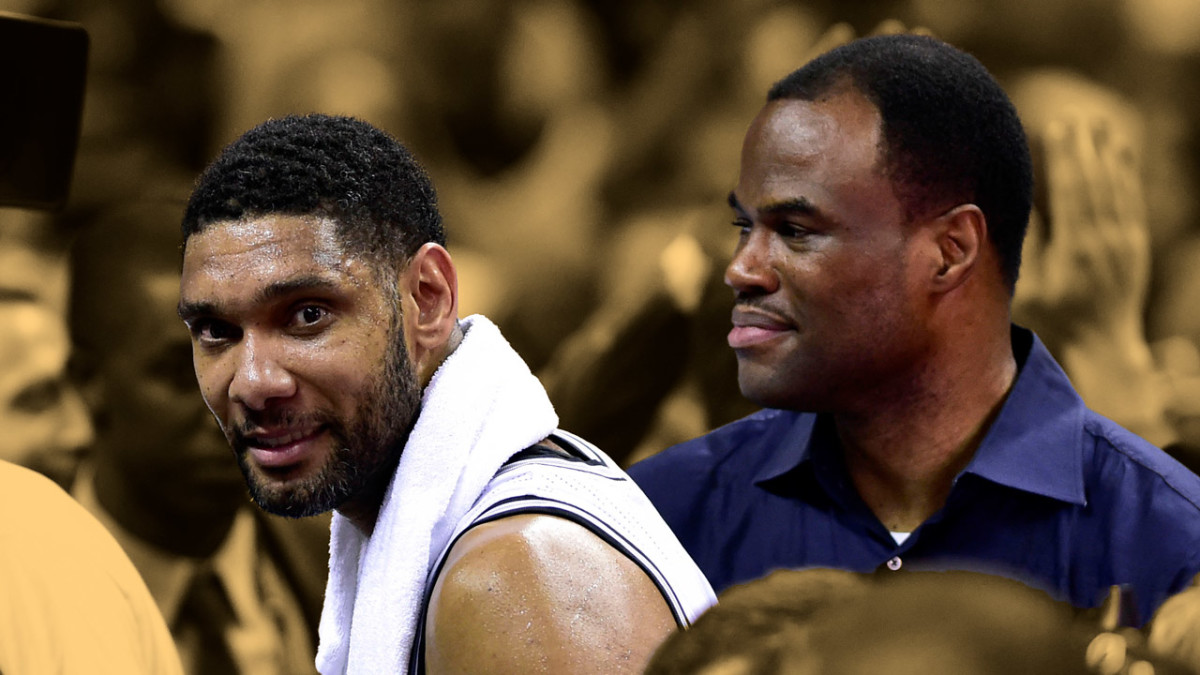
“Unfortunately, the public doesn’t really get to see that side of him” – David Robinson on how Tim Duncan sacrificed to make the Spurs an immediate dynasty originally appeared on Basketball Network.
He wouldn’t have wished for another person. All David Robinson had to do was watch as Tim Duncan was next in line to take the San Antonio Spurs to the promised land.
Advertisement
When the torch was passed in the late 1990s, it didn’t fall but was handed over, steady and seamless. Robinson had been the face of the franchise, the man who rescued the Spurs from irrelevance when he arrived as the No. 1 pick in 1987.
He was the anchor that pulled San Antonio from years of losing seasons into consistent playoff contention. But for all the accolades — league MVP, 10-time NBA All-Star, Defensive Player of the Year — there remained a ceiling.
That ceiling cracked the moment Duncan walked through the door in 1997.
Fate in Duncan
Duncan didn’t announce himself with flash or bravado. His presence was quieter than most top picks, but it came with something more enduring — substance.
Advertisement
From the jump, it was clear the rookie wasn’t just going to complement Robinson but was going to be someone to elevate the entire franchise. And he did it without stepping on toes. Robinson, by then a seasoned veteran, embraced his young teammate’s rise.
“You all saw what he did on the court as a player, a phenomenal player,” Robinson said of Duncan. “But to be honest with you, he’s even a more phenomenal man. Unfortunately, the public doesn’t really get to see that side of him as much, but brilliant guy.”
Duncan would go on to win five NBA championships, three Finals MVP awards and two league MVP awards. But the essence of his greatness wasn’t found in those stats. It was the way he operated within the system, never above it. He didn’t seek the spotlight. He just made room for others to shine within it.
Advertisement
Duncan’s impact was immediate, averaging 21.7 points and 11.4 rebounds as a rookie and then taking it up another level in the playoffs the next season. His pairing with Robinson — famously dubbed the “Twin Towers” — was less a clash of egos and more a union of purpose. That was the magic of those early Spurs teams, beginning in 1998 and culminating in their first title in 1999.
Robinson had been an MVP in 1995. The Spurs had racked up regular-season wins throughout the ’90s, including a 62-20 campaign in 1995. But postseason heartbreaks — most notably to the Houston Rockets and Utah Jazz — became familiar. When Duncan arrived, it changed. They won their first championship in 1999 and it was a milestone that marked the birth of a dynasty.
Becoming a legend
Before Duncan stepped on an NBA floor, Robinson had watched him play and sensed the shift coming. He knew what the franchise was about to inherit.
Advertisement
“When we drafted him, I remember just snickering to myself like, ‘Oh my God, people do not know what we just got, this guy is going to just blow people away,'” Robinson recalled.
Duncan did just that.
By the time the Spurs won their first title in 1999, Robinson willingly deferred to the younger star, playing fewer minutes and giving Duncan more room to lead. It was foresight. The Wake Forest product was the future, and Robinson had the humility to let that future arrive unencumbered.
The cultural tone of the Spurs also began to shift. Gregg Popovich, then in his early years as head coach and general manager, built a system where egos were secondary and execution was everything. Duncan, with his quiet work ethic and team-first mentality, fit that model perfectly. He didn’t crave endorsements or chase headlines. He wanted wins. And wins followed.
Advertisement
After Robinson retired in 2003, Duncan didn’t skip a beat. He led the Spurs to titles in 2003, 2005, 2007 and 2014. Over 19 seasons, he finished with 26,496 points, 15,091 rebounds and 2,732 blocks — each stat a pillar in one of the most quietly dominant careers in NBA history. But numbers only told part of the story.
The foundation Duncan built, beginning with that 1998 season, was one of unselfish excellence. From Manu Ginobili to Tony Parker, players came into San Antonio and learned what it meant to sacrifice for the greater good.
That culture of accountability and humility flowed from Duncan’s demeanor. His leadership didn’t come with theatrics, just consistency and a readiness to do the hard work without applause.
This story was originally reported by Basketball Network on Jul 13, 2025, where it first appeared.