
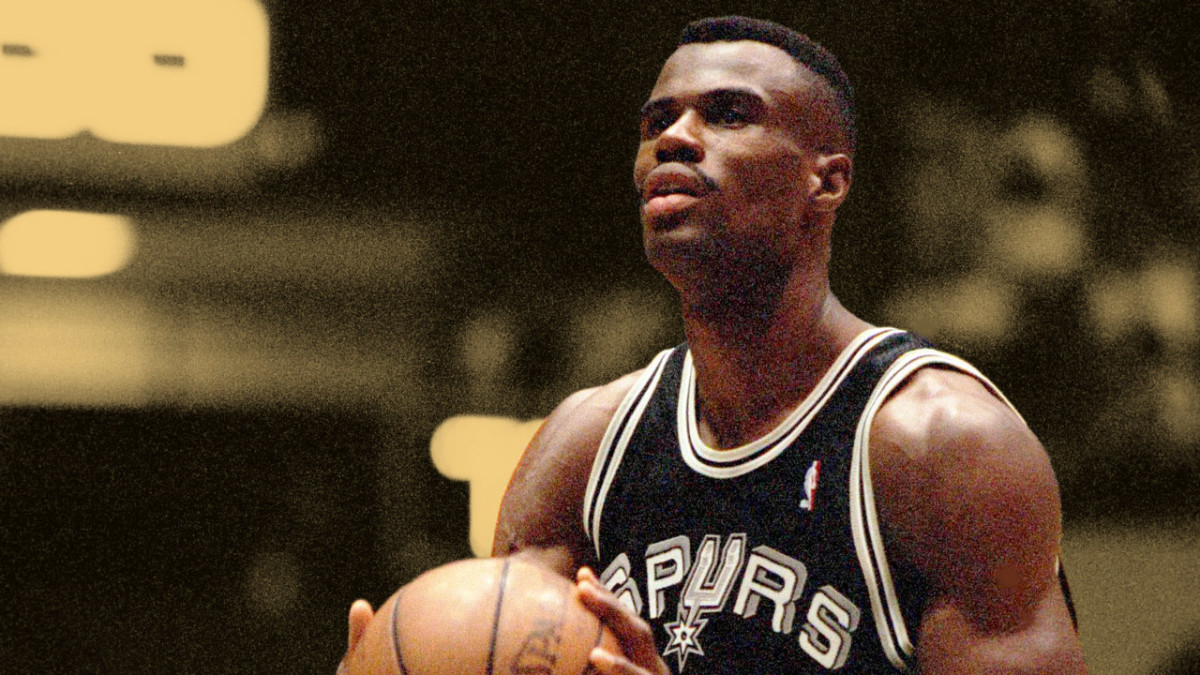
“Everybody looked at me like, ‘Who the heck do you think you are?” – David Robinson on why he doubted he’d become a superstar when he arrived in San Antonio originally appeared on Basketball Network.
There isn’t really much to hold ground for the San Antonio Spurs before the era of David Robinson.
Advertisement
By the time he finally put on the jersey in 1989, the team had spent much of the 1980s drifting in the lower rungs of the NBA standings, piecing together seasons that never promised more than mediocrity.
The city had basketball, but it didn’t have belief, not the kind that shakes a franchise out of the mud. Robinson, drafted first overall in 1987, didn’t touch the court for two full years due to his Naval commitment, and by the time he arrived, the locker room he walked into wasn’t exactly waiting with open arms.
Robinson’s initial pressure
Even before he played his first game in San Antonio, white and black, he thought he was met with a locker room with little faith in a revolution.
Advertisement
“I just got this feeling that everybody looked at me like, ‘Who the heck do you think you are? You’re gonna come in here and change things?” Robinson recalled. “So, I felt that pressure almost immediately that I’m supposed to have this great impact.”
He wasn’t entirely mistaken.
The Spurs were dysfunctional before he suited up, and in a league where talent often falters under the weight of expectations, there was nothing subtle about what Robinson was walking into. He was 7-foot-1, an Olympic gold medalist, and a national player of the year, yet he still found himself surrounded by skepticism and silence in that locker room.
Players didn’t doubt his ability; they doubted what it meant. The team had not made it past the second round since joining the NBA in 1976. They’d cycled through coaches, scorers, and defensive specialists. Hope came and went like ticket promotions.
Advertisement
Robinson had spent those two years after the draft at the Naval Academy, a world apart from the NBA. He wasn’t hardened by the league’s pace or its politics. What he walked into in San Antonio wasn’t just a bad team; it was a team whose core was numbed by losing, whose chemistry felt like rust, not resolve. So when he sensed tension, it was real.
Changing fortunes
There was no honeymoon phase for Robinson. No warm-up season. By every account, he was expected to carry a city to the next era.
“Coming in at the number one player is a lot of pressure and you feel like the team is betting their future in you almost,” Robinson said. “And San Antonio had come off a really tough year. The year before I came, we were 21 and 61, or something, so yeah, there was a tremendous amount of pressure coming in.”
Advertisement
The Spurs were coming off one of their worst stretches ever. Over a four-year span from 1985 to 1989, they had lost at least 50 games in three seasons. The 1988–89 team, specifically, finished with 21 wins and 61 losses. It was a patchwork of expired contracts and weary legs.
What followed that pressure, however, was one of the most transformative rookie seasons in NBA history. Robinson completely altered their trajectory. The Spurs jumped from 21 wins to 56 in just one season. That 35-win improvement remains one of the most significant single-season turnarounds in NBA history. Robinson averaged 24.3 points, 12 rebounds, and 3.9 blocks per game that year, earning Rookie of the Year honors and planting San Antonio firmly on the national radar.
He became the fulcrum around which the entire organization pivoted. His presence wasn’t just about stat lines but about standards. Practices became more competitive. The culture changed from cautious to hungry. Veterans like Terry Cummings and Maurice Cheeks found renewed relevance beside him. The Spurs had a franchise face again, not just a poster boy, but a legitimate foundation.
The Robinson effect was immediate, but it wasn’t just short-term adrenaline. Across the 1990s, San Antonio became a perennial playoff presence. Between 1990 and 1996, the Spurs never missed the postseason. In that stretch, Robinson collected MVP honors in 1995, 10 All-Star selections, and multiple All-Defensive Team nods. He led the league in rebounding (1991) and scoring (1994) while serving as the spiritual and vocal center of the franchise.
Advertisement
He laid the groundwork for Tim Duncan, Gregg Popovich’s dynasty, and what would eventually become five championships and decades of dominance. But none of that seemed evident in 1989.
This story was originally reported by Basketball Network on Jul 13, 2025, where it first appeared.