
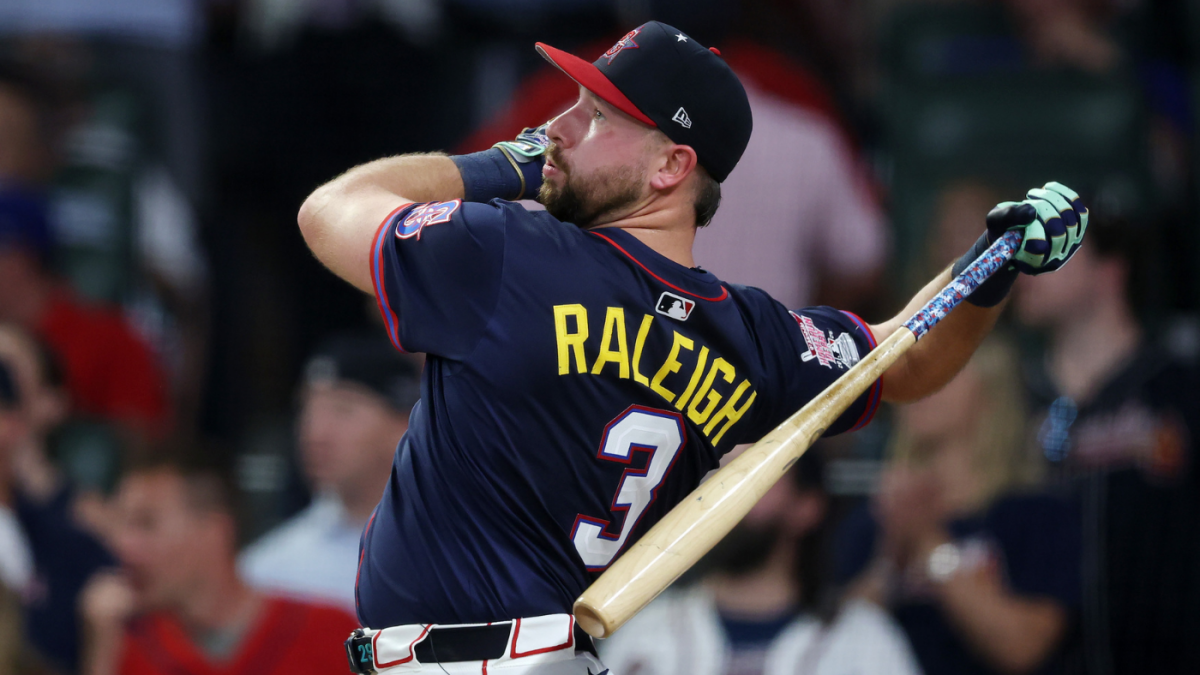
The best home run hitter in baseball won the 2025 Home Run Derby. Monday night at Truist Park, Mariners backstop Cal Raleigh outlasted Rays slugger Junior Caminero to become the first catcher to ever win the Home Run Derby. He’s also the first switch-hitter to win the Home Run Derby outright; Ruben Sierra was the co-winner with Eric Davis in 1989.
Raleigh joins Hall of Famer Ken Griffey Jr. (1994, 1998, 1999) as the only Mariners to win the event. He entered the All-Star break with an MLB-leading 38 home runs, second most at the break behind Barry Bonds’ 39 in 2001. Raleigh eliminated Pirates slugger Oneil Cruz in the semifinals. Caminero beat out Twins star Byron Buxton to reach the finals.
Here’s how the Home Run Derby bracket shook out:
2025 Home Run Derby bracket, results
First round
Oneil Cruz: 21Junior Caminero: 21Byron Buxton: 20Cal Raleigh: 17Brent Rooker: 17 (eliminated)Matt Olson: 15 (eliminated)James Wood: 16 (eliminated)Jazz Chisholm Jr.: 3 (eliminated)
This is the second year of the current format, which gives players three minutes and 40 pitches to swing away in the first round. They also receive three bonus outs in which they can hit as many homers as possible before making three outs. Players can earn a fourth bonus out with a 425-foot homer in bonus time. The top four home run totals advanced to the semifinals.
Raleigh and Rooker tied with 17 homers. The tiebreaker is longest home run distance, and good gravy, it was close: 471.61 feet for Raleigh and 471.53 feet for Rooker, per the Statcast overlords. That extra 0.08 feet — that is 0.96 inches! — was the difference between Raleigh advancing and Rooker going home. That extra 0.96 inches paved the way for Raleigh’s win.
If nothing else, the Raleigh vs. Rooker situation shows the only acceptable Home Run Derby tiebreaker is a three-swing swing-off. I was told there would be no math!
Semifinals
No. 4 Cal Raleigh (19) over No. 1 Oneil Cruz (13)No. 2 Junior Caminero (8) over No. 3 Byron Buxton (7)
The four remaining players were seeded 1-4 based on their first-round home run totals, then they squared off head-to-head in a 1 vs. 4 and 2 vs. 3 format. In the semifinals, players get two minutes and 27 pitches to hit as many homers as possible. The same bonus outs rules as the first round apply.
Finals
Cal Raleigh (18) over Junior Caminero (15)
The final two players went head-to-head for the Home Run Derby crown. The time/pitch limits (two minutes and 27 pitches) are the same as the semifinals, and the same bonus outs rules are used throughout. Raleigh went first and hit his 18 homers. Caminero knew the number he had to beat, and fell short.
And here now are five takeaways from the 2025 Home Run Derby.
1. Cruz went 513 feet
At 122.9 mph, Oneil Cruz hit the hardest ball of the Statcast era (since 2015) earlier this season. He is the hard-contact king, and in the Home Run Derby, he launched a ball 513 feet! To the action footage:
Cruz also hit home runs 492 feet and 498 feet Monday. No other player cleared 486 feet. Cruz had the five longest and nine of the 10 longest homers of the Home Run Derby.
Cruz’s 513-footer is the longest homer in the Home Run Derby since Aaron Judge hit one 513 feet in 2017. That is ignoring the 2021 Home Run Derby, which was held a mile up at Coors Field. There were several balls hit farther that year, including a 520-foot Juan Soto blast. At sea level though, Cruz’s 513-foot shot is the farthest Home Run Derby homer in almost a decade.
Also, don’t sleep on the 118 mph exit velocity. Hitting a batting practice pitch 118 mph is insane. Guys might — might — get to 110 mph during batting practice during the season. It’s really tough to drive a soft-tossed pitch that hard. Not for Cruz though.
2. Raleigh switched it up
Raleigh entered the All-Star break with 38 home runs, which would be an excellent full season total for a catcher and is simply preposterous for a first half total. This is an all-time great power season period. You don’t need need the “for a catcher” qualifier.
Raleigh is of course a switch-hitter — those 38 homers are the most ever for a switch-hitter before the All-Star break — and he showed off his power from both sides of the plate Monday. He started the first round left-handed, then switched over to the right side after taking his timeout. Shades of Adley Rutschman in 2023:
Raleigh hit 10 homers left-handed and seven right-handed. Also, he got hit by a pitch right-handed! When’s the last time you saw a hit-by-pitch in the Home Run Derby? It’s OK: Raleigh’s father, Todd, was pitching to him, and he was fine. It was a batting practice pitch, after all. Raleigh hit left-handed exclusively in the semifinals and finals.
3. A kid robbed a homer
I gotta say, being one of the kids who gets to run around the outfield catching fly ball during the Home Run Derby seems like one of the coolest things ever. One of them pulled a Denzel Clarke, and robbed Junior Caminero of a homer in the finals. Check it out:
Replays showed the ball would have cleared the wall, so MLB went ahead and counted the homer, which ultimately had no impact on the outcome. If I were that kid, I would brag about robbing a homer in the Home Run Derby the rest of my life.
4. Jazz had the worst round of the clock era
The Home Run Derby has undergone many format changes over the years, the most significant of which was the addition of a clock in 2016. Home run totals exploded in the clock era because there was no limit on the number of “outs” a hitter could make. It used to be 10 outs and you were done. With the clock, you keep hitting until the time runs out.
The clock was put in place in 2016 and Jazz Chisholm Jr. had the worst round of the clock era Monday. He hit only three home runs, even with the three bonus outs. The previous low was seven homers by Robinson Canó in 2016. Canó in 2016 and Chisholm this year are the only single-digit rounds of the clock era. The all-time record is 41 homers in a single round by Julio Rodríguez in 2023. Chisholm came, uh, just short of that.
5. The camerawork left something to be desired
I fully acknowledge it is not easy to broadcast an event like the Home Run Derby. You want to see the pitch, the flight of the ball off the bat, and where it lands. It’s a lot to show the audience again and again with little downtime between pitches. It’s a challenge, I get it. That said, this year’s split screen was not great:
Television networks have been looking for the best way to show the Home Run Derby for decades. Give ESPN credit for trying new things. This year’s split screen, though, ain’t it. We saw the ball hit the bat, where it landed, and not enough in between. Maybe next year will be better.