
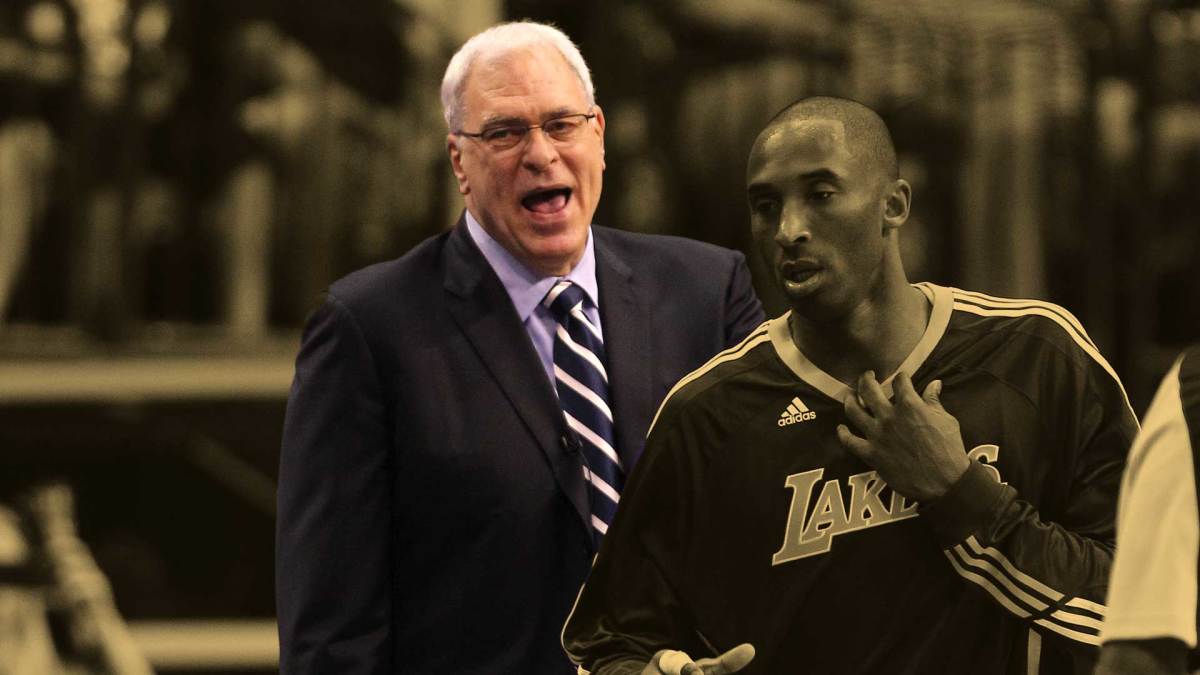
Phil Jackson on why he didn’t return to coach the 2012 Lakers superteam: “I never had the feeling that this is the right thing to do” originally appeared on Basketball Network.
Phil Jackson had multiple stints as the Los Angeles Lakers head coach.
Advertisement
And after he stepped down in 2011, the franchise was never quite the same. His departure closed the book on an era that had delivered five championships and a deeply woven identity built around the triangle offense, elite leadership and winning at any cost.
But as the Lakers spiraled through turbulent coaching transitions and underwhelming seasons, many believed there might be one more chapter left. One more return. One more Phil-Jackson-save-the-day moment.
Except it never came.
Not going back
Even as the front office frantically tried to retool the roster, pairing an aging but still hungry Kobe Bryant with Steve Nash and Dwight Howard in 2012, Jackson stayed away. There would be no third homecoming for the legendary head coach.
Advertisement
“I felt it would be pretty easy for Nash and Howard to learn the system; it’s an easy system to learn,” Jackson said. “But I never had a feeling it’s the right thing to do or must be done.”
When the Lakers reached out to Jackson in late 2012, they were a franchise clutching at fading relevance. Head coach Mike Brown had been fired after just five games. Bryant was still pushing his body and spirit toward one last deep playoff run. So L.A. turned to big moves, bringing in Nash, a two-time MVP, in a sign-and-trade with the Phoenix Suns and acquiring Howard, a three-time Defensive Player of the Year, from the Orlando Magic.
On paper, it felt like a super team. But on the court, it was a chemistry experiment that never stabilized. Nash, then 38, struggled with injuries almost immediately. Howard, still recovering from back surgery, clashed with Bryant’s demanding personality and never looked at ease. The triangle offense, which had always worked best with patient, cerebral players and unselfish ball movement, was an afterthought. Instead of building continuity, the Lakers burned through instability.
Advertisement
They finished the 2012–13 season with a 45–37 record, barely making the playoffs, only to be swept by the Spurs in the first round. That season also marked the end of Bryant’s ironman phase, with an Achilles injury that would alter the final chapters of his career.
Jackson’s challenge
Looking back, Jackson understood the potential of that roster. He wasn’t discrediting the talent. But even with Nash’s vision, Howard’s rim protection and Kobe being Kobe, the risks weighed heavier than the reward.
Advertisement
“I said, ‘Maybe we can get out of the Western Conference, we’re a good enough team, there’s talent enough,'” Jackson said. “But, boy, I’d sure hate to lose in the Finals again, and that’s something I’ve started to think about.”
For a coach who had tasted both dynastic triumph and bitter Finals defeat, the thought of coming back only to fall short again didn’t sit well. He had already battled through the peaks and valleys of coaching legends — Michael Jordan and Scottie Pippen for the Chicago Bulls, then Bryant and Shaquille O’Neal, then Bryant again and Pau Gasol in Los Angeles.
He had coached over 1,600 games, won 11 championships and shaped three separate three-peats. There was nothing left to prove.
Returning to a high-pressure locker room with conflicting personalities and fragile dynamics wasn’t appealing, especially after watching the Lakers fumble their identity post-2010. They were no longer the calculated juggernaut of old. They were chasing relevance through star power and marketing splash.
Advertisement
The Lakers were a shadow of themselves in the early 2010s. Between 2011 and 2017, the franchise missed the playoffs four times and never advanced past the second round.
The superteam experiment failed.
Nash retired in 2015 after appearing in just 65 games across two seasons. Dwight bolted after one year, and Kobe’s retirement in 2016 marked the end of a generation.
Jackson, meanwhile, transitioned to an executive role in New York, where his time as Knicks president was far less flattering. But even in that stretch, his name never left L.A. conversations. His imprint was simply that lasting.
This story was originally reported by Basketball Network on Jul 14, 2025, where it first appeared.