
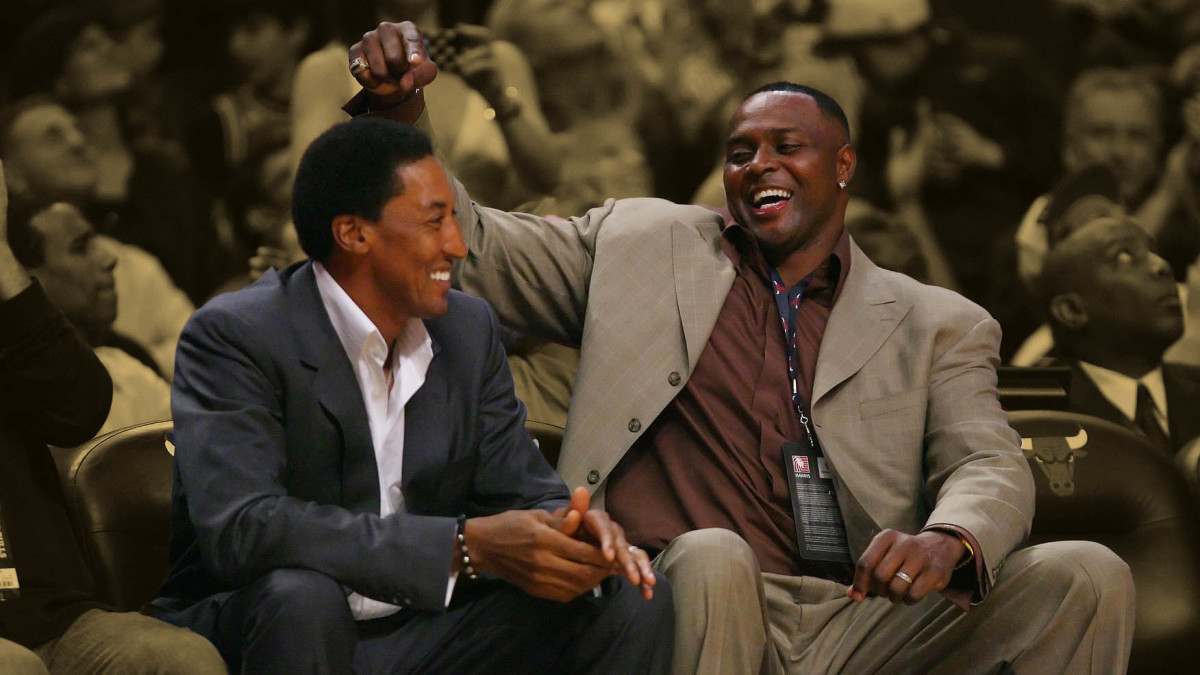
“Michael had a little problem with that” – Scottie Pippen on how his friendship with Horace Grant created friction inside the Bulls’ dynasty originally appeared on Basketball Network.
There was no playbook for surviving the inner politics of the 1990s Chicago Bulls. Winning titles came with their own set of rules, many of them unwritten and guarded.
Advertisement
By the man at the center of it all. Michael Jordan.
For Scottie Pippen, navigating that terrain meant being the league’s premier two-way forward and understanding that friendships could become liabilities depending on who stood beside in the locker room. The bond he shared with Horace Grant during those early years turned out to be one of those quiet storms.
Caught in a crossfire
Pippen had a close relationship with Grant, not only as teammates but also as friends. However, he was caught in a dilemma because of that relationship.
“Michael had a little problem with that,” Pippen said. “And really, it was more of a problem with him and Horace. Horace and Michael didn’t really see eye to eye. Horace was a twin, so he believed in everything being equal.”
Advertisement
Grant arrived in Chicago in 1987 as the 10th overall pick. He was wide-eyed, athletic, and full of the type of raw energy a championship-bound roster needed.
He and Pippen, also drafted that same year, were rookies on a mission. Their shared timeline immediately bred a tight-knit brotherhood. Their chemistry off the court was obvious, from hotel rooms to pregame routines.
But as Pippen recalled, that dynamic began to complicate his standing with the team’s best player. Jordan’s ultra-competitive nature didn’t make room for that kind of egalitarian mindset. He didn’t believe in equal minutes, equal roles or equal praise. He demanded more from his teammates, but only on his terms.
Advertisement
Horace, who shared a womb with his twin brother Harvey and grew up in a household where everything was divided evenly, brought a different philosophy into the Bulls’ hierarchy, a mentality that subtly clashed with Jordan’s win-at-all-costs approach.
By the early ’90s, Pippen found himself stuck in the middle of their Cold War. He was close to Grant emotionally and developmentally, but siding too visibly with his younger teammate could come off as siding against the big dog.
Tension with Jordan
Grant’s numbers told the story of someone doing their job; he averaged 12.6 points and 8.6 rebounds per game in his seven years with the Bulls, often serving as the unsung hero on a team driven by megastars. However, the disconnect with Jordan meant that no matter how reliable Horace was, he was never fully embraced as an equal cog in the dynasty.
Advertisement
“There were days when Michael would play 45 minutes, maybe even 48 minutes, and Horace didn’t understand,” Pippen recalled. “The next day, Phil would tell Michael, ‘You don’t have to practice.’ So Horace felt like he was getting a special treatment. So that kind of put a space in our relationship.”
On the surface, it was a minor detail. Jordan being excused from practice after heavy minutes. But in the close quarters of an NBA locker room, those little exceptions were magnified under the pressure of title expectations.
To Grant, it wasn’t about Jordan’s greatness and fairness. That perceived favoritism built cracks in the team chemistry, and for Pippen, those cracks became traps.
Grant’s frustration grew, not only with Jordan’s treatment, but with the broader structure that enabled it. Jackson was managing egos and sometimes that meant keeping Jordan fresh came at the cost of unity. For Pip, watching one friend become gradually alienated while another silently demanded loyalty was a balancing act few could handle without repercussions.
Advertisement
Grant eventually left for the Orlando Magic in 1994; the writing had long been on the wall. He became a key part of the Magic’s 1995 run to the Finals, ironically defeating Jordan and the Bulls in the Eastern Conference semifinals. That victory, brief as it was, felt personal to the former Bulls star — revenge for the franchise that underestimated him and the dynamics that pushed him to the margins.
This story was originally reported by Basketball Network on Jul 15, 2025, where it first appeared.