
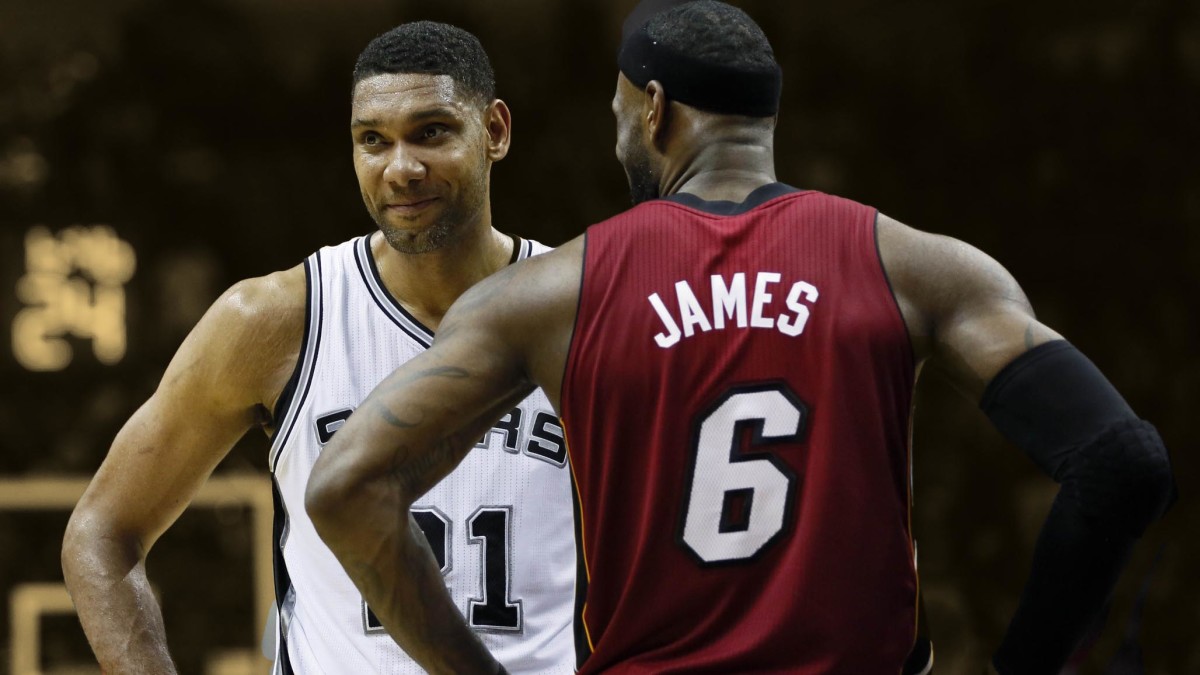
“I had the same thing happen to me years back in a Game 7” – Tim Duncan says LeBron James’ “mysterious” cramps in the 2014 Finals were legitimate originally appeared on Basketball Network.
After back-to-back championships and a four-year reign as the Eastern Conference’s gold standard, the Miami Heat returned to the NBA Finals in 2014 with every intention of completing a three-peat. They were star-studded, battle-tested and still had the league’s most dominant force in LeBron James.
Advertisement
But they were also running on fumes.
The San Antonio Spurs, the same team Miami had barely outlasted a year earlier in an unforgettable seven-game classic, were back with a vengeance. This time, they were healthier, hungrier and less forgiving.
And for LeBron, the series began under an unwanted spotlight.
LeBron’s cramps
James had a fourth-quarter exit in Game 1 due to cramps. That moment sparked days of mockery and questions about his toughness. The conversation drifted from basketball to bravado. However, for Spurs icon Tim Duncan, who had his own experience with game-altering cramps in high-stakes situations, there was never any doubt about what had happened.
Advertisement
“I had the same thing happen to me years back in a Game 7,” Duncan recalled. “So I knew it wasn’t a joke. Obviously, we just wanted to win the game and not worry about what’s happening to him.”
Back in 2006, Duncan had battled cramps in a Game 7 against the Dallas Mavericks in a grueling overtime loss that ended San Antonio’s repeat bid. He knew the pain. The paralyzing spasms. The frustration of a body betraying the mind in moments that mattered most. So when James went down, Duncan didn’t laugh. He locked in and the Spurs went for the kill.
Midway through the fourth quarter, with the Heat trailing by just two and the Finals opener hanging in the balance, James pulled up lame. He had already been subbed out twice in the second half due to cramping, but this time, with 3:59 left, he collapsed into the baseline stanchion, grimacing, his legs unwilling to carry him any further. Trainers lifted him off the floor and he would not return.
There had always been speculation about the Heat’s legs, about whether their Big Three had already peaked, about whether San Antonio’s precision was simply too much to match a second time.
Advertisement
All of that bubbled over in Game 1, where a sudden and strange power outage at the AT&T Center forced the arena’s air conditioning to shut down. The temperature soared to 90 degrees and what unfolded next quickly overshadowed the Spurs’ scorching offensive display.
Unrelenting performance
While the headlines in the aftermath revolved around LeBron’s absence, the Spurs authored one of the finest stretches of team basketball the Finals had ever seen. From the moment James left the floor, San Antonio exploded on a 16-3 run and closed the game with a staggering 31-9 burst. They scored on 12 of their final 14 possessions, notching 10 assists in that stretch, a clinic in motion, spacing and selflessness.
Advertisement
Though the Heat bounced back to win Game 2, the rest of the series was unraveling. Games 3, 4 and 5 were almost blowouts. San Antonio’s average margin of victory in their four wins was 18 points. By the time it was over, the Spurs had posted the highest point differential (+70) in NBA Finals history.
Yes, you may have heard “LeBron’s Heat were blown off the floor by a record Finals margin” at points in the past. It’s true.
Yet amid the Spurs’ triumph, Duncan’s empathy for James added a human layer to the narrative.
The noise around James’ cramps eventually faded, replaced by appreciation for what the Spurs had done. But Timmy’s respect cut through the fog of hot takes. He had no interest in undermining an opponent. He had seen enough, done enough and suffered enough to know that moments like those don’t need to be dramatized or diminished, they just need to be understood.
Advertisement
What the 2014 Finals revealed wasn’t weakness, but wear. The King had played more minutes than anyone else in the league over the previous four seasons, with multiple deep playoff runs, Olympic duty and an unprecedented level of physical responsibility.
This story was originally reported by Basketball Network on Jul 15, 2025, where it first appeared.