
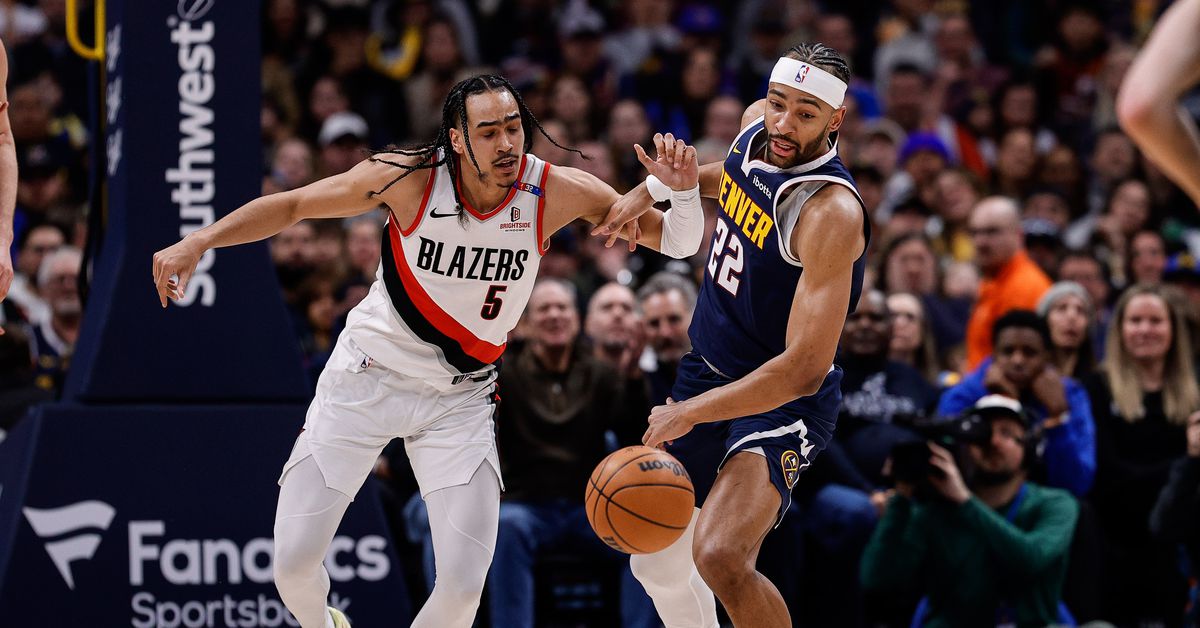
Most of the discussion surrounding the Portland Trail Blazers centers around their flashiest players: Shaedon Sharpe, Scoot Henderson, Deni Avdija. But Portland is a young, developing team. They depend on plenty of underneath prospects to grease the wheels. What of their fate in the year to come? That’s the subject of today’s Blazer’s Edge Mailbag.
Well, the Blazers had a surprisingly good season of mediocrity that will net a mid-first round pick. This is familiar draft territory that has been very hit or miss for the Blazers historically. It feels like draft purgatory
Which role players are going to move forward with the team? Dalano Banton and Matisse Thybulle have certainly made a strong case for staying on the roster. What about Jabari Walker? Or Duop Reath?
Daniel
The most interesting cases are the two “veteran” role players (though I use the term lightly and non-exclusively), Matisse Thybulle and Robert Williams III.
Thybulle will enter the final year of a three-year contract next season, provided he plans to play under its terms. It’s worth $11.5 million but it’s a player option. He can decline that year and enter unrestricted free agency this summer if he wishes.
There are two schools of thought on that decision. One is that he’s only played 11 games this season and will max out at 15. That doesn’t leave the greatest recent impression. It’s unlikely to earn him a $10 million raise. Assuming he wants his next contract to be higher, assuming he wants it to extend beyond a single season, he might be better served to play out his final year and hope the market for his services looks brighter next summer. On the other hand, salaries across the league are rising. The 2025-26 mid-level exception projects at $14 million, more than Thybulle is currently making. If he can find a single taker and wants only a modest raise (or no raise and an extension), he could easily opt out.
Chances are that Thybulle will stay. The Blazers won’t be unhappy about that either. He’s reasonably priced, plays defense, and they can use his contract as a trading chip if necessary.
Williams has had even more injuries than Thybulle. He’s played only 26 games over two seasons for the Blazers after appearing in 35 the season before he arrived. He has one more year remaining on his contract at $13.3 million.
The Blazers reportedly love Williams’ skills and approach to the game. He hasn’t shown any ability to stay on the floor, however. That’s going to make him hard to trade in the short term. Likely Portland will let him suit up at the start of the 2025-26 season, see if he can contribute, and make their decisions from there. Like Thybulle’s, Williams’ expiring contract could become a trade asset. The Blazers could also let him play out his deal and take the cap savings in the Summer of 2026. They’d still retain Bird Rights if they wanted to re-sign him.
Though staying is the most likely course of action for both veterans in the short term, long-term they’re likely to move on. Unless something turns around drastically next year, Portland won’t want to commit more money to players who aren’t going to crack the starting lineup and, at least in Thybulle’s case, are replaceable by younger, cheaper substitutes. The Blazers aren’t close enough to contending to make retaining Williams and Thybulle practical in the long run.
With the more experienced players accounted for, we’re left with a quintet of marginal contributors to deal with: Jabari Walker, Duop Reath, Dalano Banton, Kris Murray, and Rayan Rupert.
Walker will become a restricted free agent this summer. Should they choose, the Blazers will have the right to match any salary offers he gets from other teams. He’s currently making $2 million and playing fewer than 12 minutes per game, so that decision is not likely to impact them significantly.
The problem with Walker and the Blazers right now is that he’s a power forward, especially defensively, but they need him to be a center. His two greatest assets are rebounding and the ability to hit the three-pointer when open. The former is considered disposable in the modern NBA. The latter he’ll have to prove under more stringent circumstances before it becomes bankable.
Portland doesn’t necessarily need Walker, but they don’t have to let him go either. It all comes down to dollars and common sense. Their 15-man roster has to be filled by somebody. If they like him and nobody makes him a crazy offer, there’s no reason they can’t retain him. But their hold on him is likely to be loose. Their new archetype for power forward is lithe and able to defend the perimeter. Their center pattern has drifted towards huge (or at least athletic) rim protectors. Walker isn’t any of those things. If they lose him, they’ll probably figure his 12 minutes can be replaced by players who fit those molds better.
Kris Murray, on the other hand, fits right into what Portland is doing at the wing positions. He’s tall, rangy, and willing to defend. His three-point shot needs work, but chances are the Blazers will let him develop it over time. All players at Murray’s level are apt to become throw-ins to bigger deals, but failing that, the sophomore forward will continue to get an extended tryout behind Deni Avdija and Toumani Camara.
Duop Reath will make $2.2 million next season and, like Walker, will become a restricted free agent in the Summer of 2026. The stakes surrounding Reath should be even lower than Walker’s. Lower-level centers are plentiful in the NBA. The market is depressed right now. Reath hasn’t shown himself as anything more than an emergency substitute. He’s good at that, but it’s not going to earn him a serious contract. I don’t feel like Reath will be here forever, but it wouldn’t hurt if he was.
Rayan Rupert might join Walker and Reath as a restricted free agent in 2026. Before that the Blazers have a team option for next season. None of it amounts to significant money. Honestly, I’m not sure we know enough about Rupert to make a solid judgment about his future here or anywhere.
That leaves Dalano Banton, an unrestricted free agent this summer. He can score. We know that much. But his three-point shot is unremarkable, his defense equally so, and questions remain about whether he can run the point. That’s clearly the position that would make him seem special. You don’t see many 6’9 floor generals out there. But despite a roughly 2-1 assist-to-turnover ratio, Banton doesn’t look like a natural passer or reliable ball-handler. If he’s just a shooting guard or small forward, the Blazers are replete with those already. Most of them can defend better than Banton too.
The questions surrounding Banton are two. First, how much does he want? If Portland can get him on another cheap contract—he only makes $2.2 million now—he becomes much more attractive. But if he’s making that little, he might look for a team where the path to playing time is clearer. That’s the second question in Rip City. Scoot Henderson and Anfernee Simons stand ahead of him currently, with a logjam at the wing positions for him to negotiate as well. Will Banton want to stay here even if the Blazers covet him?
I don’t see Portland opening the coffers for Dalano. I could see him factoring in if a trade comes down the pike, opening up rotation spots ahead of him. If that’s going to happen, I might even see them overpaying a bit to keep him (and keep him happy). But “overpaying” in this case is only a small percentage of the salary cap. And I think they’d be equally willing to let him go if they don’t need him.
Thanks for the question! You all can send yours to blazersub@gmail.com and we’ll try to answer as many as we can!