
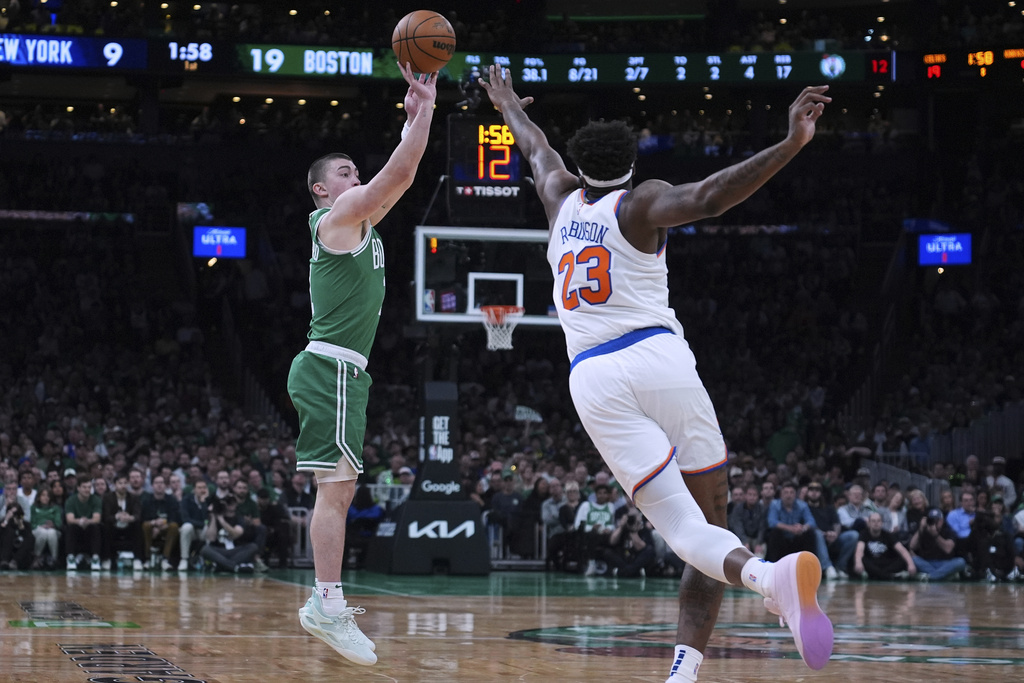
BOSTON — Mitchell Robinson didn’t care. At least, that’s what he says.
The swirling trade rumors ahead of the 2025 NBA Trade Deadline? No effect on his mental state. No emotional weight.
“Nah not really,” he told the Daily News ahead of Game 2 against the Celtics on Wednesday. “I really don’t be paying attention ‘cause honestly I just don’t care — like deadass.”
Whether or not he truly cared is secondary. The fact is, his future in orange and blue was uncertain. The NBA’s what-have-you-done-for-me-lately culture rarely offers patience. A player who anchored the Knicks’ paint for years had been sidelined for 10 months, and a team low on tradable assets — and thinner still at center — could’ve opted to move on from their injured big for short-term help.
“It’s always tricky around trade deadline. It’s a weird time for players,” said team captain Jalen Brunson. “As you can see [with the Luka Doncic trade to the Los Angeles Lakers], no one is safe. No one is safe. It’s all about your mindset, once everything happens. But we all have each other’s back, no matter what.”
The Knicks chose patience. They waited. And waited longer. When Robinson returned to the rotation on Feb. 28 against the Memphis Grizzlies, the vision of a bruising, two-headed frontcourt finally became reality. The Knicks went from a bottom-10 defense to top-10 in defensive rating after his return. That’s not a coincidence. Robinson changes things — so much so that Boston is trying everything to keep him off the floor in their second-round series.
“Just who he is. When he’s on the floor, he’s a positive for our team with his natural, God-given intangibles and obviously his ability to defend at a high level. It gives us a different offensive attack scheme and it gives us more different opportunities that we have in our lineups to do,” said Karl-Anthony Towns. “He’s special man. He’s always been special. Been fortunate to play against him for years now. So I’ve always had tremendous respect for him and it’s only gone up being his teammate now.”
“Do you not see what I do on social media? You don’t see what I be doing?”
Robinson’s serious — “deadass” — about tuning out the noise. It peaked just before his return from a second stress fracture in his left ankle, as New York’s need for a backup big grew urgent.
Towns may be an All-Star center, but his past two seasons were spent alongside four-time Defensive Player of the Year Rudy Gobert in Minnesota. The Knicks envisioned a similar synergy with Robinson. But each time his return approached, it got pushed back. By the Feb. 6 trade deadline, it was clear Robinson wouldn’t return until afterward — forcing a decision: trade the perfect fit with an uncertain bill of health, or settle for a healthier player who didn’t offer the same upside next to Towns..
“I stay in my own world. Whatever happens, happens,” Robinson said. “I just go with the flow.”
The Knicks kept him. Instead, they dealt reserve center Jericho Sims to the Bucks for Delon Wright and elevated rookie Ariel Hukporti into the rotation. The Robinson-Towns pairing was too promising to abandon. Through 17 regular-season games and a round-plus of the playoffs, the results speak for themselves.
Yet even while sidelined, Robinson was studying. He watched Gobert-Towns film to understand his new teammate’s tendencies.
“Obviously me and Rudy ain’t the same kind of player,” he said. “But we do have some similarities here and there, so we had to figure it out.”
Towns, meanwhile, stayed close through the rehab process.
“We would be in the weight room together sometimes, on the court at the same time, stuff like that,” Robinson said. “It was good getting to know him. Hadn’t really been around him too much and as that rehab was going on, getting to know him a little better and here we are.”
“I think spending time off the court when he was working out rehabilitating himself to get back into the team, being able to spend time with him and talk to him and see where he finds himself having success on the basketball court,” Towns added. “I had a lot of experience in my career: teammates got injuries, I got injuries, trades, free agent pickups. It’s something I’m used to doing in my career which is adapting and adjusting.”
Nothing about the transition was seamless. But because Gobert and Robinson share a profile — rebounding, defense, lob threat — the foundation was familiar.
“I think it just lessens the learning curve because of the experience,” said Towns. “Mitch is a great talent and has so many intangibles that coaches can’t teach.
Towns found a familiar comfort on the defensive end with Robinson, a bona fide rim protector and anchor, back in the lineup.
“Just gotta be more a perimeter defender and also tap into that Minnesota experience I had with Rudy Gobert,” he said. “Just doing that a high level, especially in the playoffs, I feel like I’ve shown the world I can do it at a high level, especially in last year’s playoffs. So I just want to carry that experience, grow on that, and get even better.”
If Robinson weren’t a threat, the Celtics wouldn’t have resorted to hacking him. To him, the strategy is a badge of honor.
“Again, it’s more to basketball than just free throws,” he said. “Obviously, I might not be making the free throws but I do other things on the court that teams don’t want to deal with. So I take that as I’m a threat, and imma continue to stand on that.”
Still, the intentional fouls can wear on a player — especially when they target a known weakness.
“Yeah it is, but it’s my own fault. I gotta get back to what I know,” Robinson said. “When I came back, I was knocking ‘em down then started getting away from it. Just gotta lock it in. That’s all.”
He says the fix is simple: shoot more often and shoot with confidence. Hart, who’s had his own struggles at the line, wasn’t about to offer advice.
“Mine was broke, too,” he said. “But we have all the trust and the faith in him. What did he miss, seven free throws? I think he only played 20-21 minutes and I think he was a plus-13 something like that. So it shows his impact even if he’s not making free throws, even if they’re doing hack-a-Mitch or whatever you want to call it. He was still down there for us when he was on the court.”
The Knicks view it the same way: intentional fouls may slow the game, but Robinson’s presence shifts everything.
“It’s two-fold. Obviously he has great impact on a game when he’s on the floor with the extra possessions. The fouls can get us to the bonus earlier, so we can take advantage of it that way,” said head coach Tom Thibodeau. “And also, it allows us to set our defense. So there’s some advantages to that as well, and when you look at points per possession, that’s what you’re looking at. Then you’ve gotta make decisions based on what’s going on in a game, how well is he shooting them, and things of that nature, and then are you gonna sub between [the five- and two-minute marks of a quarter].”
Robinson knows he needs to be better from the stripe. Three-of-10 won’t cut it. But the Knicks aren’t measuring his value in free-throw percentage.
“I think just the strengths that he brings to the team, the rebounding aspect of it, the rim protection, the ability to switch. His size is very important for us,” said Thibodeau. “And so, that’s what we’re trying to take advantage of. I’m sure he’s been fouled before and he’s gotta just step up there and make.”
He missed seven free throws. The Celtics did their best to get him off the floor. But he still dominated during his minutes in Game 1, and he has the potential to spoil Boston’s run at repeating for a title.
Because this — his impact, his presence, his game-changing value — is exactly what the Knicks held out hope for. It’s why they never moved him at the deadline.
Big Mitch is back, and the Knicks are better for it.
He might not have cared about the trade noise — but it’s clear the Knicks always cared about keeping him.