
Free agency is off and running for the Sixers, although it’s been far less active in the early going than it was last summer.
Last year, the Sixers carved out $60-plus million in cap space and splurged on Paul George, Andre Drummond and Caleb Martin before re-signing Tyrese Maxey and Kelly Oubre Jr. This offseason, their biggest signing to date has been… Trendon Watford?
Quentin Grimes is still lingering in restricted free agency, although Guerschon Yabusele is reportedly heading to the New York Knicks after one season in Philadelphia. So, where does that leave the Sixers financially? Which mid-level exception do they have? How close are they to the aprons? We’re partnering with SalarySwish to use their data and help answer every question you have about the Sixers’ financial situation.
We’ll make updates here as the season rolls along, so bookmark this page to keep up on the latest changes moving forward.
Sixers Roster, Salaries, Draft Picks, Cap Space and More
Here’s a table with all of the Sixers’ salary information, courtesy of our friends at SalarySwish:
That’s a lot of information to sift through, so let’s dive into a few key notes.
FAQ
How much cap space do the Sixers have this summer?
Unlike last offseason, the Sixers entered free agency well over the $154.6 million salary cap this year.
George, Maxey, Joel Embiid and Jared McCain alone are earning more than $149 million. Add in VJ Edgecombe’s $11.1 million salary, and the Sixers would be over the cap even if they somehow managed to salary-dump every other player on their roster.
Until they break up their Big Three, the Sixers do not project to have cap space again in the near future. Luckily, the Sixers’ front office seems to specialize in hitting moves on the margins. (If only they had a better track record on their big swings.)
How close are the Sixers to the first and second aprons?
The Sixers might not have had cap space this offseason, but they’ve still been busy. They signed Watford to a two-year, $5.3 million veteran-minimum contract, re-sign Eric Gordon and Kyle Lowry on one-year, veteran-minimum deals and declined their team option on Justin Edwards to re-sign him to a three-year, $7.1 million deal.
The Sixers now have 14 players on standard contracts. That includes Ricky Council IV, whose $2.2 million salary is fully non-guaranteed until Jan. 10. Those 14 players put the Sixers at roughly $188.1 million in total salary.
The first apron in 2025-26 is roughly $195.9 million, so the Sixers are about $7.8 million below that. The second apron is around $207.8 million, so the Sixers are $19.7 million below that.
Which mid-level exception will the Sixers have?
Well… it depends.
If the Sixers use the $14.1 million non-taxpayer mid-level exception, they’d be hard-capped at the first apron. If they use the $5.7 million taxpayer mid-level exception, they’d be hard-capped at the second apron. And if they go over the second apron at any point—say, if Grimes gets his way and lands a $25 million salary—they won’t have any mid-level exception.
Realistically, the Sixers won’t have access to the non-taxpayer MLE unless they cut salary elsewhere. Using it would put them above the first-apron hard cap, which means they wouldn’t be able to re-sign Grimes. They’re far more likely to use the taxpayer MLE, which would leave them somewhere between $15-16 million to spend on Grimes.
How much will the Sixers pay in luxury taxes this year?
As of now, the Sixers are nearly $220,000 above the $187.9 million luxury-tax line. That means they’d have a tax bill of roughly $220,000.
The Sixers already reset the clock on the repeater tax by ducking the tax each of the past three seasons. They now can’t be subject to the repeater tax until 2028-29 at the earliest. (Teams have to stay above the luxury-tax threshold three times in a four-season span to become subject to it.)
The new CBA did spike the tax rates for both standard taxpayers and repeater taxpayers once teams get roughly $10 million over the tax line. The repeater rates become preposterous from there, which helps explain why the Boston Celtics decided to detonate their roster this offseason.
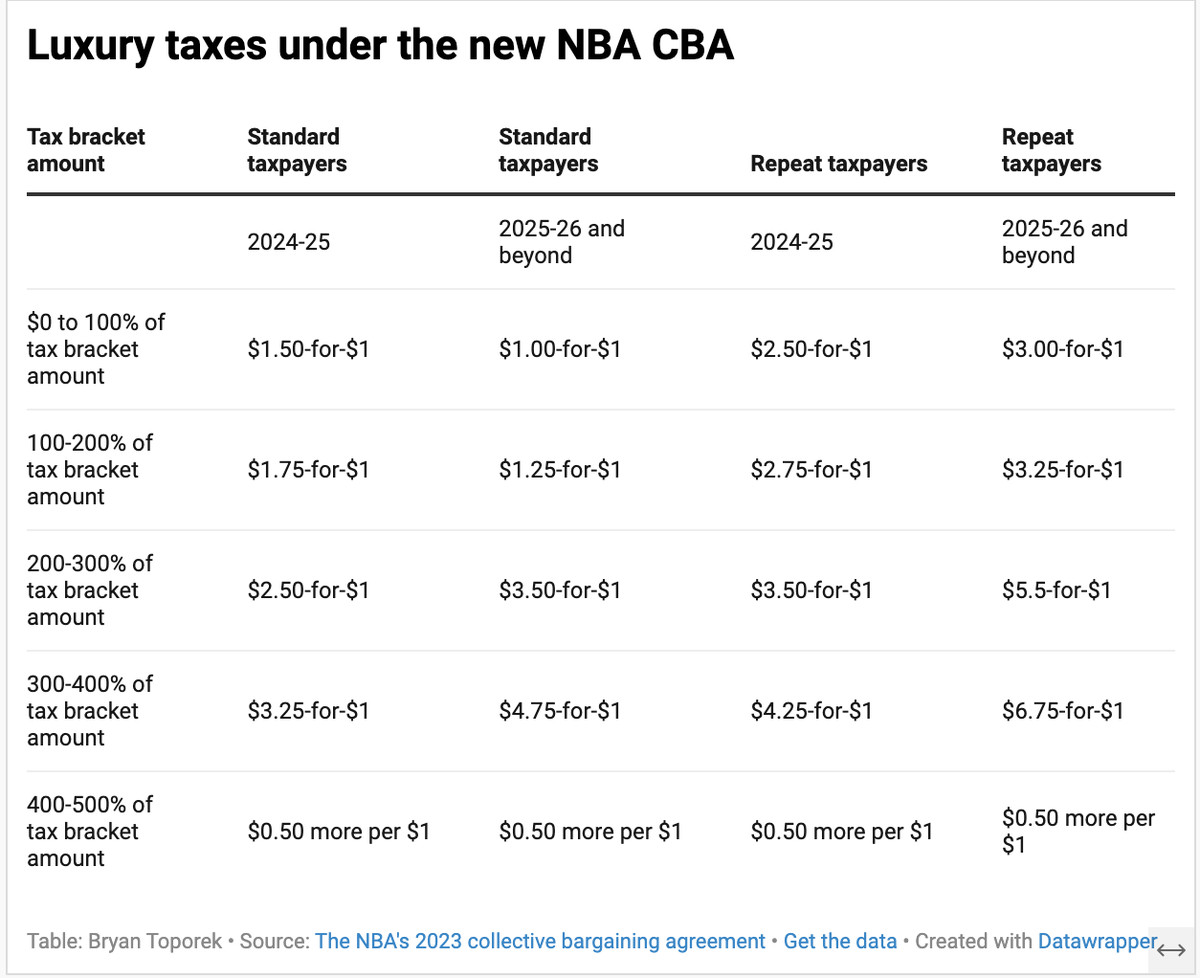
These tax rates go into effect in 2025-26.
What draft picks can the Sixers trade?
The Sixers can currently trade first-round picks in the following drafts:
2026 (only if it falls in the top four)
2028 (their own, protected 9-30, or an unprotected LAC pick)
2029 OR 2030 (not both)
2031 (if they don’t trade 2030)
2032 (if they don’t trade 2031)
The Sixers owe a top-four-protected pick to the Oklahoma City Thunder in 2026 and a top-eight-protected pick to the Brooklyn Nets in 2028. The Stepien Rule, which prohibits teams from going back-to-back drafts without a first-round pick, limits what other picks they can trade. Since they traded the 2026 first-round pick that they got in the James Harden trade (the worst of the LAC/HOU/OKC picks), they now can’t trade their own 2027 first-round pick unless they acquire another one in that year.
They also have the right to swap first-round picks with the Los Angeles Clippers in 2029 (top-three protected). With both Kawhi Leonard and James Harden’s contracts set to expire after 2026-27, those could wind up being valuable swap rights.
Additionally, the Sixers can currently trade the following second-round draft picks:
2027 Warriors or Suns pick (more favorable)
2028 Warriors pick
2028 Pistons pick (top-55 protected)
2029 Sixers pick
2030 Wizards pick
2030 Suns or Blazers pick (more favorable)
2031 Sixers pick
2032 Sixers pick
They can’t trade their 2027 or 2028 second-round picks for now because they’re tied up conditionally in the first-round picks that they owe to the Thunder and Nets. If they convey a first-round pick to the Thunder in 2026, they will be able to trade their 2027 second-round pick afterward. The same goes for their 2028 second-round pick if their 2028 first-rounder conveys to the Nets.
If you found this page useful, please bookmark it and/or share, and if you have any questions or information you’d like to see included, let us know in the comments below!