
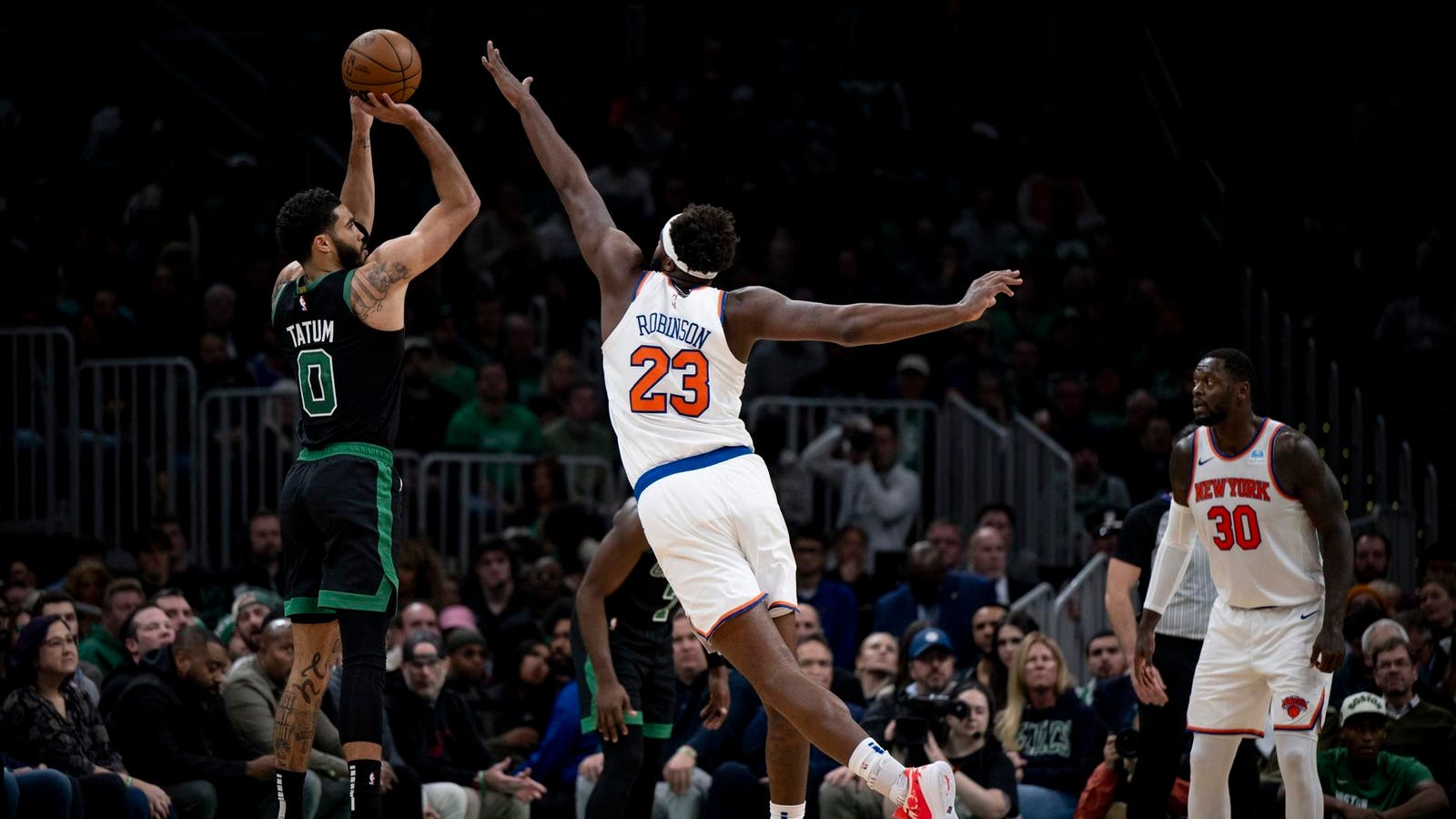
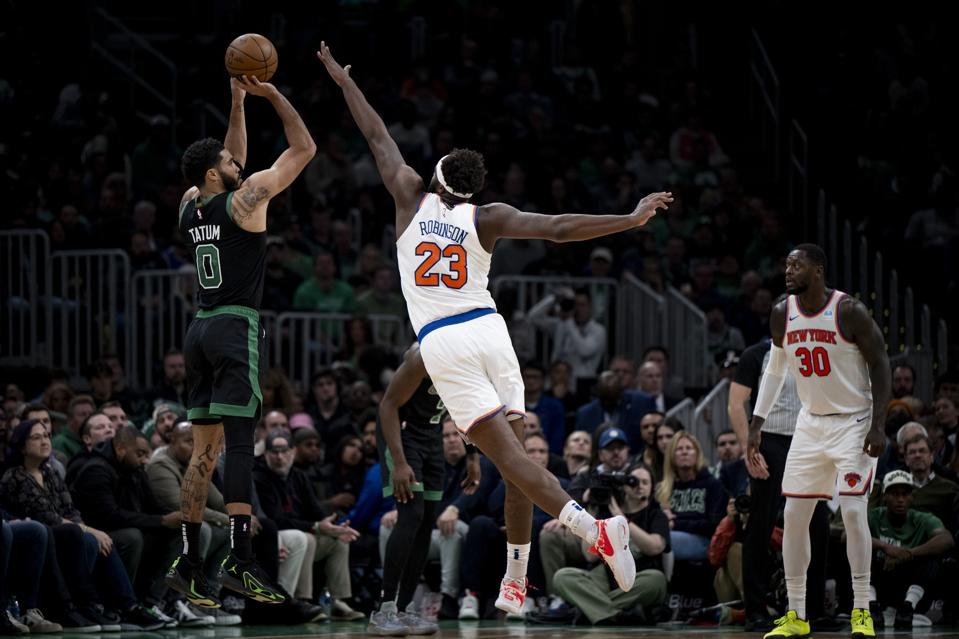
BOSTON, MASSACHUSETTS – NOVEMBER 13: Jayson Tatum #0 of the Boston Celtics shoots the ball against … More Mitchell Robinson #23 of the New York Knicks during the first half at TD Garden on November 13, 2023 in Boston, Massachusetts. (Photo by Maddie Malhotra/Getty Images)
Getty Images
Mitchell Robinson is easily the longest tenured New York Knicks player after completing his seventh season with the organization in June. There has been a ton of turnover with the roster over the past 25 years, and that has included the past few years with Leon Rose steering the ship. That could continue this season.
Robinson is in the last year of a four-year, $60 million extension that he signed after the 2021-22 season. Based on how the Knicks have operated in the past it would be quite odd for them to just let this season play out and then make a decision on what to do with him. Just like Mikal Bridges, time is of the essence to make a commitment on a player that will play a pivotal role this upcoming season.
Let’s look at the reasons for why they will and won’t extend the 27-year-old this summer:
Why They Will
There has been no true indication from Mike Brown on who he plans to start this upcoming season. Some of the rumblings before the head coach was picked indicated that the front office could be leaning toward a lineup in which Mitchell Robinson starts next to Karl-Anthony Towns. Once again, that conversation is a bit premature but it is a signal that Robinson factors into playing a large part for the team this year. Even if the coaching staff views Towns as a center for the majority of his minutes the team will still need lineup flexibility to play with a double big lineup in order to ramp up the defense. During the playoffs the Knicks allowed 106.2 points per 100 possessions with both Robinson and Towns on the floor, which would have ranked as the best mark in the league during the regular season.
That speaks to the impact that Robinson had during the postseason. He performed the best on the team relative to expectations and did so with the verve that would have made him a defensive player of the year candidate. This possession against the Boston Celtics showed off his ability to take on a drive and then dart over to the 3-point arc to cover an open shooter.
His ability to change the game on defense obviously adds an additional play style that becomes important during the postseason, but so does his offensive rebounding. Poor shooting games are inevitable for any team during a small sample size, and Robinson can swing those games back into the Knicks’ favor by giving them additional possessions. He has been in the 96th percentile or better at his position for offensive rebounding in every season for the past four years. That skill set is a unique force that gives the Knicks the opportunity to diversify the way it attacks a series, which is really the point of this new era of New York basketball— provide the most options to win against a variety of play styles. Robinson gives them that tool.
Why They Won’t
The best lineup configuration for the Knicks is to have Karl-Anthony Towns at the center position in order to maximize the effectiveness of the team’s offense. New York had the 2nd best offensive rating in the NBA over the first 41 games last season with Towns only playing the center position. Things changed over the back half of the year for a variety of reasons, but one was a failure to maximize Towns at the five when non-centers were guarding him. The hope is that Brown finds the magic elixir that allows the Knicks to thrive with a dominant offense that highlights the best traits of Towns at center.
The organization is fixated on winning a championship and part of that calculation is keeping players on board that can help them reach that goal. Robinson has shown plenty of promise, but has failed to consistently make it to the court to prove it. He has missed over 100 regular season games over the past two years, which doesn’t include the seven games he missed during the playoffs in 2024. His durability has always been a question, and that becomes even more a part of the calculation as he becomes older.
Let’s say, hypothetically, that the Knicks are able to work out a contract with Bridges, but it comes in at four years, $156 million. It would all but guarantee that the Knicks would have to go into the 2nd apron to extend Robinson. The team may be willing to do that as a part of their championship window, but it’s more likely they extend Bridges and figure out what to do with Robinson after the season. The team may be ready to make some sort of consolidation trade at that point and Robinson would figure to factor into the scenario.