
The Phoenix Suns still have two open roster spots. And until they’re filled, we’ll keep doing what we always do this time of year. Speculating, projecting, hoping. Maybe you’re in the Kuminga camp. Maybe you’ve pitched a tent on Giddey Island. Maybe it’s Ben Simmons who catches your curiosity, or perhaps you’re yearning for a reunion with a familiar face like Jevon Carter or Josh Okogie, players whose grit once gave this team its edge.
This is the cycle of every offseason. When gaps exist, we naturally begin sorting ourselves into camps, staking out our preferred visions of what this team should be, like a basketball version of Lord of the Flies. Some of us value fit, some value upside, some chase names, and some just want to see toughness and tenacity again. We identify what we believe the team needs and align the players to those needs. It’s a process built on passion, perception, and philosophy.
I’ll continue to explore possibilities and entertain all sorts of thought experiments. But it’s important to me that I’m transparent about the foundation I’m working from. If I suggest a player you disagree with, that’s fine. It’s maybe even the point. I probably feel the same way about some of your picks. That’s what makes this fun. That’s what drives discussion. Not blind agreement, but thoughtful, informed disagreement.
So with that in mind, as we look toward training camp and wonder who might fill those final two roster spots, I want to clearly lay out where I’m coming from; the principles that guide my thinking, the gaps I believe need filling, and the types of players I believe can help elevate this roster.
Here’s the foundation. Let’s build from there.
Roster Needs
For me, it all starts with what this roster actually needs. While I’m firmly in the camp that you draft based on talent, not fit, because you’re investing in development over immediacy, free agency is a different conversation entirely. When you go shopping with roster spots in hand, you better have a list. You identify the gaps, and then you find the guys who fill them.
So, let’s walk through the Suns’ current depth chart and frame the foundation of this discussion.
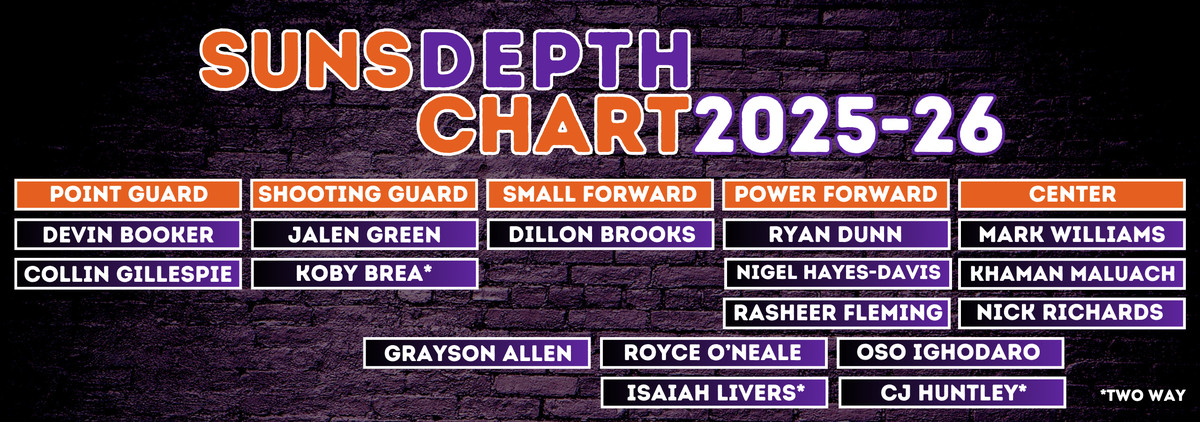
Center? Locked in. And honestly, it feels good to say that. For the first time in a while, the center room isn’t a revolving door of misfit pieces or one-dimensional backups. We’ve got three legitimate options, each bringing a different skill set and level of experience. For once, the five isn’t a question mark.
Shooting guard? Overloaded. That’s where most of the money is tied up, and technically we’re deep. We’ve got enough shooting guards to field a whole second unit of them. So let’s be clear: when it comes to using the final two roster spots, please, no more shooting guards. We’re full.
Small forward? Covered. The ideal version of this team next season includes either Dillon Brooks or Ryan Dunn manning the three, and preferably one of them is always on the court. Add in Royce O’Neale and possibly Grayson Allen sliding into that spot when needed, and it’s hard to argue the need for another true small forward.
Point guard? Now it gets interesting. My definition of a point guard isn’t just who brings the ball up. It’s your facilitator, your tempo-setter, your initiator. Last season, Collin Gillespie filled that role admirably in spot duty: 5.9 points, a nearly 5:1 assist-to-turnover ratio in 14 minutes per game over 33 appearances (including nine starts).
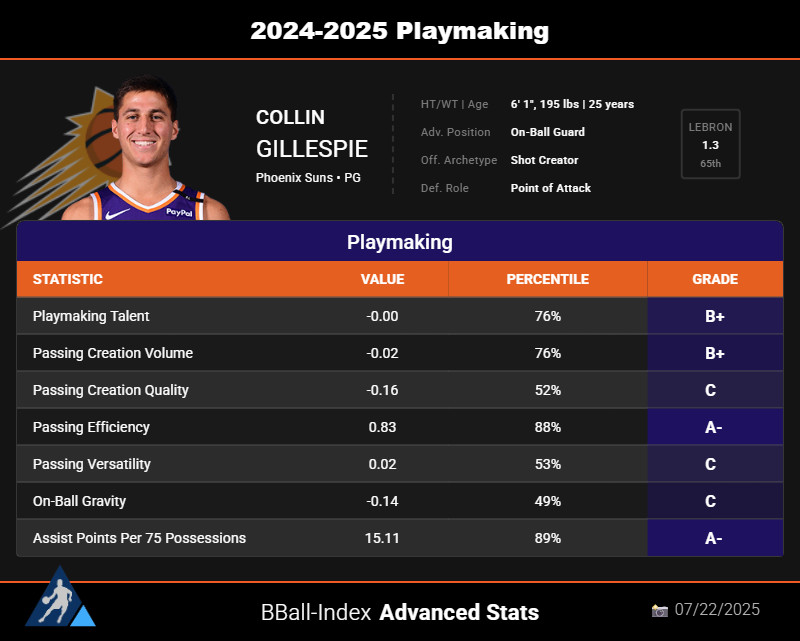
But the vision is Devin Booker and Jalen Green are slated to start in the backcourt, which means Booker will function as the lead guard by default. Gillespie backs him up. But is that enough? That’s a position of opportunity.
Power forward? Another area where help could go a long way. Right now, you’re looking at a mix of Ryan Dunn, Nigel Hayes-Davis, Oso Ighodaro, and rookie Rasheer Fleming to eat those minutes. Royce O’Neale could slide in to stretch the floor, but the truth is, there’s no clear starting-caliber power forward on this roster, at least from a size perspective. They have athleticism and some rebounding options, but no clear-cut answer at this time. It’s a gap, and one that matters in a conference full of versatile, physical fours.
So that’s the foundation I’m working from as I evaluate options. When I suggest a player, it’s not just about the name; it’s about the need.
The Market
As I scan the remaining names on the market at both the point guard and power forward positions, I’ll be honest, I’m not blown away. I haven’t been for months. And that’s the lens through which I evaluate how the Suns should proceed.
It’s been a while, so here’s the best remaining NBA free agents after three weeks of free agency being open:
PG
J. Giddey (R)
M. Brogdon
R. Westbrook
B. Simmons
J. Butler
SG
Q. Grimes (R)
C. Thomas (R)
D. Melton
G. Payton II
A. Burks
SF
A. Coffey
T. Craig
L. Stevens
K. Edwards…
— Keith Smith (@KeithSmithNBA) July 21, 2025
At point guard, there are some serviceable options. I see solid depth pieces who could contribute in limited minutes, names like Malcolm Brogdon. But no one, whether unrestricted or on the restricted market, feels like a true difference-maker. Certainly not enough to justify the price tag it would take to bring them in.
The power forward market, on the other hand, is a different story. There are still some intriguing names out there. Players like Chris Boucher and Precious Achiuwa, guys who aren’t past their prime but have actively contributed to winning basketball in recent years. Maybe they come to Phoenix and start, maybe they don’t. But they have what this roster needs: size, length, and athleticism.
The Suns do have options at the four internally, but many of those options trend small. Adding a true power forward with verticality and physicality would go a long way in rounding out the roster, and in my view, that’s the most logical place to invest. But there’s one thing that makes me hesitate…
Philosophy and Expectations
This, more than anything, is the lens through which I’m evaluating how the Suns should approach their final two roster spots, and it’s shaping how I view who’s available and who’s worth pursuing. The Suns have chosen a new direction. One rooted in patience, development, and sustainability. That path deserves time to breathe.
With young players like Khaman Maluach, Rasheer Fleming, Oso Ighodaro, Koby Brea, and Ryan Dunn on the roster, the priority should be clear: create space for them to grow. These guys need real opportunities to play, to fail, to adjust, and to prove what they’re capable of becoming at the NBA level.
That’s why I’m focused more on proven depth — steady, low-cost veterans — rather than swinging for another high-upside question mark like Jonathan Kuminga. Because while the talent is tempting, the price, in both dollars and developmental oxygen, is a gamble. And the Suns don’t need to gamble anymore.
This season is a reset. A recalibration. They’ve put themselves in a position to pull back financially, invest in their young core, and see what takes root. It’s why I don’t have lofty expectations for the Suns’ final record in 2025–26. It’s a bridge year. A necessary gap between the chaos of the past and whatever the next chapter becomes.
And if you’re constantly looking to make a splash, if you’re chasing names or shortcuts, you risk undercutting the very philosophy that got you here. You don’t plant seeds just to dig them up early. Let them grow. Let them prove something. That’s the path now. And it’s worth staying on.
As for the point guard position, let’s be clear: the Suns don’t need a starter. They need a depth piece. I’ve said this before, and it remains the bedrock of my thinking: going after a non-defensive, undersized starting-caliber point guard would land the Suns right back in the Tyus Jones dilemma from last season. That move forced Booker down the positional line, pushing him into matchups at small forward where he simply can’t hold his own defensively. He’s sized appropriately for the one. He can function there. But bumping him up the lineup to accommodate a traditional point guard? That’s not solving anything. That’s asking for the same defensive breakdowns we saw time and time again last year.
This team is committed to a backcourt of Devin Booker and Jalen Green. That’s the plan. And unless you’re bringing in a game-changing floor general — which, let’s face it, you’re not finding on the open market — there’s no reason to deviate. We’ve seen what small-ball defense looks like when it’s built around undersized backcourts. It doesn’t work.
This year isn’t about finding quick fixes. It’s about evaluation. You need to see what Booker and Green look like together as your starting backcourt. And if it doesn’t work? You reassess next offseason. Green will still have two years and $72 million left on his deal. Movable if necessary.
And let’s not forget about Collin Gillespie. No, the investment wasn’t huge in terms of dollars, but it was real in terms of trust and development. He earned his spot. He’s shown growth. This will be his third season, and he deserves the opportunity to solidify himself as the backup point guard. But if you go out and sign someone who expects that role — or worse, expects to start — Gillespie gets buried again.
This team needs to be smarter with its minutes and its money. Depth at point guard is fine. But clarity in the backcourt is better. Give Gillespie the chance he’s earned. Let the Booker-Green experiment breathe. And save the reshuffling for when you actually need it.
Patience. It’s a word this organization hasn’t truly embraced in over half a decade. But now, they finally have an opportunity to do just that. So why the rush? Why are so many eager to shortcut a process they’ve spent months demanding?
The same voices that called for a reset — to get younger, to get faster, to build something sustainable — are now the ones pushing to accelerate that very reset. It doesn’t make sense. Outside of Devin Booker, this roster has been completely retooled. The foundation has shifted. This is a new era, and it needs time to take shape.
Looking to free agency right now for a plug-and-play savior not only misunderstands what this team needs, it undermines the entire philosophy behind the changes the Suns have made to reach this point. Growth takes time. Development requires room to breathe. Let it happen.
So this is where I’m coming from as I put together the list of players I believe the Phoenix Suns should pursue in free agency. You may see it differently. In fact, you probably do. Maybe you think there’s still a free agent out there who can genuinely move the needle, who can fit within the Suns’ new philosophy and elevate their ceiling.
That’s what makes conversations like these worth having. It’s fascinating to see how everyone interprets this roster in its current state, especially while navigating a free agent market that, frankly, isn’t brimming with obvious answers.
But when you see me suggest names like Malcolm Brogdon or Josh Okogie, I want you to understand where I’m coming from. Yes, Okogie can’t shoot. Yes, Brogdon has durability concerns. But I’m not asking them to carry the load or be something they’re not. I’m looking for veterans who can quietly fill depth roles, players who can step in if and when injuries hit.
This season should be about one thing: development.
The Suns have three cards on the table, and two more tucked in the hole. This isn’t the time to overplay the hand or chase a wild bluff. This is the time to see what we’ve got, to give our young core room to grow, to make sure the foundation holds. Be smart. Be steady. Let the season unfold without forcing it into something it’s not.
And that’s the mindset guiding every name I put forward.
Listen to the latest episode of the Suns JAM Session Podcast below. To stay up to date on every episode, subscribe to the pod on Apple, Spotify, YouTube, YouTube Podcasts, Amazon Music, Podbean, or Castbox.
Please subscribe, rate, and review.