
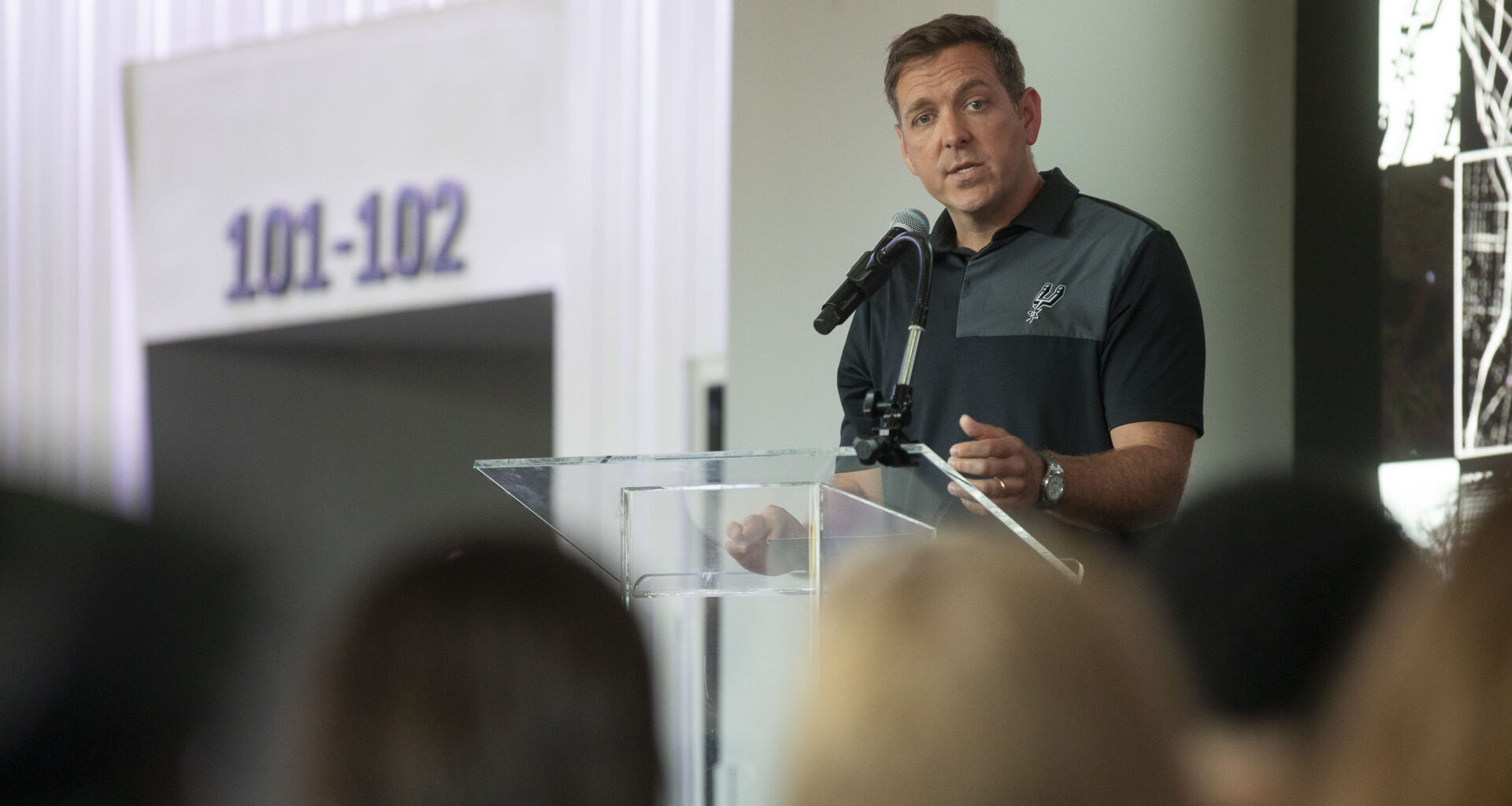
The Spurs organization wants to participate in developing a downtown sports and entertainment district in San Antonio, Spurs Chairman and General Manager Peter Holt said on Wednesday.
But it won’t ask residents to pay for the estimated $1 billion new arena.
“I just want to clear up one thing,” he told the crowd of developers, architects and real estate professionals gathered for an Urban Land Institute of San Antonio (ULI) program.
“The model for our arena today is a public-private partnership, where the Spurs put in money and the public puts in money with Bexar County that is 100% funded by the venue tax,” Holt said. “We are not looking to disrupt that model, we are not looking to add a new tax to San Antonio citizens.”
The ULI program is another in what’s become a series of meetings with the local developer industry to discuss the expansive redevelopment plan, starting with two sessions put on by the city, ULI and the American Institute of Architects in April.
Sitting on the most recent ULI panel that also featured former Oklahoma City Mayor Mick Cornett, Holt explained that the Spurs organization is motivated to develop the district, nicknamed Project Marvel, for the same reasons it built The Rock, a training facility completed in 2023 at La Cantera on the far Northwest Side.
“If that helps us, if that helps the community, if that helps the economy, if that helps housing, if that helps — name a priority that we have in our city — we want to be either direct contributors or enablers to that,” he said.
So why is downtown the move, panel moderator and local developer David Adelman asked Holt. “How does a downtown arena benefit the Spurs?”
In fact, that was always the plan — even before the existing arena on the East Side was built in 2002, according to the Spurs general manager.
Holt said the AT&T Center, now Frost Bank Center, was built at the urging of the NBA which was looking to continue building on a success that began with getting a national television contract, and establish dedicated, world-class venues for play.
The Spurs organization sought investors to make that happen and interest came from the Maloof family of Las Vegas. But concern grew that the team could be moved to that city, Holt said. “Alarm bells went off rightfully, so the city … approached my mom and dad.”
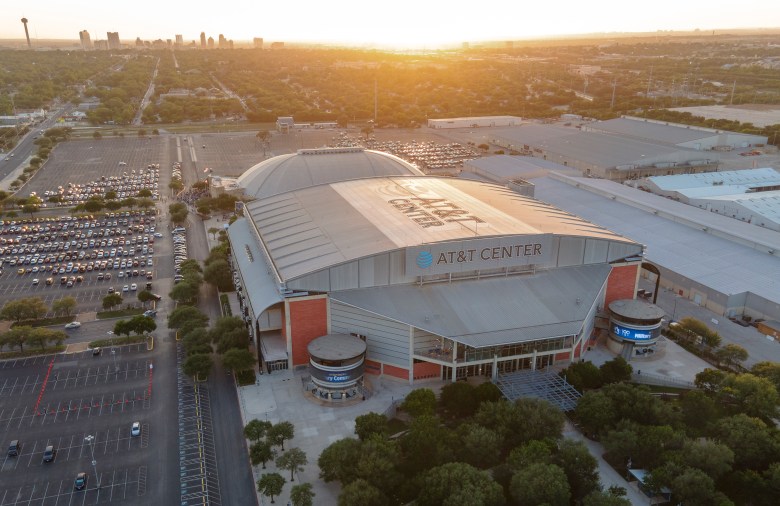 The Frost Bank Center has played host to the Spurs on the East Side since 2002. Credit: Nick Wagner / San Antonio Report
Peter M. Holt and his then-wife, Julianna Hawn Holt, became the Spurs’ largest shareholders in 1996, and the Holt family remains the franchise’s majority owners.
“When we first knew that we needed a world-class arena in the ‘90s, downtown was our first mission,” said Holt, a son to Peter M. Holt. But other stakeholders had other ideas that included the North Side and East Side. “That’s how we ended up where we are.”
Completed in 2002, the arena is only three years shy of the 30 years some consider the lifespan of a viable arena.
Going forward, Spurs Sports and Entertainment wants to be “rooted in a foundation of the past and legacy, [not] beholden to it,” Holt said. So the organization has evaluated other possible locations around San Antonio while also considering the option to remain at the Frost Bank Center.
“The resounding, both objective and subjective score was, if possible, we should reimagine the urban core sports and entertainment districts that was rooted in a Spurs arena that would advance and enable the community that we live,” he said.
Based on the experience of other cities, the organization also wants a “turn-key” development; in other words, a district that comes with a hotel and other offerings within proximity to the arena versus a phased-in or organic approach.
In addition to the Spurs arena, the proposed sports and entertainment district would include an expansion of the Henry B. González Convention Center, the construction of a new Convention Center hotel, a land bridge over I-37 to connect the East Side to downtown, improvements to the Alamodome, transformation of the John Wood Courthouse into a live entertainment venue, other mixed-use development and improved infrastructure.
Keynote speaker Cornett, a former TV personality and four-term mayor of Oklahoma City, spoke about bringing the NBA franchise Thunder team to his city which led to significant private investment and development.
Cornett said he knows of no city that isn’t focusing its arena plans on a center city, urban site, including his hometown. In many cases, that means displacing something else to make room, but in San Antonio, the chosen site of Hemisfair seems to be “almost shovel-ready,” he said.
“I don’t know that downtown San Antonio is desperate, needing a catalyst, because downtown San Antonio is doing so well now, but nonetheless, it can be better, and [a sports facility] can be a catalyst,” he said.
Still, it is difficult for elected officials to support such initiatives, he added. The prevailing question from residents is why the public should help a wealthy group of athletes and owners.
“But the bottom line is, these are extremely valuable franchises that would locate in any number of communities around the country, and places are lining up to be able to offer an arena in exchange for an NBA franchise,” Cornett said.
Holt said that despite some local media reports, the Spurs organization is loyal to San Antonio.
While voters are split on the Project Marvel plan, according to a recent poll by the University of Texas at San Antonio, and some community advocates are against it, outgoing Mayor Ron Nirenberg has indicated his support for the project.
Attending the Wednesday program at the Tobin Center for the Performing Arts, mayoral runoff candidate Gina Ortiz Jones said she thinks it is always useful to hear a range of perspectives on the topic, including what Holt is thinking.
“I think it’s still very early on, and [I] look forward to hearing more,” she said.
Jones’ opponent, mayoral hopeful Rolando Pablos also attended the event. He did not respond to a request for comment. At a debate on April 8, he said of Project Marvel: “Taxpayers come first.”