
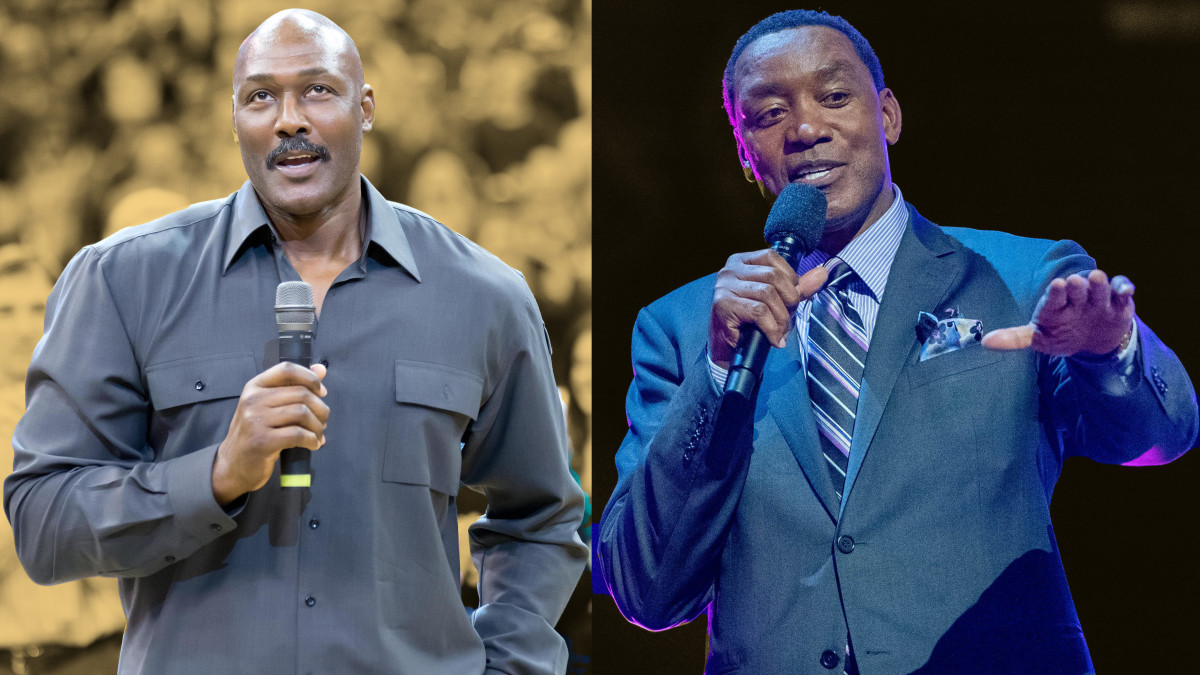
“I wanted to say this to you for so long” – Isiah Thomas on why Karl Malone called him near tears after watching The Last Dance originally appeared on Basketball Network.
Isiah Thomas was front and center of the bruising, no-prisoners Detroit Pistons era, famously known as the Bad Boys, a team whose reputation was built on hard-nosed defense and psychological warfare.
Advertisement
But sometimes they were on the receiving end and in late 1991, Thomas became the one left bloodied and broken.
During a game against the Utah Jazz on Dec. 14, Thomas suffered a brutal elbow from Karl Malone that resulted in 42 stitches above his right eye. That violent collision broke the line between physicality and recklessness.
Malone’s long guilt
It would take nearly three decades for the silence between them to finally break.
After the release of “The Last Dance,” ESPN’s 10-part documentary chronicling Michael Jordan’s career, old wounds were reopened.
Advertisement
But for Malone, the documentary reopened basketball debates and cracked something open in his conscience, going back to that night in 1991.
“He called me up and said, ‘I am a man and I never had anything against you. Isiah, I wanted to say this to you for so long,” Thomas recalled of his conversation with Malone. “He goes, ‘I apologize.’ And I said to Karl, ‘I accept your apology.’ He almost started crying on the phone. He goes, ‘I meant to hit you, but I didn’t mean to do that, because that is how we played.”
The docuseries painted Thomas as a central antagonist, especially in relation to the infamous walk-off by the Pistons in the 1991 Eastern Conference finals, a decision that Jordan and the Chicago Bulls took to heart for years to come. The portrayal stirred emotions across the league’s old guard.
Advertisement
That night, Thomas had been carving up Malone’s Utah teammates, including a 44-point barrage that left the Jazz reeling. For a point guard barely touching six feet, Thomas had always thrived on defying odds, blending finesse with fearlessness. But after a strong drive to the basket, he collided with Malone at full speed.
The elbow came down hard and fast. Thomas hit the floor, blood pooling beneath him. What followed was a chaotic scuffle that threatened to spill over. Malone was immediately ejected, later fined $10,000 and served a one-game suspension.
Advertisement
But the scar Thomas carried, both physically and emotionally, went far deeper than any league-issued punishment.
The early ’90s NBA was a war zone in shorts — and no team embodied that better than the Pistons. However, Thomas had never set out to intentionally hurt someone on the floor and he never questioned Malone’s competitive spirit until that night in ’91.
A scar of the era
Malone’s call was a personal decision, rooted in reflection for what he had done especially after watching The Last Dance that had ignited conversations about legacy, respect and the messy politics of rivalry.
Advertisement
Seeing Thomas painted as a one-dimensional villain didn’t sit right with him. Their paths had collided violently in Salt Lake City, but their stories ran deeper than a single moment.
That elbow remains one of the most haunting images of the era, Thomas dazed, holding his forehead, blood dripping down his face as Pistons trainers rushed onto the floor.
The Pistons icon had won two championships playing through broken wrists, sprained ankles and torn muscles.
Advertisement
But the Malone incident stood out because it felt so personal at the time.
The Pistons had played rough, but rarely reckless. Thomas had taken hits, but rarely such deliberate violence. And yet, in the long narrative of NBA rivalries, that night became just another entry in a long book of unfinished business.
Years later, Malone’s phone call offered something rare in sports, a postscript of vulnerability and Thomas, a man whose legacy has often been debated more than celebrated, had to forgive.
Advertisement
This story was originally reported by Basketball Network on Jul 24, 2025, where it first appeared.