
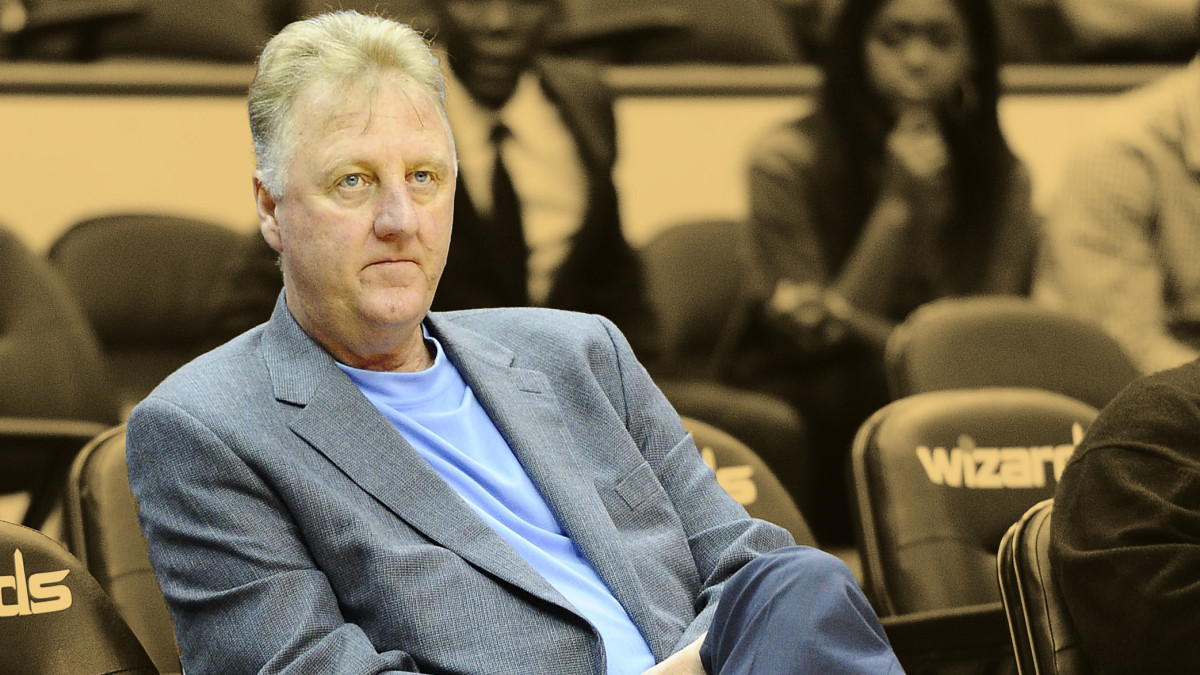
“Now I’m worried about the centers” – Larry Bird once shared his concern about the future of big men in the NBA originally appeared on Basketball Network.
The NBA has always evolved in waves, shaped by shifts in athleticism, rules and the philosophies of the era’s dominant teams.
Advertisement
In this ongoing transformation, Larry Bird, one of the game’s greatest and fiercest competitors, is watching closely. He is concerned about the vanishing footprint of the traditional big man, a position that once anchored dynasties.
Bird has worked in the background since his retirement, from the Boston Celtics front office to the head coach position of the Indiana Pacers and an executive position also at the Pacers. He has seen different eras of players come and go and the center position worries him.
Bird concerns
The three-time MVP and Celtics legend, known for his sharp basketball mind as much as his iconic jump shot, reflected on the modern game, which is increasingly driven by pace, space and positional fluidity.
Advertisement
Bird’s nostalgia is laced with admiration for the NBA’s transformation, even as he admits he’s uneasy about what’s being left behind.
“I love the way the NBA is going,” Larry said. “I can remember 20 years ago I was worried about small guards; now I’m worried about the centers. The game changes. I like how they cleaned it up. There is more freedom of movement and guys can sort of let their game go.”
It all comes down to the arc of change. The old worries about whether smaller guards could survive the league’s bruising, hand-checking brand of basketball have been replaced by a different question of where dominant centers could fit in a game that no longer runs through the low post.
Advertisement
Throughout the ’80s and ’90s, the paint was sacred territory. The league revolved around giants — Kareem Abdul-Jabbar, Hakeem Olajuwon, Patrick Ewing and later Shaquille O’Neal.
In Bird’s own career, championship runs required confronting some of the most fearsome bigs to ever play. Boston’s battles with Moses Malone in the early ’80s, or their physical wars with Bill Laimbeer and the Detroit Pistons later on, were rooted in size and interior dominance.
But the evolution came swiftly.
Advertisement
The 2004 Pistons were perhaps the last team to win a title on the back of true frontcourt defense, anchored by Ben Wallace and Rasheed Wallace.
The 2010s ushered in a new style, kicked off by the San Antonio Spurs’ beautiful ball movement, perfected by the Golden State Warriors’ perimeter barrage and soon adopted league-wide.
Stretch-fives became a necessity, not a novelty. The bruisers became bench options, at best.
More open but less grounded
Many legends lament the change for the sake of the modern game, some even calling it flat-out bad. Bird’s words, however, come with respect for how far the game has progressed. But at the same time, there’s a reverence for the kind of center that once forced teams to build rosters specifically to counter them.
Advertisement
“When we played in Boston in the East Coast, it was a grind-out game,” Bird recalled. “But when we got to the West Coast, it was more open. You could show your talents. Guys weren’t holding on to you, grabbing you. And I think that’s what the NBA is today. It’s a freer game, it’s more open. If you’ve got a number of skills, you’re able to display them every night.”
The East was once known for its defensive grit and physical post play. The West, even in the ’80s, leaned toward pace and transition. Today, that wide-open style dominates every conference.
This evolution has brought the game to a new creative high in many ways. Bigs are now asked to pass like guards, shoot from the perimeter, and defend in space, skills that players like Nikola Jokic and Joel Embiid have fused into modern superstardom.
Advertisement
Yet, there’s a growing list of centers whose decline wasn’t due to injuries or effort, but rather a game that moved away from their strengths. Bird’s concern reflects this shift.
The freedom he applauds is also the same environment that challenges traditional post players to adapt or fade. Once, a big man could dominate without ever leaving the key. Today, a player who can’t switch on a screen or stretch the floor finds his minutes shrinking and his value diminished.
This story was originally reported by Basketball Network on Jul 24, 2025, where it first appeared.