
Its an off day for the Texas Rangers, which makes it a convenient time to do an off-topic post.
Luka Doncic’s return to Dallas for the first time since the trade, his emotional reaction when the pre-game montage of highlights from his time in Dallas was played, the fans unreserved, wholehearted cheering for him throughout the game, really crystallized for me something I’ve been thinking about since I woke up that morning a couple of months ago and was floored by the news that Doncic had been traded.
I do not see how the Dallas Mavericks’ current ownership can ever recover from this. I do not see how this ownership group can ever regain the trust of the fans.
And this isn’t just because of the trade itself. I am not going to re-hash the criticisms of the deal and the betrayal to the fans it represented. That’s been covered plenty, by people much better qualified to speak to it than me, someone whose Mavs fandom lapsed some time ago (though isn’t completely dead, I discovered, based on how sad I was and continue to be over this deal).
Its because of a confluence of factors, starting with the fact that the folks who own and are running the team have no connection with the Metroplex. They are outsiders, carpetbaggers who bought the Mavericks because they wanted to own an NBA team. Say what you will about Mark Cuban — and I have said plenty — he bought the Mavericks because he wanted to own the Dallas Mavericks, not just some NBA team.*
* I made no secret of the fact I did not want Cuban to buy the Texas Rangers when they went through their lengthy sales process in 2010, and that was in large part because he didn’t want to buy the Rangers because they were the Texas Rangers, he wanted to buy the team as part of an effort to create a regional sports network.
No, the new owners bought the Mavericks because they were a franchise that was in an area that they wanted to try to enter for business purposes. It was a foot in the door, a way to get a toehold in an effort to expand the family business empire into the Metroplex, as Adelson son-and-law and ownership point man Pat DuMont described in Brad Townsend’s DMN piece almost a year ago, two and a half months after the sale was announced:
“As a family, we’ve been wanting to be part of the Texas business community,” Dumont said. “We think it’s a great place to be. Dallas is a growing city. There’s a lot of positive factors in Dallas from the perspective of owning an NBA franchise.
“It’s probably a top-five market; could easily go into the top four in the next couple of years. … And it was incredibly compelling to us to invest with Mark and go ahead and do this. For us, the public company is something that we really focus on, but this was a family decision.”
What made this deal particularly ironic is that the Ross Perot Jr.-led ownership group Mark Cuban originally bought the team from back in January of 2000 acquired the team from Don Carter in 1996 primarily as part of a real estate play, a way to help move his business deals and developments forward. When he sold, 24 years later, it was to a group that, as he acknowledged in that Townsend piece, was acquiring the team as part of its real estate efforts:
“I’m sure we will work it out,” [Cuban] said, adding of Dumont and Adelson: “They’re not basketball people; I’m not a real estate person. That’s why I did it.”
* * *
When Cuban, 65, explained his reasons for selling the franchise but maintaining a significant stake, he touted Sands Corp.’s infrastructure and know-how to build and operate the kind of large-scale entertainment complex that he and Dumont and Adelson have envisioned for more than a year.
* * *
Beyond the immediate goal of improving American Airlines Center, Dumont said it’s extremely premature to speculate about a timetable for another potential arena.
But that doesn’t mean he hasn’t imagined the possibilities. One of two options, he said, is to meet with the Stars and Dallas community leaders and consider what to do about AAC when the lease expires in July 2031.
The other?
“We believe very strongly that there’s an opportunity to develop destination resorts in the state of Texas, at some point, over the next years,” Dumont said. “I don’t know how long it will be; I couldn’t tell you, but I’m hopeful about it. People tell us that they would like to see it happen, which is nice. It feels like we have good support from certain areas.
“When that does happen, there might be an opportunity for us to build a brand-new arena for the Mavericks as part of an entertainment complex that’s large-scale, in a destination resort, with hotel rooms and space for both business and leisure tourism.”
And yes, pretty much every owner looks at owning a professional sports franchise as a business deal. But there’s a matter of degree, a spectrum, going on one end from owning a sports franchise as a business that essentially operates as a very expensive hobby, to the other end of owning a sports franchise as primarily either a money-making enterprise (see the Jones family and the Dallas Cowboys) or as a vehicle to help make money with your other business ventures.
From the time the deal was announced, it was framed in the local and national media as a billionaire oligarch using the franchise as a way to advance their other business ventures, and in particular, to provide a gateway to development in the Metroplex. It was even initially announced that Mark Cuban would keep running the basketball side of things — as he said, “they’re not basketball people” — while they focused on the business side of things.
And the Luka Doncic trade simply reinforced the perception that the new owners are outsiders, disconnected from the community and the fanbase, with their priority being to use the team as a tool towards their overall goal of making more billions with what they actually care about — their “real” businesses.
Further complicating matters is that the real owner of the team, Miriam Adelson, has delegated the running of things to her son-in-law, Pat Dumont. Now, it is probably for the best that she stay in the background — she’s a polarizing figure, and has done nothing to create the idea that owning the Dallas Mavericks is a passion project for her.
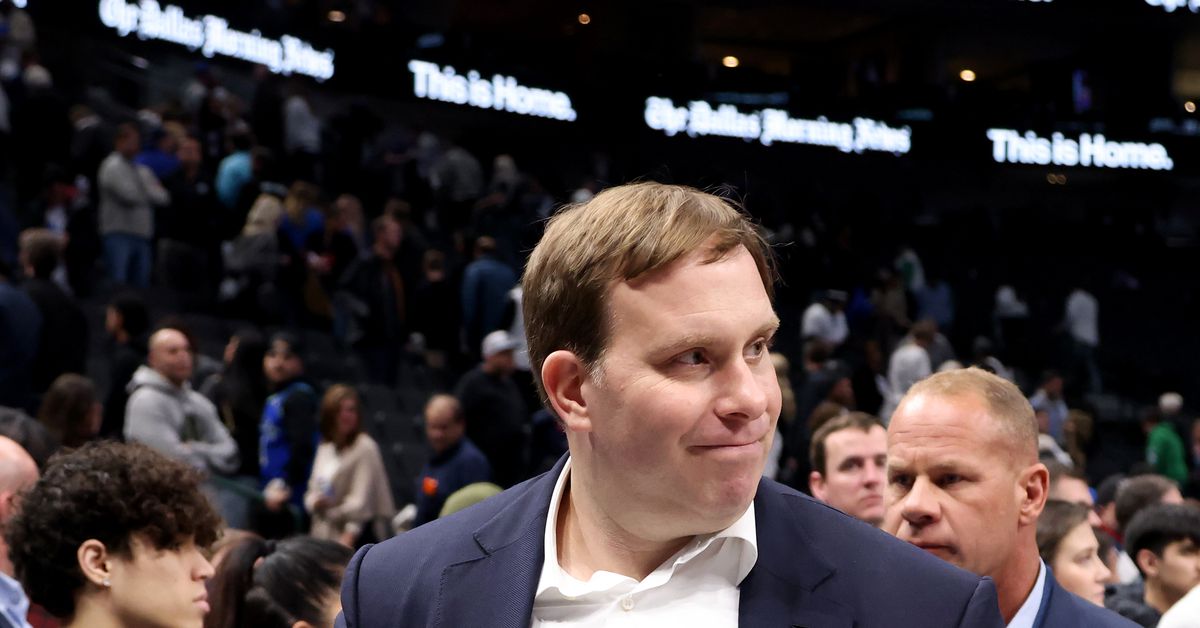
But having Dumont as the face of ownership, in the aftermath of the Doncic trade, seems to be a disaster. In his first public comments after the trade, he tried to mollify fans by professing to love Luka Doncic just as much as they did:
“I’m a big Luka fan. My family are big Luka fans. I have a really deep appreciation for what he brought to this team, what he brought to Dallas, and the excitement he brings. He’s an electrifying player.
“I want you to know I really sympathize with all of our fans who feel hurt. Look, as far as I’m concerned, Luka is a Mav for life and I really wish him nothing but happiness and success in his career as he continues in LA.”
Those quotes really ring hollow, though, in the context of professing to be “a big Luka fan” when it doesn’t appear he had any particular affinity for the Mavericks before his mother-in-law bought the team a year earlier, didn’t watch Luka enter the league as a rookie and grow and become one of the top five players in the game.
Even more absurd the statement that he considers Luka “a Mav for life.” We aren’t talking about Emmitt Smith joining the Arizona Cardinals in the twilight of his career. We aren’t talking about Hakeem Olajuwon playing out the string with the Toronto Raptors. We are talking about shipping out a 25 year old, a top five player in the game, a player who wanted to spend his entire career in Dallas and had his best years ahead of him.
I don’t see how anyone can read those words, coming from someone who had not connection with the organization 14 months prior, and not find them offensive — especially when combined with what he had to say in that same interview defending the move:
“In my mind the way teams win is by focus, by having the right character, by having the right culture, and having the right dedication to work as hard as possible to create a championship-winning outcome,” Dumont said. “And if you’re not doing that, you’re going to lose.”
* * *
“If you look at the greats in the league, the people you and I grew up with — [Michael] Jordan, [Larry] Bird, Kobe [Bryant], Shaq [O’Neal] — they worked really hard, every day, with a singular focus to win,” he said. “And if you don’t have that, it doesn’t work. And if you don’t have that, you shouldn’t be part of the Dallas Mavericks.
“That’s who we want. I’m unwavering on this. The entire organization knows this. This is how I operate outside of basketball. This is the only way to be competitive and win. If you want to take a vacation, don’t do it with us.”
I’m not sure how to square this particular circle, where ownership — the person purportedly in charge of the franchise — talks about what a huge fan of Luka Doncic he is, how he’s a “Mav for life,” then turns around moments later and calls him out for not having the “right character” and accuses him of taking a vacation during the season, other than to conclude the praise he offered is lip service in an effort to try to make fans believe he understands them.
The events of last night makes me think that the relationship with ownership and the fans is not really salvageable — not when fans see the team being mocked around the league for the deal, not when Mark Cuban is publicly criticizing the trade and suggesting that his being cut out of decision-making was not in accordance with what he thought new ownership had agreed to, not when the Mavs are eking into the final play-in spot while Doncic is playing at a superstar level for a team that Mavs fans have grown up despising.
And not when the face of ownership is an interloper, someone who comes across as a carpet-bagging fail-son who two centuries ago would have been sent into the priesthood in an effort to keep him from befouling the family name, someone who personifies Molly Ivins’ line about having been born on third and thinking he hit a triple. An outsider, who signed off on sending out one of the most beloved players in the history of the D/FW area, one of the greatest players in the NBA, then lectures the fans, implicitly telling them that their devotion was misplaced and their love of Luka Doncic was misguided.
That’s what really sucks about this. That this doofus, this casino check-signer, thinks marrying into money makes him an expert on everything, makes him the ultimate arbiter of character, puts him in a position to say, barely a year after joining the organization, that the 25 year old icon doesn’t meet his personal standards of greatness, and in the process, destroys all the goodwill that Mark Cuban, for all his flaws, had built up in the previous two-plus decades.
And thus we have the fans, the people who have supported and lived and died with this team, watching the point man for a billionaire destroy what they love in an act of hubris. Watching this family use its billions to acquire something they don’t really care about, that they can wreck and mismanage, safe in the knowledge that such destruction won’t impact the quality of their life one iota.
I will end this with a quote from the Great Gatsby, a quote I’ve been thinking of quite a bit lately, and which I think applies here:
They were careless people, Tom and Daisy — they smashed up things and creatures and then retreated back into their money or their vast carelessness or whatever it was that kept them together, and let other people clean up the mess they had made.