
The archetype representing Indiana basketball is an orange rim attached to a red barn, featuring a background of brown cornstalks.
Doesn’t really sum it up, does it?
The Indiana Pacers’ run to the NBA Finals is a reminder that, as far as hoops are concerned, all roads lead to Indianapolis. All corners of the state, of the country, even of the world, convene in the Circle City.
NBA Finals schedule
Game 1: Thursday, June 5 at Oklahoma City, 8:30 p.m.
Game 2: Sunday, June 8 at Oklahoma City, 8 p.m.
Game 3: Wednesday, June 11 at Indianapolis, 8:30 p.m.
Game 4: Friday, June 13 at Indianapolis, 8:30 p.m.
Game 5: Monday, June 16 at Oklahoma City, 8:30 p.m.*
Game 6: Thursday, June 19 at Indianapolis, 8:30 p.m.*
Game 7: Sunday, June 22 at OKC, 8 p.m.*
* If necessary.
It has been so for more than a century. In fact, it was 100 years ago that the sport’s inventor, James Naismith, watched the high school state tournament in the Exposition Building of the Indiana State Fairgrounds.
“The possibilities of basketball as seen here were a revelation to me,” he later wrote. “Basketball may have been invented in Massachusetts, but it was made for Indiana.”
For Indianapolis, if you want to get picky.
We will have to wait until June 11 and Game 3 against the Oklahoma City Thunder for the city’s first NBA Finals game in 25 years. Indy need not get ready. Indy stays ready.
After all, this city has showcased Oscar and Oscar. Oscar Robertson led Crispus Attucks, which, in 1955, became the first all-Black high school to win an open state basketball championship. Oscar Schmidt scored 46 points for Brazil in a 120-115 victory over Team USA in the 1987 Pan American Games at Market Square Arena.
Or the Indianapolis Olympians (NBA team from 1949-53) and U.S. Olympians (a record 67,596 attended a 1984 exhibition at the Hoosier Dome).
Or a pandemic NCAA Tournament held all in one city (2021) or a FIBA World Championship (2002).
Or 97-year-old Hinkle Fieldhouse, a prototype for the Pacers’ Gainbridge Fieldhouse.
We have our traditions, but also our innovations.
For instance, why is the basketball orange? That was introduced by Tony Hinkle, the longtime coach at Butler University.
Who popularized the 3-point shot? The Pacers’ Reggie Miller, who held the NBA career record before Stephen Curry. Or Butler’s Darrin Fitzgerald, who made a record 158 in 1986-87, the first season of college 3s. At 5.6 per game, that is still the NCAA record.
Why is there a 3-point shot? That was introduced by the American Basketball Association, a league won three times by the Pacers: 1970, 1972, 1973.
The last time a banner was raised locally was not actually in 1973. It was in 2012 by the Indiana Fever, led by Tamika Catchings. Soon, there will be a mural of her on Mass Ave.
When there is discussion of the GOAT in women’s basketball, Catchings’ name is rarely mentioned. It should be. She was the WNBA’s defensive player of the year a record five times, the steals leader a record eight times, an MVP, a four-time Olympic gold medalist. That’s a GOAT resume.
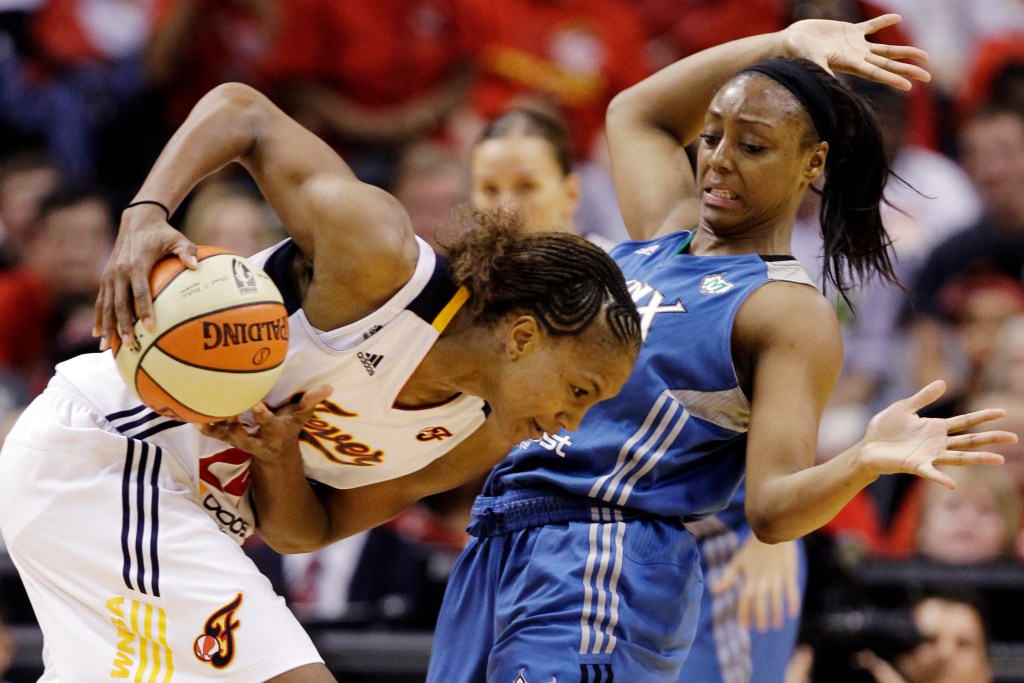 Indiana Fever forward Tamika Catchings (left) tries to make room as she is defended by Minnesota Lynx guard Monica Wright on Oct. 21, 2012, during Game 4 of the WNBA basketball Finals in Indianapolis. Credit: AP Photo/Michael Conroy
Moreover, there is no denying the synergy between Caitlin Clark of the Fever and Tyrese Haliburton of the Pacers, point guards and friends.
Clark has generated a surge in popularity of women’s basketball. Haliburton, recently voted the most overrated player in the NBA, was acquired by the Pacers in February 2022. All he has done since is take the Pacers from no playoffs in 2023 to the finals in 2025.
“This is a franchise that took a chance on me. … Sometimes I think they saw more in me than I saw in myself,” said Haliburton, who was 3 months old when the Pacers last went to the NBA Finals.
The Pacers are the biggest finals underdogs in seven years, with the Thunder given an 85% chance of becoming champions. We love our underdogs.
There was 1954 Milan, the inspiration for the movie “Hoosiers,” winning on Bobby Plump’s shot at then-Butler Fieldhouse. There was 2010 Butler, which came within Gordon Hayward’s half-court shot of beating Duke at Lucas Oil Stadium.
Now we have the Pacers, who started this season 10-15 and were in peril of missing the playoffs entirely. How unlikely are they?
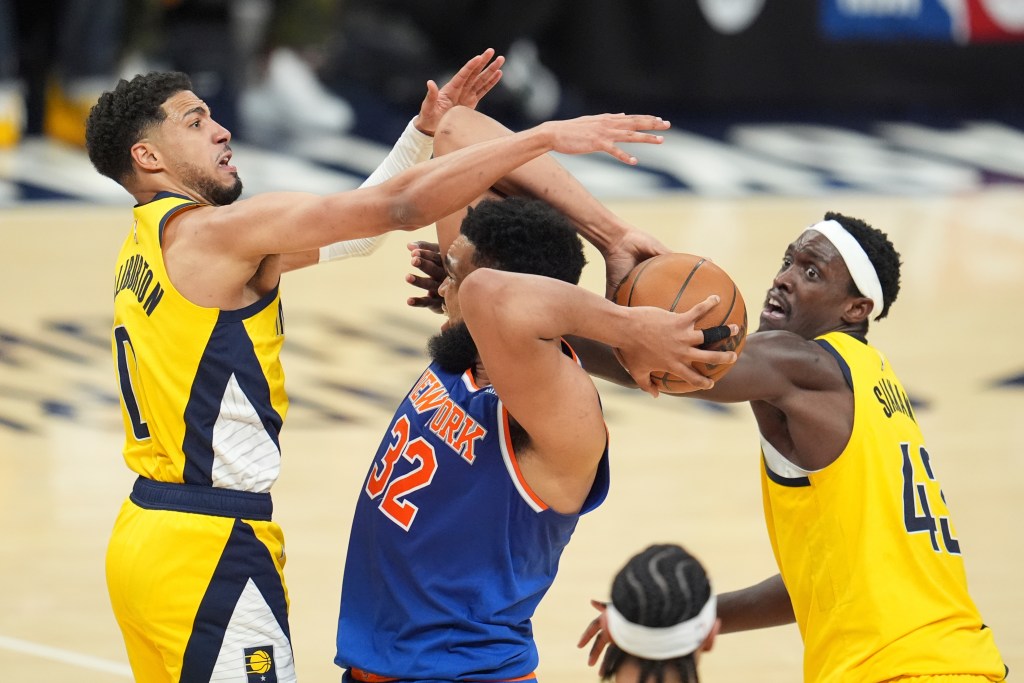 Indiana Pacers guard Tyrese Haliburton (0) and forward Pascal Siakam (43) defend against New York Knicks center Karl-Anthony Towns (32), May 31, 2025, during the first half of Game 6 of the Eastern Conference finals of the NBA basketball playoffs in Indianapolis. Credit: AP Photo/Michael Conroy
Besides Haliburton, the Pacers’ other key component is Pascal Siakam. The 31-year-old once studied to be a priest in his native Cameroon, didn’t play organized basketball until age 17 and eventually played for the Toronto Raptors’ NBA champions in 2019.
“I just love the fact that everyone stayed to the grind,” Siakam said. “That we stayed with the process . . . We just started to slowly build an identity. Once we built defense into who we were, it just took it to another level.”
Hoosiers who appreciate humility and community love this team. That goes from Bronx native Herb Simon, who bought the team with his brother in 1983 and is the longest-tenured owner in NBA history, to general manager Kevin Pritchard, to coach Rick Carlisle.
Teamwork was underscored when seven Pacers scored 10 or more points in a clinching 125-108 victory over the New York Knicks. Foremost among them was Thomas Bryant, a former Indiana University player who had been the biggest cheerleader on the bench. After not playing for two games, he scored 11 points in 13 minutes.
Myles Turner has been with the Pacers for 10 years, through four coaches and annual trade rumors.
“When the buzzer was sounding, it was nothing but joy,” Turner said. “All the years, all the hate, all the love, all the in-between just made sense in that moment.”
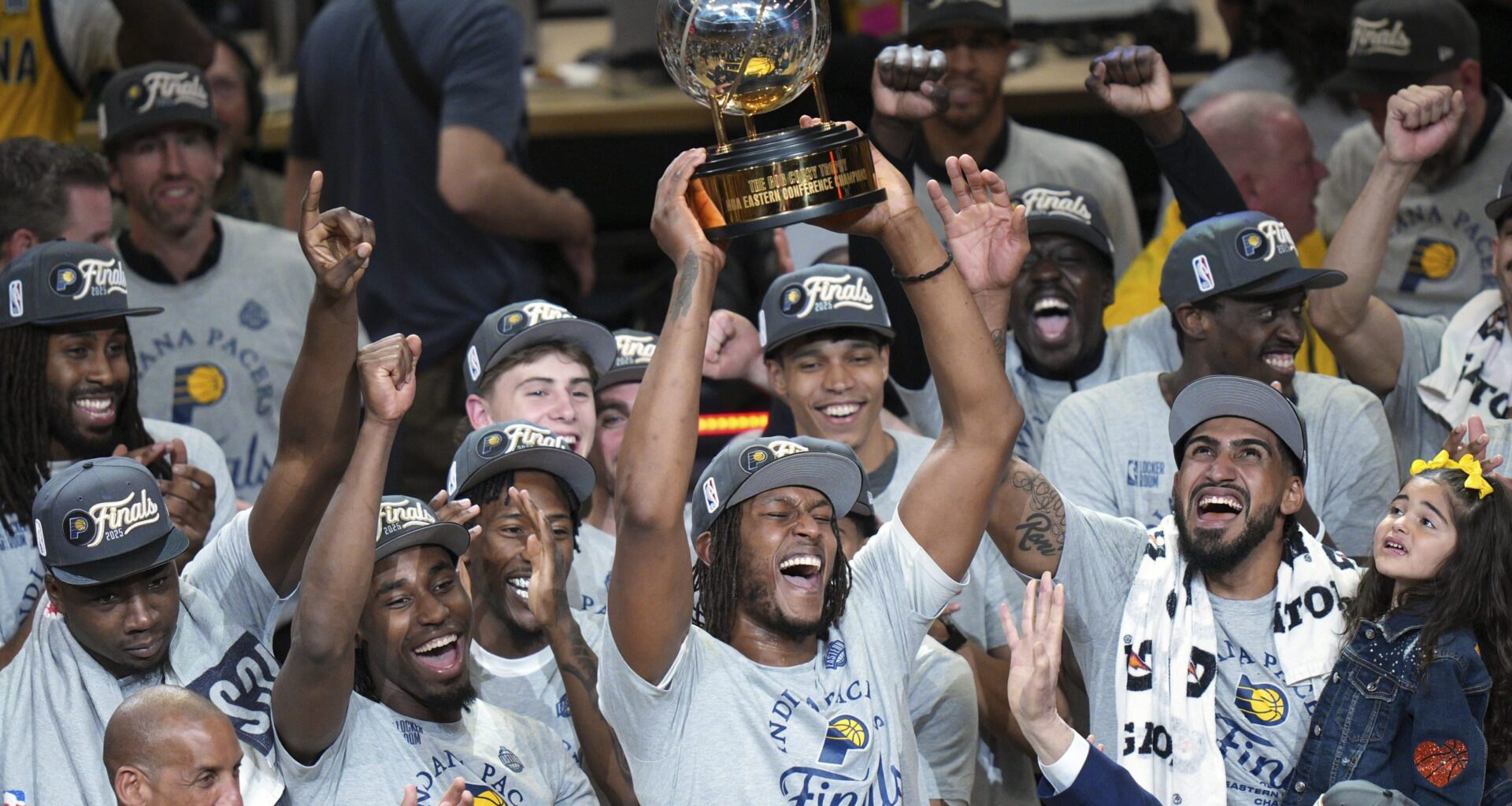
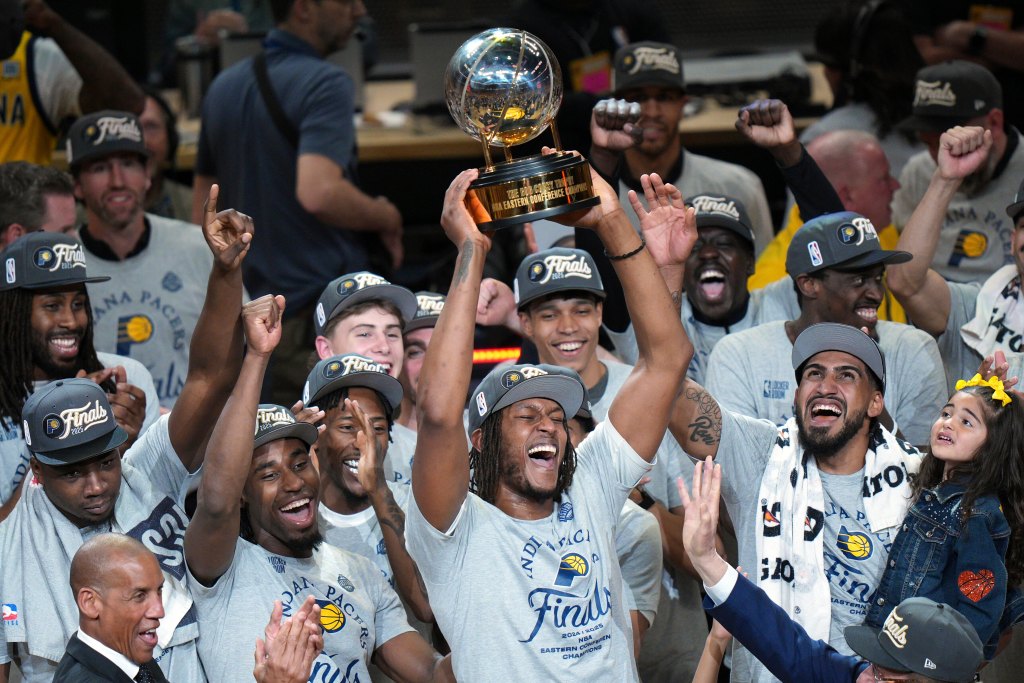 Indiana Pacers center Myles Turner holds the trophy as players celebrate May 31, 2025, after winning Game 6 of the Eastern Conference finals of the NBA basketball playoffs against the New York Knicks in Indianapolis. Credit: AP Photo/AJ Mast
There is sorrow, too, accompanying the Pacers’ run.
The franchise has lost Mel Simon, brother of the owner; Jim Morris, civic leader and Pacers executive; David Benner, media relations director; Bobby “Slick” Leonard, coach and broadcaster; and Hall-of-Fame players Roger Brown, Mel Daniels and George McGinnis.
All helped build the Pacers’ foundation.
Indianapolis has its theater, art, literary and food scenes, and, of course, the 500-mile race and Colts. There is no solitary symbol of basketball’s place in this cultural milieu.
How about looking up 10 feet and imagining a hoop and the sound of a bouncing ball? It is the stuff that Hoosier dreams are made of.
Mirror Indy, a nonprofit newsroom, is funded through grants and donations from individuals, foundations and organizations.
David Woods is a Mirror Indy freelance contributor. You can reach him at dwoods1411@gmail.com or follow him on X @DavidWoods007.
Related
Republish This Story

Republish our articles for free, online or in print, under a Creative Commons license.
Local news delivered straight to your inbox
Mirror Indy’s free newsletters are your daily dose of community-focused news stories.
By clicking Sign Up, you’re confirming that you agree with our Terms of Use.