
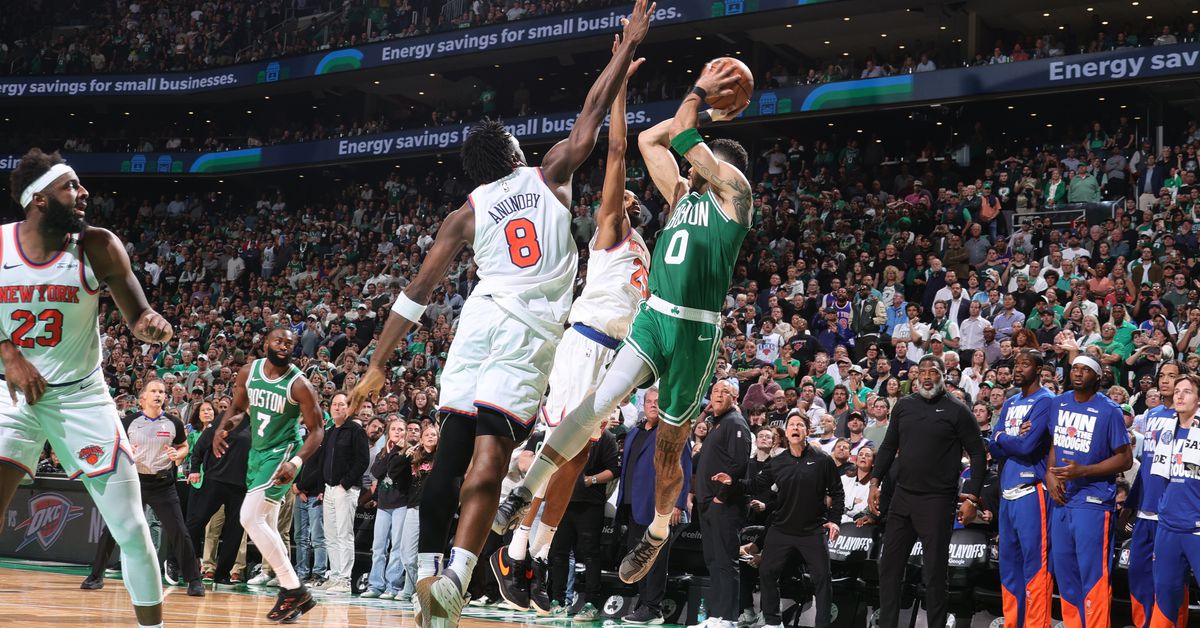
How would you have reacted if someone told you on Monday morning that the Knicks would be heading back to the one true Garden on Saturday with a 2-0 series lead?
What if they told you the Knicks were down by 20 in both games and won?
You’d probably be completely and totally stunned, as would I. The Knicks got dominated by the Celtics repeatedly in the regular season, were massive underdogs, and writers in this own blog were skeptical of how competitive they’d be.
As for the comebacks, they hadn’t come back from 20 down all season. The franchise’s largest postseason comeback was 18 in Game 6 of the 2000 East Semifinals against Miami. This doesn’t happen to us.
And yet, it did.
Between the two improbable victories, the media chose not to shower the Knicks with praise for their resilience but shame them for needing a horrific shooting night from Boston to get one win.
“I’ve never seen a Game 1 upset that means less. This is the only game the Knicks are going to win.”@ColinCowherd isn’t worried about the Celtics after their overtime loss to New York pic.twitter.com/HzWkDJn1lB
— Herd w/Colin Cowherd (@TheHerd) May 6, 2025
It’s not happening again. Who cares? The Celtics are the better team and they’ll turn it on. If a team shoots 60 threes, they can’t possibly miss that many again!
In their series opening loss to the Knicks, the Celtics attempted and missed more 3’s than any team ever has in a playoff game. That’s bad news for New York https://t.co/Tli42307Tm
— Michael Pina (@MichaelVPina) May 6, 2025
Look! NBA.com’s stat page says Boston had almost all of their attempts as open or wide open. The Knicks will get an avalanche of threes dropped on their heads soon enough.
NBA tracking scored 56 of Boston’s 60 3-pointers as open or better (4+ feet of space from nearest defender)
Celtics shot 29.2% (7-24) on wide-open 3s, down from 40.7% on those shots in regular season.
Celtics shot 21.9% (7-32) on open 3s, down from 35% in regular season. pic.twitter.com/8KJNkAN6lr
— Chris Forsberg (@ChrisForsberg_) May 6, 2025
Today, we’re gathered to see if Boston truly had almost all of their threes as good looks.
After Game 1, I went back and watched all sixty three-point attempts by the Boston Celtics. After a similarly bad shooting performance in Game 2, I decided to do the same. I have placed these shots into four labels, which are not as cut-and-dry as the NBA site makes it. My loose criteria is as follows:
Great: Wide open look, feet are set, great shooter or good shooter for location.
Good: Wide open look for decent/ok shooter, semi-open look for good shooters with enough separation.
Decent: Moving threes/in-rhythm looks by good shooters, ill-advised but solid shots by decent shooters.
Bad: Terrible shot, not enough separation, desperate heave, bad shooter spotting up, guy whose bad at non-C&S pulling up.
This very incomplete table allowed for some judgement calls. I’m sure if I put every one of Boston’s 100 3PA in here, I’d get called out for inconsistencies.
Nevertheless, let’s go.
In Game 1, the distribution was as follows:
Great: 6-15 (40%)
Good: 5-22 (22.7%)
Decent: 2-13 (15.4%)
Bad: 1-10 (10%)
37 of Boston’s 60 threes were at least good, which isn’t bad. They made 40% of their great looks, but was horrid from beyond that point.
To give you an idea of what is classified as what, I’ll give examples.
Derrick White is a great three-point shooter. He’s wide open at the top of the key. This is a textbook great look.
This is what people will consider a wide open three. Yet, I have this labeled as only a good look. Why? Jaylen Brown shot 32.6% from 3 in 2024-25. He shot 29.2% on pull-ups and 29.6% above the break. It doesn’t matter how open you are, this isn’t any better than a Josh Hart attempt.
Sorry to pick on Jaylen Brown but cmon. This is decent. Brown has space, but he’s again not a great shooter and is deeper than a normal three. If Pritchard shot this, it’s good.
This was a bad look. A fadeaway from a bad shooter in a desperation play. Easy call.
For Boston, their best stretch of getting quality looks was, unsurprisingly, the stretch where they bludgeoned the Knicks late in the second and early in the third. They ran Horford pick-and-pop, got Pritchard open in the corner, and gave White the ball with room to shoot repeatedly.
As the fourth hit, the shot quality got worse. Notably, Brown and Tatum started taking some bizarre shots.
I gave this a bad rating. Why? Tatum is shooting 32.9% on pull-ups and he’s pulling up with limited space against a center with a long reach. He shot so many of these despite so many mismatches. He shot 52.6% on pull-up triples against the Knicks in the regular season and that confidence might’ve costed Boston an entire game.
You’re 6’10” with Jalen Brunson guarding you and seven to shoot. What are you doing? It’s not Jrue Holiday guarding you!
Let’s move onto Game 2. Boston only took 40 threes, but were they better looks?
Jrue Holiday does have space here, but he’s shot just 27% on stepback threes. At best, this is a decent look.
I’ve said it before. Why the hell is Jayson Tatum not attacking? You have the mismatch on Towns and there’s nobody in the paint.
This is one of the only flat-out bad looks I found and it’s not really Boston’s fault, it’s the situation. That said, what is this play off an inbound? Brown shooting a deep stepback 3 on Mitchell Robinson?
You want to know why the Knicks came back? Guys took shots like these. 34 feet away? It’s a playoff game!
The Celtics were shooting over 50% on “great” looks until the infamous fourth. Al Horford, who has been an ageless wonder for the Celtics, was possibly the biggest culprit of missing wide open looks. These are shots I groaned loudly seeing live and he kept missing them.
This is a rare time I’m using context. On paper, this is a great look. However, Tatum has been awful from 3 this series, has a wide open Horford down low after Brunson fell, AND has a wide open lane. This is decent, at best. Terrible situational awareness.
Ultimately, it graded out like this:
Great: 6-15 (40%)
Good: 4-12 (33.3%)
Decent: 1-12 (8.3%)
Bad: 0-1 (0%)
They aren’t even shooting bad on the truly great looks. After two games, the combined numbers look like this:
Great: 12-30 (40%)
Good: 9-34 (26.5%)
Decent: 3-25 (12%)
Bad: 1-11 (9.1%)
So, the verdict is that Boston is probably due for better shooting down the road, but the amount of truly wide open looks they’ve gotten is deceiving.
Just for fun, here’s what the Knicks’ numbers look like:
Great: 10-14 (71.4%)
Good: 11-27 (40.7%)
Decent: 2-17 (11.8%)
Bad: 0-6 (0%)
The Knick haven’t generated as many looks, but they’re choosing quality over quantity. That said, those decent looks have some room for improvement.