
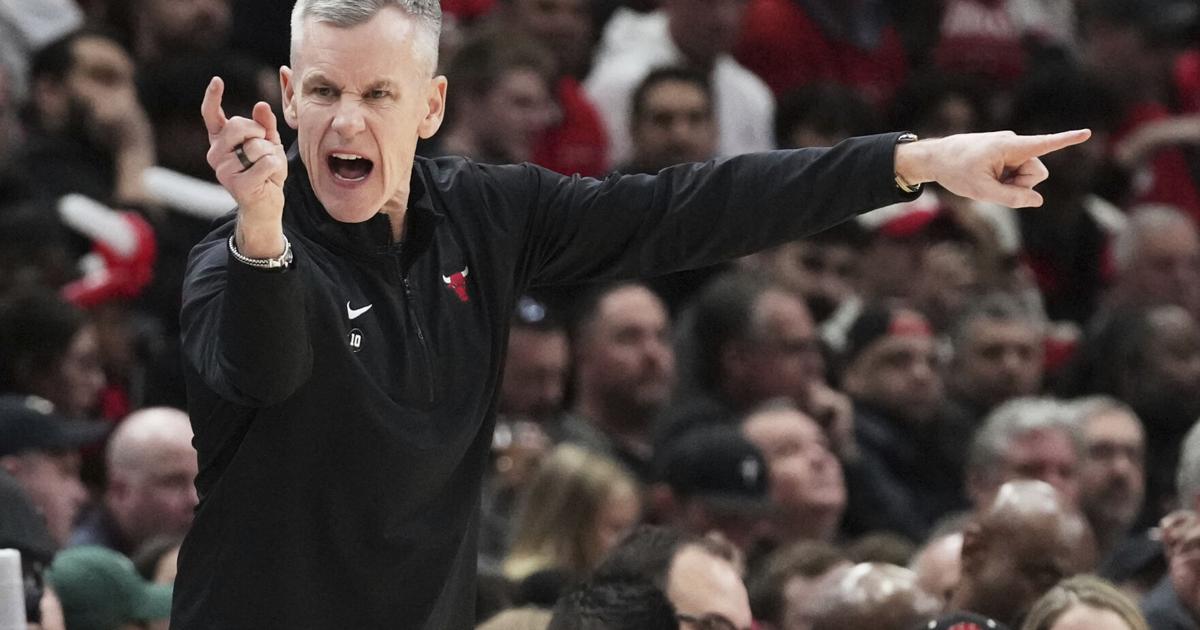
ESPN has reported that Chicago Bulls coach Billy Donovan has signed a multi-year contract extension. I can report that Donovan’s five-year record with the Bulls is 195-205, plus a 1-4 record in the playoffs, having lost a first-round series to the Milwaukee Bucks in 2022.
Do you think Donovan wishes in his heart of hearts that he had stayed with the Thunder?

Chicago head coach Billy Donovan has signed a multi-year contract extension to stay with the Bulls.
Nam Y. Huh, Associated Press
In 2020, Donovan’s contract with the Thunder ended, and he was hired on by the Chicago Bulls.
Here’s what we know and don’t know about that transition.
We know Donovan wasn’t crazy about a Thunder rebuild, a project which successor Mark Daigneault gladly took on and has done wonders with.
We don’t know if the Thunder brass was glad to see Donovan go, though it seems likely that Clay Bennett and Sam Presti weren’t hip on paying Donovan the $5 million per year or so it had been paying their coach. Why spend that kind of money on a coach during a tanking period, especially when that coach wasn’t all-in on the rebuild with younger players?
People are also reading…
We don’t know the percentage of the departure, how much was “why don’t you look for another job before we talk contract extension?” and how much was “I think I’ll look for another job before we talk contract extension.”
But this we know. The move turned out great for the Thunder. Daigneault was the 2024 NBA coach of the year and now is an NBA championship coach. He’s a communicator of the highest order, seems like a fine strategist and is beloved and respected by his ballplayers.
Did it turn out well for Donovan? Well, Chicago has been a good landing spot. The Bulls are a patient franchise under general manager Arturas Karnisovas and owner Jerry Reinsdorf.
When Donovan begins the 2025-26 season, his sixth in Chicago, he becomes the third-longest-tenured Bulls coach, trailing only Chicago icons Dick Motta (1969-76) and Phil Jackson (1990-98). These Bulls don’t like to fire a coach with years left on his contract, and they apparently don’t like to start over, content to let Donovan keep coaching what has become a perennial mediocre franchise.
The Wednesday ScissorTales salute Deion Sanders, let a reader say his piece about Brent Venables’ job security and listen to Kansas State coach Chris Klieman’s theory on the College Football Playoff. But we start with Donovan’s contract extension and how the NBA landscape could have been different.
If Donovan had stayed, there is no assurance that the Thunder script would have remained the same.
Donovan was slow to play young players, though in his defense, the Thunder always was in playoff races. Still, more Jerami Grant, less Carmelo Anthony, would have been nice in 2018. More Nerlens Noel, less Markieff Morris in 2019.
Would Donovan have shepherded this version of Thunder U. the way Daigneault has? Hard to see it, though let’s give Donovan credit. Year 1 of Shai Gilgeous-Alexander and Luguentz Dort in OKC came under Donovan’s watch.
Donovan isn’t the first Oklahoma-based coach to walk away from a good job.
In 1973, Chuck Fairbanks left perhaps the most star-studded OU football roster ever and took the New England Patriots job. Fairbanks did a fine job in Foxborough, but he was 22-2 his last two years with the Sooners and there’s no reason to think he wouldn’t have been 55-5 over the next five years.
Lincoln Riley left the Sooners after the 2021 season, and things haven’t gone swimmingly for Southern Cal or OU since then. Does Riley regret leaving? I’m guessing no.
Dave Smith left Oklahoma State football for Southern Methodist after a 6-5 1972 season. The Cowboy program was another decade from taking off, but Smith was fired by SMU after three years, a 16-15-2 record and recruiting scandals. He probably would have been better off staying in Stillwater.
Jimmy Johnson left OSU after the 1983 season. He was good in Stillwater. He was great with Miami U. and the Dallas Cowboys.
Same with Les Miles, who left OSU after the 2004 season and won a national championship with Louisiana State. Sure, Miles eventually got fired at LSU, but you know that goes with the job in Baton Rouge.
The University of Tulsa football coaches that have left of their own volition got pay raises and a spot in a major conference. F.A. Dry to Texas Christian in 1977, John Cooper to Arizona State in 1985, Don Morton to Wisconsin in 1987, Steve Kragthorpe to Louisville in 2007 and Todd Graham to Pittsburgh in 2011. Relatively easy decisions.
Seemed like an easy decision for Donovan five years ago. We’ll let Donovan say whether it turned out well for him. We know it turned out well for the Thunder.
Oklahoma head coach Brent Venables looks across the field during the Crimson Combine on April 12 in Norman.
Daniel Shular, Tulsa World Archive
Mailbag: Brent Venables’ future
The future of Venables is a constant part of this Oklahoma summer.
Mike: “I don’t see the narrative of Brent Venables on the hot seat being based on facts or reality. Who knows what happens with a new AD, but I can’t see a change happening this year unless the bottom falls out. There appears to be a great proactive system in place to utilize NIL (paying players) and transfer portal and future recruiting at OU, given the people they have hired in those positions. With money at a premium, the math and common sense doesn’t work on paying a huge buyout to fire a really good, well-liked, competent coach, then pay at least that amount to hire another coach and a whole new staff and still have money to use for NIL to replace all the players that leave. Your program goes from third base back to first. I also don’t think you can assign a number to how many games he has to win to save his job. It’s not that simple.”
Berry: I agree. The money is a huge obstacle in trying to fire Venables. However, I do think a 6-6 (or worse) record would be quite problematic for keeping Venables, no matter the financial costs, so never say never and rarely say rarely. But if the Sooners post a 7-5 or better record, I think Venables is safe. And I think 7-5 (or better) is quite likely.
North Dakota State head coach Chris Klieman and his players hoist the championship trophy after beating Eastern Washington 38-24 in the NCAA FCS championship game, on Jan. 5, 2019.
Jeffrey McWhorter, Associated Press file
Klieman supports 16-team playoff
Kansas State’s Chris Klieman supports a 16-team College Football Playoff, and Klieman’s voice should carry more weight than most. Klieman has participated in a 16-team college football playoff.
As player, graduate assistant or assistant coach at Northern Iowa, Klieman was involved in seven 16-team brackets. With the CFP considering an expansion from 12 to 16 teams, Klieman is uniquely qualified to offer his opinion.
“Yeah, I think a perfect landing spot would be 16, and how we get to that I’m not quite sure,” Klieman said. “But I think it would be 16, and I would eliminate the byes. Everybody should play the same amount of games.”
Some CFP models have suggested early-round byes. Some even have suggested double byes, like we see in the 16-team conference basketball tournaments. But a pure bracket would be much simpler.
“Shoot, you had to win four straight weekends, so the best team would truly get to be crowned,” said Klieman.
Klieman’s Northern Iowa teams never won the Division I-AA title, but he was head coach at North Dakota State from 2014-18, and his Bison won four national titles in five seasons, though the bracket had expanded to 24 teams by then.
“I’d like it to get to 16,” Klieman said. “I know the wear and tear on the athletes is real. I don’t think we help that at all by knocking the roster size down (to 105 maximum). I don’t think that was a good move at all, but control what you can control … I’m excited about what I was able to watch last year of the playoff and the potential expansion here in another year.”
Colorado head coach Deion Sanders, center, speaks about beating bladder cancer during a news conference Monday.
AAron Ontiveroz, The Denver Post via AP
Deion provides a public service
Deion Sanders always finds the spotlight. Sometimes, that’s not a bad thing.
Deion used the spotlight Monday for the best of reasons — to illuminate the need for people to seek early detection of cancer. The Colorado football coach staged a campus press conference
Monday to announce that he has had successful surgery to remove a cancerous bladder and that he now is cancer-free.
And Deion said he hopes his humor and humanity in describing his health will help those who face the same health issues.
“I can’t pee like I used to,’’ Sanders said with a laugh. “I depend on Depends. I’m making a joke out of it, but it is real. It is real. It is real. If you see a port-a-potty on the sideline, it is real, I’m just telling you. You’re going to see one at practice, on the sideline (for games).”
Bladder problems cause all kinds of people, particularly men, a great deal of embarrassment. When a man of Deion’s status, a Pro Football Hall of Famer, a businessman deluxe, a football coach who has revived Colorado’s fortunes, talks comfortably about such unpleasantries in public, it can’t help but counter some of the stigma.
Deion’s press conference was a public service.
Deion said he has lost 25 pounds. But he gained much respect and admirers.
Deion said the cancer was detected during a checkup of his legs, which have gone through a variety of problems, including a couple of toe amputations.
“Get checked out, get checked out,’’ Sanders said. “It could have been a whole other kind of gathering if I didn’t. … Everyone knows someone who is affected or infected by the ‘C’ word.’’
Monday, that word was courageous.
The List: MLB & NFL combo
Bud Grant, the Minnesota Vikings coaching legend, is believed to be the only player to ever compete in both the NBA and the National Football League. In the Tuesday ScissorTales, we listed the 12 men who played in both the NBA and Major League Baseball. But approximately 67 players have played in both MLB and the NFL. Here are the 12 most prominent:
1. Deion Sanders: Pro Football Hall of Famer, and a way better baseball player than you remember. Deion played parts of nine seasons (1989-2001) and had 2,123 at-bats. He hit 14 triples in 1992 and 43 for his career. That’s about one every 49 at-bats.
Los Angeles Raiders running back Bo Jackson takes a breath on the bench after a 91-yard touchdown run in a Monday Night Football game against the Seattle Seahawks on Nov. 30, 1987. Jackson had 122 yards in the first half of the game.
Robert Kaiser, Associated Press File
2. Bo Jackson: College Football Hall of Famer, and a baseball all-star in 1989. Jackson had a much shorter NFL career than did Deion and a similar baseball career, eight MLB seasons and 141 home runs over 2,323 at-bats.
3. Brian Jordan: Played three seasons with the NFL Falcons, starting 30 games at safety, then jumped to baseball and spent 15 years in the majors, playing 1,456 games and hitting 184 home runs.
4. Jim Thorpe: The NFL’s first star and the patron saint of the Pro Football Hall of Fame. But before that, the Oklahoma native played six MLB seasons, hitting .252 from 1913-19 in 698 at-bats.
5. Ace Parker: An NFL star with the Brooklyn Dodgers as a single-wing tailback (quarterback, 1937-41), Parker made the Pro Football Hall of Fame. He also had 207 at-bats for the 1937-38 Philadelphia Athletics.
6. Ernie Nevers: An NFL fullback star from 1926-31, Nevers made the Pro Football Hall of Fame. He also pitched in 44 games for the St. Louis Browns (1926-28).
7. Paddy Driscoll: A Chicago institution. Driscoll had 28 at-bats for the 1917 Cubs, then played 10 NFL seasons with the Bears and the Chicago Cardinals. He made the Pro Football Hall of Fame.
8. Red Badgro: A football Hall of Fame end for the New York Yankees and New York Giants, 1927-36, Badgro also found time for 382 at-bats for the 1929-30 St. Louis Browns.
9. George Halas: Yep, that George Halas. The patriarch of the Chicago Bears, who helped found the NFL, played 104 games for his beloved franchise. Halas had 22 at-bats for the 1919 Yankees.
10. Vic Janowicz: The 1950 Heisman Trophy winner from Ohio State had 196 at-bats for the 1953-54 Pittsburgh Pirates and played 22 NFL games for the 1954-55 Washington Redskins.
11. Chad Hutchison: Played three games for the 2001 St. Louis Cardinals, then had a 2-7 record as the starting quarterback for the 2002 Dallas Cowboys.
12. Drew Henson: Henson started a game at quarterback for the 2004 Dallas Cowboys and had nine at-bats for the 2002-03 Yankees.