
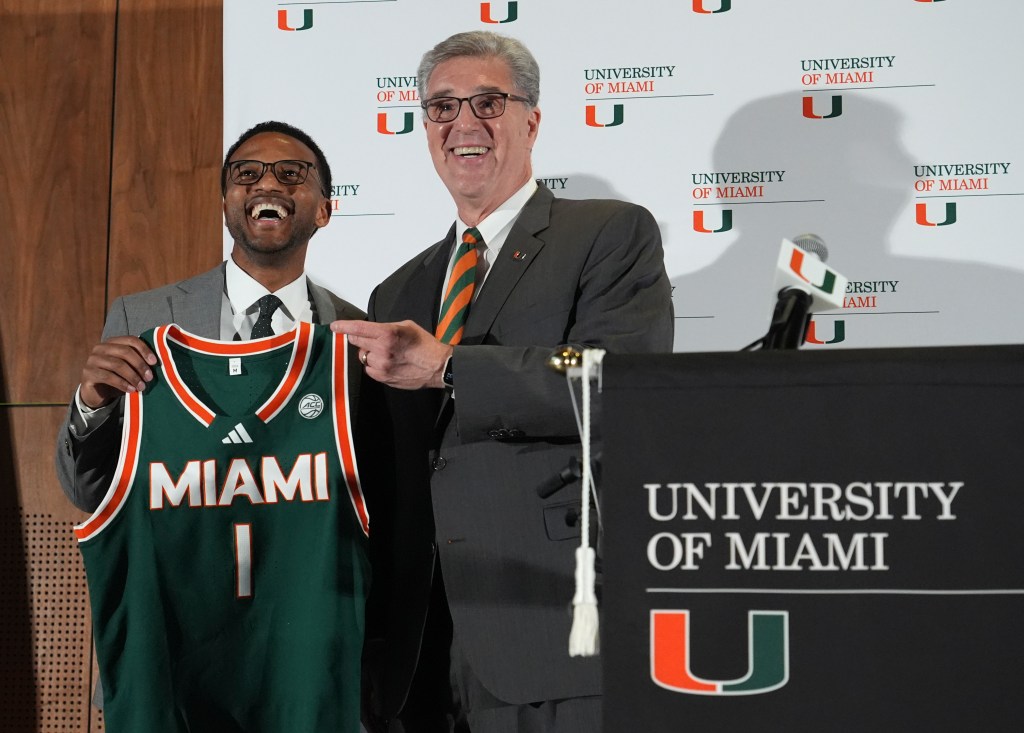
CORAL GABLES — When Miami basketball coach Jim Larrañaga announced his retirement last December, he cited a moment after the team reached its first-ever Final Four when eight players told him they planned to enter the transfer portal so they could make more money.
Larrañaga said it “shocked (him) beyond belief.”
“I said, ‘Don’t you like it here?’” Larrañaga said. “(They said), ‘No, I love it. I love Miami. It’s great.’ But the opportunity to make money someplace else created a situation that you have to begin to ask yourself, as a coach, what is this all about? And the answer is it’s become professional.”
Since Larrañaga stepped down and UM brought in Jai Lucas to replace him, college sports have only become more professionalized. As of July 1, colleges can pay athletes directly for the first time under the rules of the House vs. NCAA settlement. Schools are currently capped at $20.5 million to pay athletes in all of their sports programs.
Miami, like most other Division I programs, will likely allocate most of that money to football. In a letter to fans on July 1, UM athletic director Dan Radakovich said Miami’s football, men’s basketball, women’s basketball, baseball, soccer, volleyball, women’s tennis and women’s track and field programs will all get a cut of the revenue-sharing money. He did not say how the money will be divided.
“The last five to 10 years have been a big learning curve for every coach every year,” Hurricanes women’s basketball coach Tricia Cullop said Wednesday. “So you feel like every year you’ve got new little elements that you’re throwing into your job that you’ve got to learn on the fly. And so I think if you look at — a lot of professions are like this — but we’ve had to be very flexible and learn how to adapt quickly in order to use it as our advantage.
“The one thing I love about Miami is that we care. We care about our sports, and so Dan and (Deputy AD Rachelle Paul), my two administrators, are working hard to make sure that we have what we need in order to recruit.”
Cullop said revenue-sharing money comes up on the recruiting trail “constantly.”
“I’ll be honest, I checked the news more probably in the past year than I ever have about this, and tried to talk to a lot of colleagues about what’s happening,” Cullop said. “Because, obviously, there’s different interpretations across the country sometimes. And so we have discussions with our administration about what we’re hearing, and then they clear it up for us when we get back.”
The latest changes came last week when the new College Sports Commission and the plaintiffs’ lawyers in the House settlement came to an agreement on how to handle NIL deals from schools’ collectives. Money from NIL deals is not part of the revenue-sharing cap, and originally, there were going to be strict rules separating collectives’ NIL deals from other companies’ NIL deals in order to prevent collectives from giving out pay-for-play contracts.
Now collectives are again free to offer players NIL deals.
“It’s all still kind of fluid and just kind of figuring out initially on the front end, you were able to do some of the collective stuff and a little bit more of that,” new Hurricanes men’s basketball coach Jai Lucas said Wednesday. “But moving forward, it’s just all up to the NCAA and the NILgo (platform for approving NIL deals) and what they claim passes or not. … So it all depends on that, but we’ll kind of operate as normal.”
Lucas, who has been constructing his first roster at UM, said he and his staff will have to adjust to the new realities of college sports, but if faced with situations where players only want to play for the Hurricanes for the money, that might be a player he is OK with letting go.
“Nowadays you have agents, and agents are the main factors in college basketball right now,” Lucas said. “So the kid might not say something, but after the meeting, you’re going to get a call, and that’s just … where we are. So we have to deal with it. We have to adapt to it, and we’ve got to figure out how can we be the best.
“Part of what I was saying is how can we build strong enough relationships and show (players) how important their development is to us where there is some type of connection to us and the program, instead of to just a financial situation. If it’s just a financial situation, then most of the time it’s not going to be kids we want in the program.”
Originally Published: July 30, 2025 at 10:11 AM EDT