
Michael Shearer
| Hoops Hype
Professional athletes, no matter how great, rarely get to dictate their own denouement.
Age and injuries take a toll. Cheaper, younger labor knocks ever more insistently upon the front door. Past performance starts to pale in comparison to others’ potential. Many basketball players don’t retire; they get retired.
But that doesn’t mean that everyone goes out with a whimper. The 2025-26 season might be the last for living legends like LeBron James, Chris Paul, or Russell Westbrook. In honor of the future retirees, the crack staff at HoopsHype has compiled the 12 greatest final seasons in the NBA, pulled from every era (and then they made the mistake of asking me to write about them!). Two of them I’ve lumped together for reasons that will become obvious, so let’s start with a certain familiar name at #11.
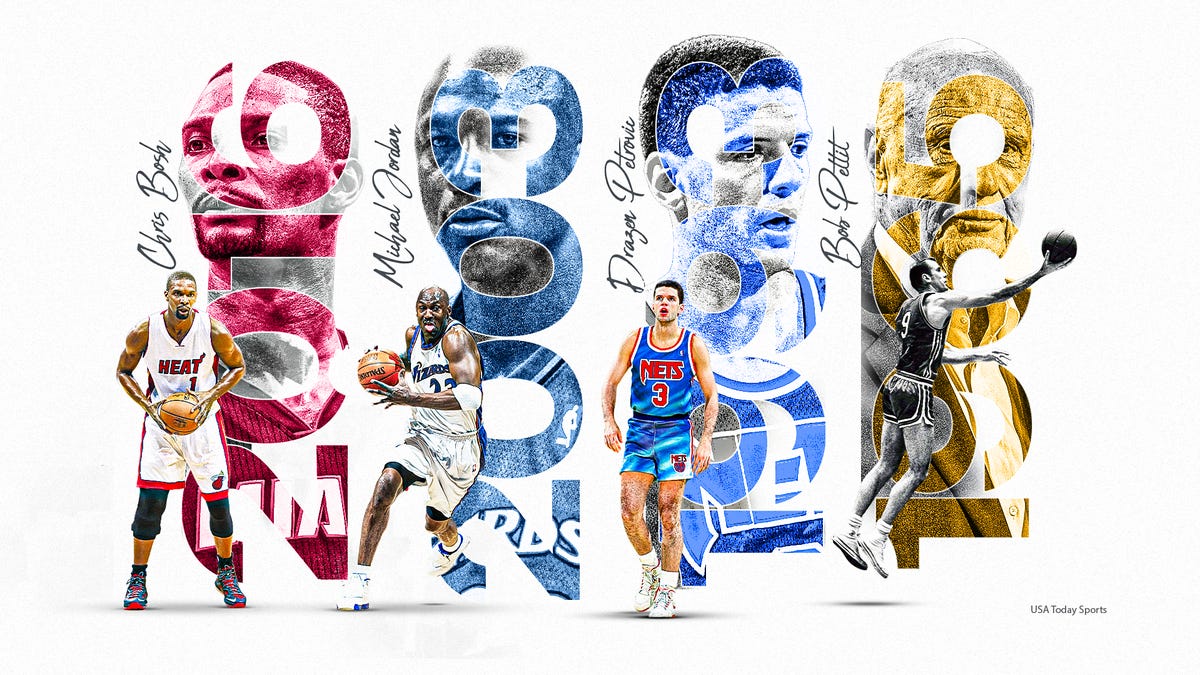
12. Michael Jordan, 2002-03
Final season: 20.0ppg, 6.1 rpg, 3.8 apg, All-Star
Jordan famously retired not once, not twice, but three times; for the sake of this article, we’re only talking about his actual final season. His last two seasons came with the Washington Wizards and are commonly ignored at best or regarded as a joke at worst, but that does a disservice to the output Jordan provided for a Wizards team with little talent around him.
Jordan put up 20 points in his final season and made the All-Star team at the tender age of 39. He cracked 40 points three separate times and played in all 82 games while dragging around a knee he had busted up in his first Wizards season. Nobody mashed the turnaround jumper button harder.
And he did all that despite a Wizards team that featured exactly one player who shot more than 35 percent from three: Larry Hughes, who averaged 1.2 attempts per game. Even for an era that placed far less emphasis on the three-pointer, every Wizards’ halfcourt possession was extraordinarily clogged.
2003 was Jordan’s retirement tour, and he received numerous tributes (the most infamous of which was the Miami Heat retiring his number 23 despite the fact that Jordan never played in South Beach).
11. Chris Bosh, 2015-16
Final season: 19.1 ppg, 7.4 rpg, 2.4 apg, All-Star
Chris Bosh was a perpetual All-Star for the Toronto Raptors and Miami Heat. He was the third wheel in the Heatles, a criminally underrated two-way force who exhibited unicorn tendencies well before that was a thing. Bosh also had an assisting role in arguably the biggest shot in NBA history.
Bosh’s final campaign came at the young age of 31, when he developed blood clots that led to a pulmonary embolism (meaning the blockages traveled to his lungs). This is a worst-case scenario for deep-vein thrombosis (DVT), which recently afflicted such NBA players as Ausar Thompson, Victor Wembanyama, and Damian Lillard.
Bosh had been averaging nearly 20 points per game and made the All-Star game, leading a deep Miami team featuring a still-effective Dwyane Wade and Goran Dragic. Even without Bosh’s services, Miami finished third in the conference and lost in seven games in the second round. With him, they almost certainly would have made at least the conference finals.
Pulmonary embolisms are life-threatening and require severely restricted exercise for many months after diagnosis, among other treatments. Bosh worked on returning to the NBA for years. Sadly, despite Bosh’s efforts, none of the many doctors he solicited opinions from granted Bosh clearance to return to play.
It was a devastating story at the time, but perhaps it was for the best. Bosh is alive and well. Sadly, we’ll see later in this list what can happen when basketball pushes people beyond their limits.
10. Dave DeBusschere, 1973-74
Final season: 18.1ppg, 10.7rpg, 3.6 apg, All-Star, All-Defensive 1st Team
DeBusschere was a Hall of Famer who starred for Detroit and New York in the 1960s and 1970s, winning two titles with the Knicks. He was a voracious rebounder, silky jump-shooter (especially for a big man), and extraordinary, physical defender. Here’s a doozy: The NBA didn’t have All-Defensive teams until the 1968-69 season; DeBusschere made 1stTeam every year from the award’s inception until his retirement six seasons later.
DeBusschere had a funny career arc; he didn’t make an All-Star Game until his fourth season and didn’t make the All-Star in his only All-NBA season (Rudy Gobert can commiserate). He also only received MVP votes three times – in his last three seasons!
DeBusschere’s final campaign was his best from a statistical standpoint, and he’s one of the very few guys who could legitimately claim to have retired at the top of his game.
9. Reggie Lewis, 1992-93
Final season: 20.8 ppg, 4.3 rpg, 3.7 apg
Lewis was just 27 years old when he died of heart failure. His death came just a few months after he collapsed onto the parquet during a Boston Celtics playoff game. Lewis was originally diagnosed with focal cardiomyopathy and told his condition was career-ending. However, like with Bosh, he looked around for other opinions and was eventually diagnosed by a different doctor with a less severe form of heart disease.
It was much disputed in the public opinion and the courtroom what happened next and whether Lewis was truly given clearance to continue basketball activities, but he certainly thought he’d been cleared to play. Lewis suffered a fatal cardiac event during a pickup game while preparing for the 1993-94 season.
The death shocked the basketball world. The aftermath was a gross, muddled mix of CYA actions, anger, and vindictiveness that requires far more context than I can provide here (except for one pertinent example: league owners voted not to allow the Celtics to remove Lewis’ remaining salary from the salary cap, something that was rectified in future collective bargaining agreements and aided the Heat with Bosh’s situation).For Celtics fans – for fans of basketball in general – the rising stars’ death will always be a massive what-if.
8. Larry Bird, 1991-92
Final season: 20.2 ppg, 9.6 rpg, 6.8 apg, All-Star
Bird’s final season was cut short by back injuries, but even as a limping, 35-year-old stiff, Bird’s offensive gifts were undeniable. He still averaged 20/10/7 while shooting nearly 41 percent from deep, receiving a smattering of MVP votes while co-leading the Celtics along with Reggie Lewis to a first-place finish in the Atlantic.
Sadly, Bird’s body failed him in the playoffs, and he quit the NBA in frustration. There was no magical comeback, no farewell tour. It was (as it so often is) simply a preternaturally gifted great accepting that even All-Timers can’t beat Father Time himself.
7. Drazen Petrovic, 1992-93
Final season: 22.3ppg, 2.7 rpg, 3.5apg, All-NBA 3rd Team
Petrovic is another tragic story. The cocky Croatian was one of the greatest shooters of the early ‘90s (and if you asked him, no one else was in the conversation!) before a trucker lost control and crashed into the car he was riding in, killing Petrovic.
It took the feisty shooting guard a season or two to find his footing after coming to the NBA from overseas, but there was no stopping him once he did. Petrović was 3rd Team All-NBA in 1992-93, shooting an astonishing 45 percent from deep and 52 percent from the field despite standing just 6-foot-5 in shoes.
Despite his brief NBA career, Petrovic remains an icon in Europe (particularly his home country). His trash-talk and toughness stood in stark contrast to the stereotypes Americans expected of European players at the time, and Petrovic backed it up on the court every chance he got.
6. Bill Russell, 1968-69
Final season: 9.9 ppg, 19.3 rpg, 4.9 apg, All-Star, All-Defensive 1st Team, NBA champion
Bill Russell is the ultimate results vs. stats guy. Certainly, his low-40s field goal percentage and paltry scoring numbers from his final season don’t jump off the page. But even at 34 years old and in his final season, Russell was the unquestioned leader of a Celtics team that inevitably won yet another NBA Finals.
Don’t take it from me; Russell finished fourth in MVP voting (which was decided upon by his peers, not the media) despite not cracking double digits in scoring, even notching 11 first-place votes! It’s only fitting he earned himself one more trophy before he hung up his sneakers.
Oh, and by the way? He did all that as a player-coach.
Russell’s retirement shocked the sports world, particularly the Celtics (tension between Russell and the city of Boston lasted for years), but there was simply nothing left for him to do in basketball. Mission accomplished.
5. Maurice Stokes, 1957-58
Final season: 16.9ppg, 18.1r ppg, 6.4 apg, All-Star, All-NBA 2nd Team
Stokes played just three seasons before a devastating head injury resulting from an on-court fall resulted in paralysis. The athletic forward was a superstar from his first day, leading the league in rebounding as a rookie and coming in fifth in MVP voting in his third and final year (when he was also third in the league in assists as a 6-foot-7 power forward).
Longtime Bulls reporter Sam Smith once wrote, “Hall of Famer Wayne Embry, a teammate, said he always used to tell Bill Russell the Celtics wouldn’t have half the titles they did if Stokes hadn’t been disabled.”
Stokes’ legacy is best remembered thanks to his unique, racial-divide-crossing relationship with teammate Jack Twyman. Twyman, a Hall of Famer in his own right, became the legal guardian of Stokes despite having a full-time job in addition to basketball (as well as a family). He arranged fundraisers to pay for Stokes’ medical support in a time when the league had no healthcare plan, visited him every day in his long-term care facility, and even helped with his physical therapy.
The Twyman-Stokes Teammate of the Year award has been an official NBA award since the 2012-13 season.
4. Wilt Chamberlain, 1972-73
Final season: 13.2 ppg, 18.6 rpg, 4.5 apg, All-Star, All-Defensive 1st Team
Chamberlain was the Babe Ruth of baseball, a larger-than-life figure whose statistical accomplishments will never be surmounted.
Chamberlain’s many exploits (on and off the court) boggle the mind. It’s inconceivable for someone today to average 50 points or 26 rebounds per game, much less simultaneously. The inability to wrap one’s gray matter around what Chamberlain accomplished, along with the fact that he “only” won two championships compared to Russell’s billion, makes it easy to dismiss Chamberlain as something other than a basketball player, some weird glitch in the matrix to be acknowledged but rushed past. It’s hard to appreciate what isn’t understood.
That is wildly unfair, peppered by the sense that Chamberlain simply didn’t “want” it enough compared to his less-talented but more successful peer. Perhaps that’s true, but the same has been said of Shaquille O’Neal, and he’s somehow managed to take that rep and turn it into a “Most Dominant Ever” label. Chamberlain has never won the PR battle like that.
He’s also never been appreciated for changing his game toward the end of his career. An underrated defender in his prime, Chamberlain became an absolute monster on that end after joining the Lakers at the end of the 60s, taking a (relative) backseat on offense to focus on swatting shots and rebounding.
His last season saw him score a career-low 13.2 points, but he led the league in rebounding for the 11th time and field goal percentage for the ninth time. Despite his lower scoring totals, Chamberlain managed a fourth-place finish in MVP voting, and he helped lead the Lakers to yet another Finals appearance.Chamberlain is the hardest historical figure for modern fans to grapple with, but I urge everyone to throw away their expectations of what he could have been and meditate on the historically dominant tour de force he was.
3. Bob Pettit, 1964-65
Final season: 22.5 ppg, 12.4 rpg, 2.6 apg, All-Star, All-NBA 2nd Team
Bob Pettit has the most impressive NBA resume you’ve never sat down and actually looked at, highlighted by nine straight Top 6 MVP finishes. He had a beautiful midrange jumper, an endless appetite for rebounds, and the ultimate triumph: A championship in the Boston Celtics era, highlighted by Pettit’s 50-burger in the series-clinching Game 6.
Pettit was still an unstoppable force when he retired after the 1965 season, but it was the first time in his career that he didn’t make 1st Team All-NBA. Pettit, at just 32, refused to age into irrelevance while making peanuts, and he retired to accept a far more lucrative job at a bank in his hometown of Baton Rouge.
1. Ralph Beard/Alex Groza, 1950-51
Beard final season: 16.8ppg, 3.8 pg, 4.8 apg, All-Star, All-NBA 1st TeamGroza final season: 21.7 ppg, 10.7rpg, 2.4 apg, All-Star, All-NBA 1st Team
Two teammates from college who joined the same pro team (the expansion Indianapolis Olympians). Two 1st Team All-NBAers by their second year. And two of the most infamous figures of the NBA’s earliest days, whose careers lasted just two seasons.
Beard and Groza were part of a fantastic University of Kentucky team. They leveraged their collegiate success into not just immediate NBA superstar status, but actual ownership stakes of the fledgling Olympians. However, during a federal investigation, they admitted to rigging games in a point-shaving scandal from their Kentucky days. The NBA’s inaugural commissioner, Maurice Podoloff, banned them for life (and forced them to sell their ownership stakes immediately, which they did at a 90 percent discount).
Beard and Groza were two of the best players in the early NBA, and Groza in particular looked like a future MVP. Alas, gambling ended their careers before they could even take off. Perhaps there is a lesson there.