
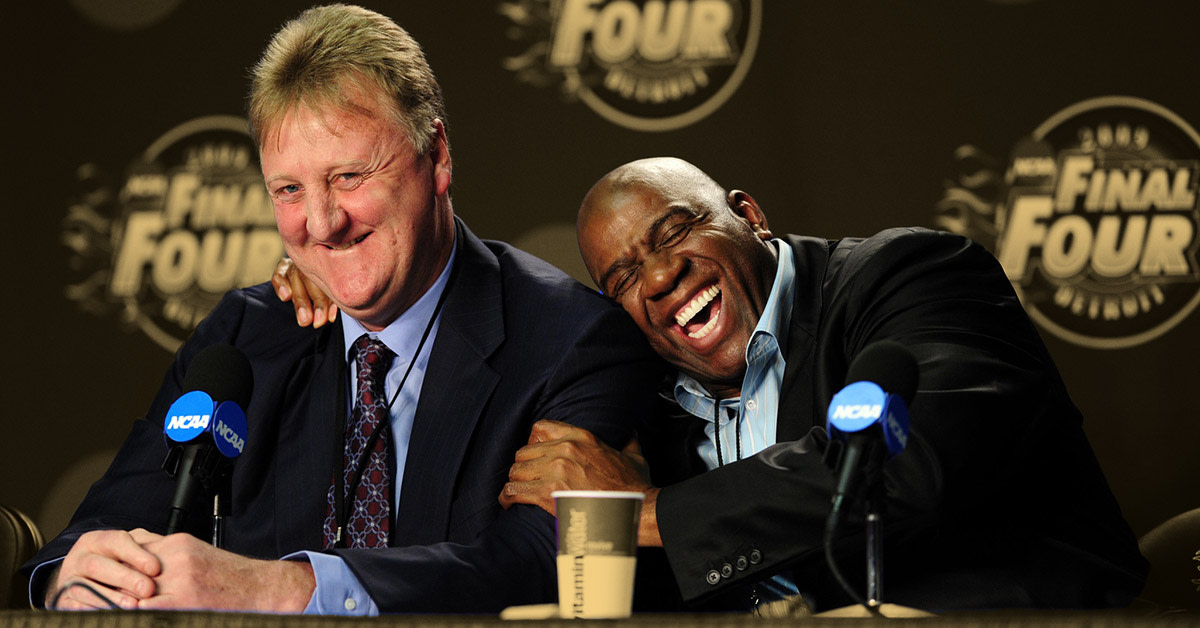
“There’s a lot of people who helped save this NBA, it didn’t start with us” – Bird rejected the narrative that he and Magic saved the NBA originally appeared on Basketball Network.
Before 1979, the NBA stood on shaky legs.
Advertisement
Television ratings hovered at historic lows. NBA Finals games were tape-delayed, pushed past late-night programming. League executives worried not just about marketability but about viability. Between drug scandals, low attendance and a disconnect with mainstream America, the NBA’s national image had dimmed to a flicker.
Yet something changed that year, when two college superstars, Larry Bird and Magic Johnson, entered the league, carrying with them not just talent, but magnetism. The NBA didn’t transform overnight, but for the first time in years, the league had a spark.
Changing the league
Still, even with the mystique that swelled around their careers, Bird has never been one to bask in self-importance. He downplayed the now-common narrative that he and Magic single-handedly saved the NBA.
Advertisement
“It’s funny, all through my career they always say, ‘You helped save the NBA.’ But there’s a lot of people who helped save the NBA. It didn’t start with us,” Larry said. “Maybe we helped in some way, as far as the competition we had in college and going against one another. But I do think we brought a different aspect to the game when we came in.”
Their rivalry began in the 1979 NCAA championship game, when Johnson’s Michigan State team bested Bird’s Indiana State squad. Their head to head dew more than 35 million viewers, the highest rating for a college basketball game in U.S. history to that point and it didn’t end at the buzzer. The NBA leaned into the duos storyline almost instinctively.
Their contrasting backgrounds, Bird, the silent assassin from blue-collar French Lick, Indiana and Johnson, the charismatic showman from Lansing, Michigan, created the kind of duality marketing departments dream about.
Advertisement
When Bird joined the Boston Celtics and Johnson joined the Los Angeles Lakers, the rivalry exploded onto one of the most storied stages in American sports history.
Their teams reshaped the league’s visibility. Suddenly, NBA games weren’t just sports events; they were cultural happenings. Fans tuned in not only to see the final score but also to witness an unfolding drama that carried athletic brilliance and emotional weight.
Bird and Magic’s image
Larry’s humility stands in contrast to the grandeur often associated with his legacy. He’s always been that way, grounded in his Midwest roots, more attuned to doing the job than talking about it.
Advertisement
His appreciation of the era’s broader ecosystem shows an awareness that while he and Johnson became the league’s faces, the foundation was laid by others before them, Kareem Abdul-Jabbar, Julius Erving, George Gervin and many more who kept the flame alive through the league’s darker years.
He doesn’t dismiss the impact he and Johnson had. Instead, he clarified it, anchoring it in how they approached the game not as personal glory chasers, but as team-driven competitors who elevated those around them.
“We both liked to pass the ball. We liked to try to make other guys better. And then we were winners, there was no question about that,” Johnson said. “Not that there wasn’t a lot of winners before us. But just how we played the game and approached the game, I think, made a big impact throughout the league as far as watching the game.”
Advertisement
Indeed, Bird and Johnson shared devotion to team basketball, reinvigorating a product that had become muddied with isolation play and ball-stopping habits. Their rivalry gave way to some of the most beautifully executed basketball the NBA had seen.
The Showtime Lakers were a masterclass in transition offense, while Bird’s Celtics perfected spacing, ball movement and grit. The two made passing fashionable again. More importantly, they made winning contagious.
Their influence echoed across the league. Young players began modeling their games not just on individual flair, but on leadership and vision. The 1980s became a golden age of team-oriented play, filled with fast breaks, off-ball movement and precision cuts. The Finals were no longer buried at midnight.
Advertisement
By 1984, ratings were surging and the NBA had become primetime entertainment.
But Bird’s reflection reminds us that the league’s rise was not the product of two men alone. It was collective and layered. David Stern’s vision, the emergence of cable TV, the influx of talent and the steady drumbeat of competition all helped turn things around.
The two legends were pivotal, but they were also part of a larger story that unfolded over a decade.
Even now, decades after retirement, Bird remains allergic to being labelled the focal point of the NBA’s evolution. His legacy speaks for itself: three-time NBA champion, three-time MVP, Hall of Famer.
Advertisement
Yet he continues to redirect the spotlight toward the game itself, the passing, the strategy and the team ethos that made basketball a global spectacle.
This story was originally reported by Basketball Network on Jul 27, 2025, where it first appeared.