
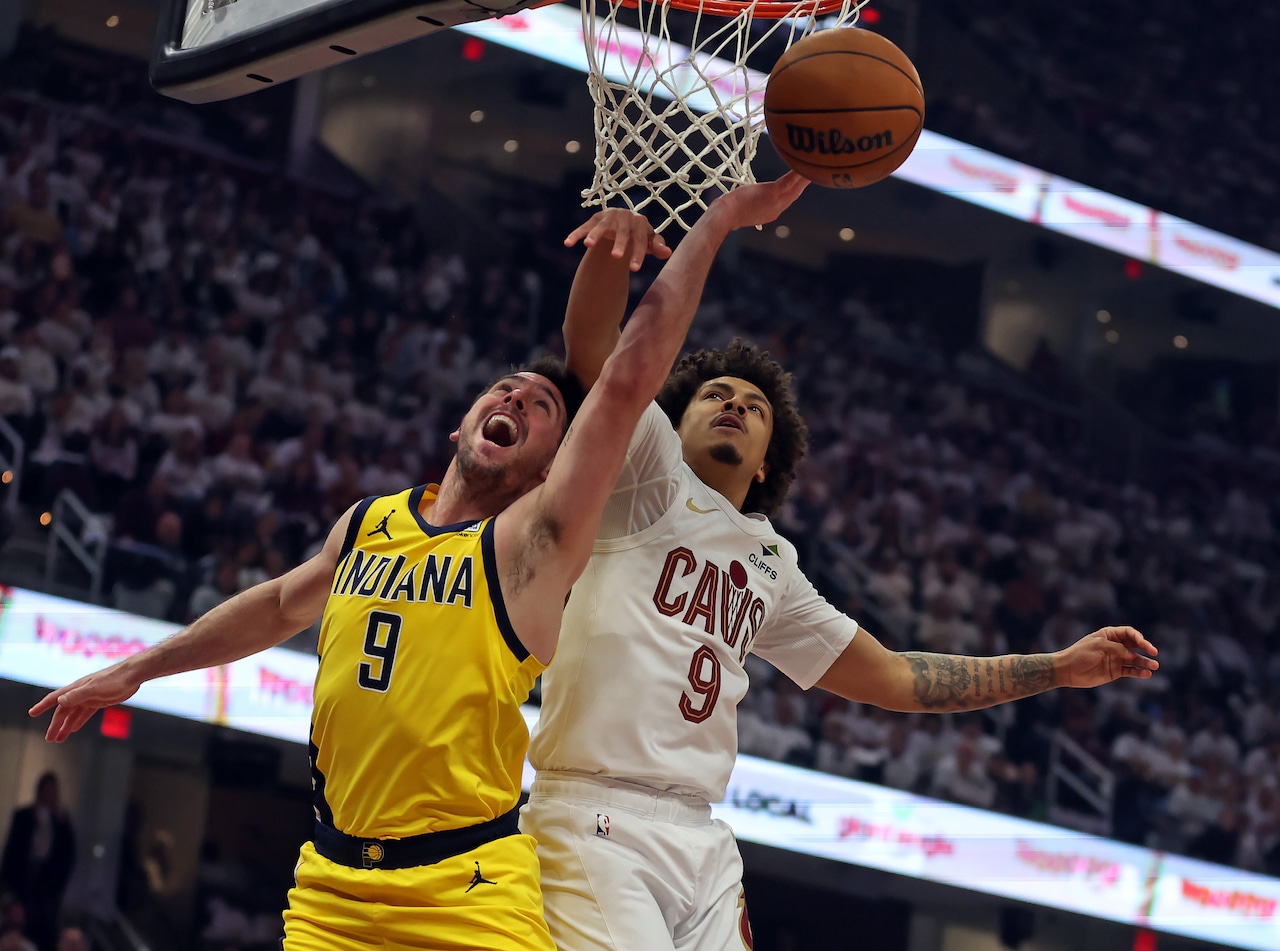
INDEPENDENCE, Ohio — As the Cavs trickled off the floor at Cleveland Clinic Courts on Thursday afternoon, just hours before boarding a flight to Indiana, there weren’t many signs left of the shootaround that had just taken place. Most of the players had vanished, escaping to gather their thoughts and luggage before a season-defining Game 3.
But one moment lingered. While reporters waited to speak with Cavs head coach Kenny Atkinson, he remained deep in thought. At the top of the key on a far court, he and assistant Mike Gerrity walked through pick-and-roll coverages like actors rehearsing lines for the most critical act of a high-stakes drama.
The message was clear: This isn’t just another game. And the Cavaliers’ defense isn’t just another talking point — it‘s their last lifeline.
How to watch the Cavs: See how to watch the Cavs games with this handy game-by-game TV schedule.
Game 1 was a sprint, with Tyrese Haliburton masterfully orchestrating Indiana’s offense while dragging Cleveland’s bigs, particularly Jarrett Allen, into uncomfortable matchups on the perimeter. The Cavs’ switch-heavy scheme, which they had honed with a potential Celtics matchup in mind, collapsed under the weight of Indiana’s movement and misdirection.
So in Game 2, they bent. Just a little. Enough to build a 42-minute lead. Enough to show they’re capable of adjusting. They didn’t overhaul the entire scheme — not yet — but they did rework how they guarded the pick and roll.
Instead of blindly switching, they began hedging — an old-school tactic that throws off the rhythm of the pick and roll.
Allen, rather than being dragged into space, flashed hard at the ball-handler, momentarily cutting off penetration before retreating to the roller. The goal wasn’t to blow up the play but to buy enough time for the original defender to recover. It‘s disciplined. And it worked — at least in doses.
On Thursday, Atkinson mimed the movement again with Gerrity. Sliding into position, dropping back, talking through reads.
They tested it in Game 2, and it could be seen even more on Friday.
If Game 1 was Haliburton’s clinic (22 points, 13 assists), Game 2 was Cleveland’s attempt to cut the cord.
“They made an effort to cut off his blood flow,” Pacers coach Rick Carlisle said of Cleveland’s defense against Haliburton. “It was difficult to catch the ball, let alone get assists or score.”
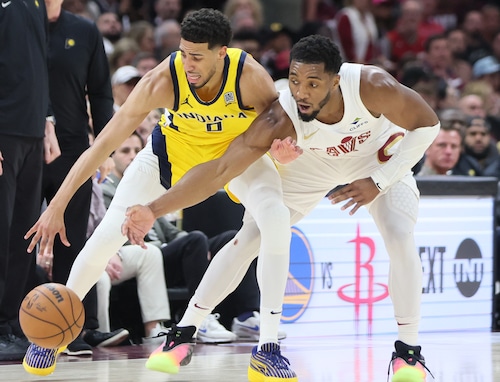
Cleveland Cavaliers guard Donovan Mitchell (R) tips away the basketball on the dribble of Indiana Pacers guard Tyrese Haliburton in the second half during their eastern conference semifinals at Rocket Arena. John Kuntz, cleveland.com
That disruption came through face-guarding Haliburton the full 94 feet — a bold, energy-draining tactic that forced Indiana to let others initiate offense.
If Andrew Nembhard, who became the defacto point guard, tried to turn the corner on a screen, the Cavs’ defender in the action would hedge.
The strategy paid partial dividends: Haliburton finished with just four assists. Nembhard stepped in with 13, but he also coughed up eight turnovers.
It was a subtle shift, but a meaningful one. A glimpse into the kind of philosophical flexibility the Cavs raved about when they hired Atkinson last summer.
He preaches adaptability — play-by-play problem-solving. Now, he has no choice but to live those ideals.
Even that small adjustment had an immediate impact. The Cavs held Indiana to just 15 points in the first quarter — the fewest Cleveland had allowed in a playoff quarter since the 2016 Finals against the Warriors. For a brief stretch, the Cavs rediscovered who they claimed to be all season — a defense-first team. They forced Indiana into hesitation. And they dictated the terms.
But only for so long.
Indiana responded with 35 points in the second quarter. Then 34. Then 36. But that was part of the Cavs’ new calculus: even if someone else is making plays, at least it‘s not Haliburton, who has made a career of turning chaos into efficiency.
Cleveland’s full-court effort on Haliburton was invasive. And necessary. It worked well enough to prove it should be a staple again in Game 3. That kind of defensive effort — exhausting, relentless, annoying — might be the only way to force Indiana to initiate offense from anyone but their engine.
Atkinson asked himself aloud after Game 1 if this could become a “stay-at-home series.” On Friday night, it has to be. No more scrambling. No more hoping switches hold. The Cavs need to win possessions with discipline, with communication, with trust.
That‘s the shift this moment demands. Not just a tactical shift — a mental one.
The question is whether Cleveland can sustain that level of focus and intensity for a full 48 minutes.
And that‘s where Atkinson will face his latest dilemma, one that filled him with regret after Game 2.
His team ran out of gas, and he knew it. The rotation had tightened, and it showed.
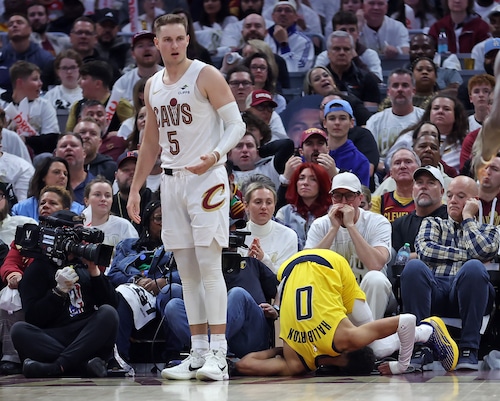
Indiana Pacers guard Tyrese Haliburton rolls over after falling against the Cleveland Cavaliers in the second half of game two of the Eastern Conference semifinals. Joshua Gunter, cleveland.com
Now, with the season teetering, does he stretch it out? Will he tap Javonte Green or Craig Porter Jr. or even rookie Jaylon Tyson as defensive specialists to buy Max Strus and Isaac Okoro precious breathers in their exhausting chase to isolate Haliburton from the offense? Or does he ride with Strus, Okoro, and maybe even Sam Merrill, asking them to empty the tank one more time in a must-win fight?
Because this isn’t just about who plays — it‘s about who has enough left to finish.
They’re down 0-2 and facing the grim reality that no NBA team has ever come back from a 3-0 deficit in a best-of-seven series. Just five teams have ever rallied from losing the first two games of a series at home. If the Cavaliers want to become the sixth, and the first since the 2021 Clippers, their defense has to deliver the kind of performance that‘ll set the tone for a turnaround.
They won’t be able to lean on their offense alone. As historically efficient as it‘s been this year, it hasn’t translated to this series — especially from beyond the arc. The 3s haven’t fallen. The rhythm hasn’t been continuous. And yet, they’ve still been within striking distance.
When the defense locks in, it does more than keep the Cavs afloat — it breathes life into everything else. That first quarter in Game 2 was proof: hold Indiana to 15, and suddenly the offense found its rhythm, pouring in 32 points like the lid on the rim never existed.
The Cavs have the fifth-best defense in these playoffs. On Friday night, they’ll need their best.
If Cleveland can hold up on defense, then maybe — just maybe — there‘s still time to flip the series. But if not, if they let Indiana run wild again, then the season that once felt destined for something deeper could end on a fast break.
Not because they didn’t have the talent. Because they couldn’t get a stop.