
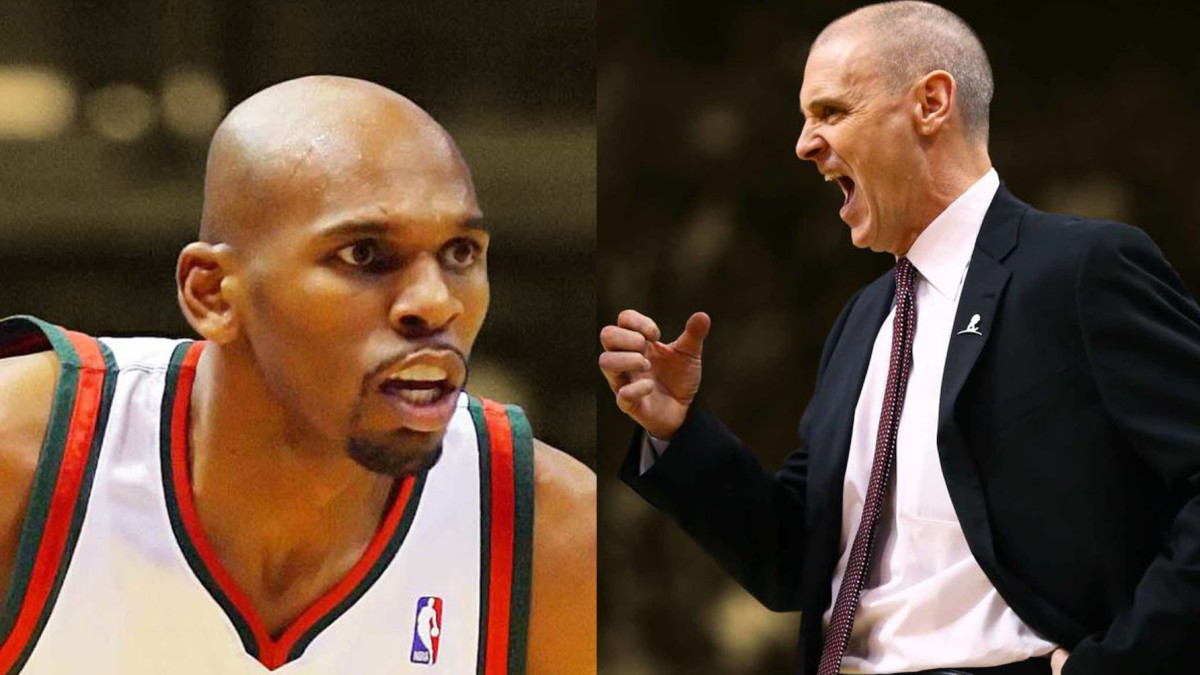
“Sometimes less is more” – Stackhouse admits he was reluctant when Carlisle wanted him as a decoy originally appeared on Basketball Network.
Jerry Stackhouse was coming off one of his finest scoring seasons in 2000-01 with the Detroit Pistons, so when new coach Rick Carlisle asked him to scale back offensively, he wasn’t convinced it was the right move. In time, though, Carlisle’s approach proved effective as the team completely turned things around.
Advertisement
“Rick Carlisle came in and was like, ‘Stack, I need you to be a decoy. Everybody knows that you can score 30. I need you to score 25.’ I’m like, ‘What?” Stackhouse told Matt Barnes and Stephen Jackson in an episode of the “All the Smoke” podcast. “Then, he was like, we’re gonna put you in more pick-and-rolls, we know they’re gonna trap you, and then they’re gonna play four-on-three on the other side, and we’re gonna win.”
The Pistons transformed their season
It was impressive for a new coach to project things the way Carlisle did, but that was precisely what happened. After averaging 29.8 points the previous season, Stack’s scoring numbers dropped to 21.4 in 2001-02. However, unlike the prior year, they were absolutely tearing it up in the win column, as Rick predicted.
Advertisement
“It took a little buying into it, but I bought into it and we went from 30-52, the year that I averaged almost 30, to 52-30 when I averaged 24. Sometimes, less is more… Those are stories and situations that I can reflect back on when I’m talking to a guy about being a little more selfless and how we can gain as a whole from that approach,” stated the then-Vanderbilt Commodores head coach.
Interestingly, Stack’s assist numbers remained the same (5.1 to 5.3), while the team’s assists totals only improved marginally (from 19.9 to 21.5). However, because of the unselfish mindset Carlisle taught, the offense was significantly better than the previous season. From ranking 20th under George Irvine in offensive rating (100.0), Rick spruced that up to 12th (104.8).
That being said, the team’s improvement could be attributed more to the defensive side of the ball. Ben Wallace turned the corner as a defender, leading the Association in rebounds (13.0) and blocks (3.5) in 2001-02. His ridiculous campaign earned him his first of four Defensive Player of the Year awards and even placed 10th in MVP voting.
Advertisement
Some may not take Wallace’s contributions seriously, but Carlisle did.
“The other thing about Ben is there were a couple of those years when he was, I believe, the top three or four for (NBA) Most Valuable Player because of his impact on the game defensively,” Carlisle said in 2021 before Wallace’s Hall of Fame induction. “But he also had an impact offensively, because he was a great rim threat, he was a great screener, and he was a tremendous offensive rebounder.”
Advertisement
Maximizing rosters has been Carlisle’s trademark
Two decades later, Carlisle’s approach in Detroit still echoes in Indiana. Much like those Pistons teams that lacked overwhelming star power but secured back-to-back No. 1 seeds in the East, his Pacers aren’t the most talented roster on paper.
Yet Rick continues to maximize his personnel, leaning on ball movement, pace and role clarity to keep Indiana competitive in a crowded conference. The formula hasn’t changed much, and neither has the result.
Advertisement
Carlisle’s Pacers may not have a go-to scorer averaging close to 30, but the emphasis on sacrifice and shared responsibility is just as clear as it was in Motor City. Stackhouse’s lesson in selflessness back in 2002 mirrors what Indiana thrives on now — a system where the whole is built to outpace the sum of its parts.
This story was originally reported by Basketball Network on Aug 1, 2025, where it first appeared.