
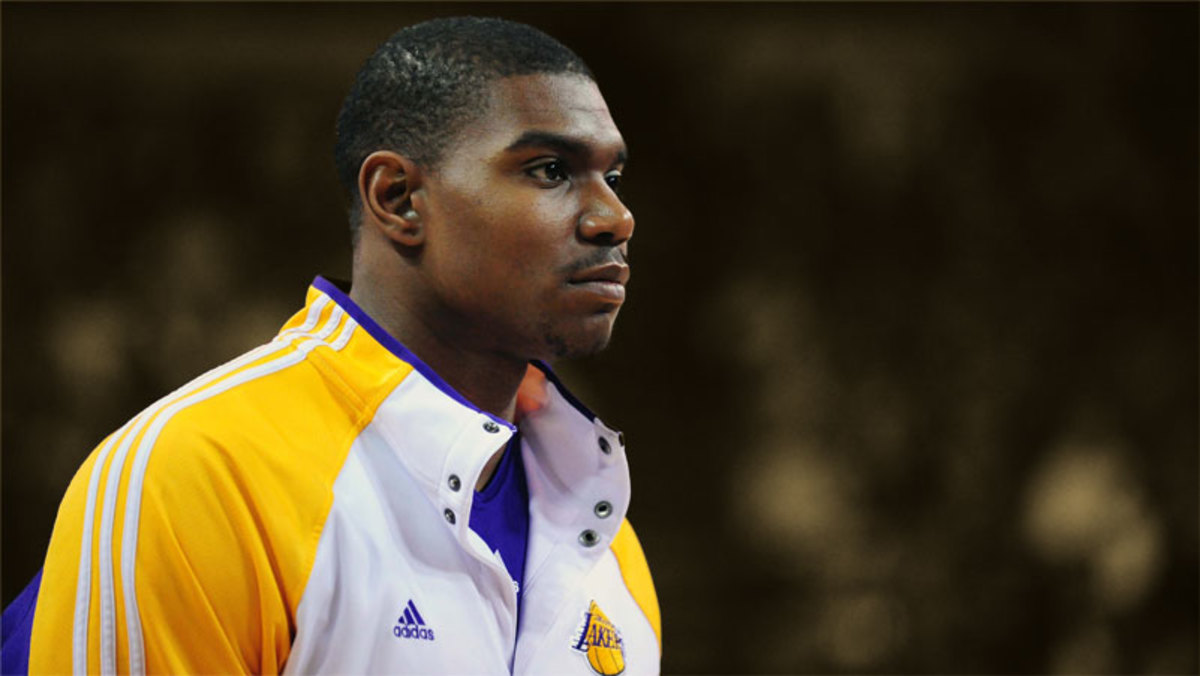
“I don’t know. I was definitely focused” – Andrew Bynum admitted he was confused by claims that he was never passionate about basketball originally appeared on Basketball Network.
There are a few things in professional sports that are as misunderstood as quiet talent.
Advertisement
For Andrew Bynum, the youngest player ever drafted into the NBA at age 17, silence was often mistaken for apathy. His unorthodox path became fodder for an entire generation of doubters.
He arrived at the 2005 NBA Draft straight out of high school, carrying both the curiosity of scouts and the hopes of a Los Angeles Lakers franchise transitioning from the Shaquille O’Neal-Kobe Bryant era into a new chapter.
Seven years later, after becoming an NBA champion and an All-Star, he left Los Angeles still cloaked in a narrative that questioned his love for the game.
Advertisement
Bynum’s commitment
Kareem Abdul-Jabbar, the all-time great and the very mentor assigned to shape Bynum’s early years in Los Angeles, once expressed doubts about the young center’s commitment to greatness. But Bynum, in his own reserved and reflective way, didn’t get the narrative.
“I don’t know. I was definitely focused,” Bynum said. “I worked with Kareem for, I believe, my first two or three years. Later on, it became more of sort of a mentor [role]. He would just give me little tips here or there.”
Advertisement
Throughout his career, there were critics who insisted that Bynum lacked focus and that he played with disinterest. And yet, the numbers painted a different picture.
During the Lakers’ back-to-back title runs in 2009 and 2010, Bynum was a vital piece, using his length, strength and presence in the paint, anchoring Phil Jackson’s triangle offense in ways rarely acknowledged.
He averaged 18.7 points and 11.8 rebounds during his All-Star season in 2012. But even at the height of his career, there remained a skepticism, a dissonance between how he played and how people felt about how he played.
Advertisement
Bynum’s relationship with Abdul-Jabbar was built during formative years, when the teenage prodigy was adjusting to NBA life, playing behind veterans like Chris Mihm and Kwame Brown and enduring the learning curve of the triangle offense. He wasn’t loud about his process, but that didn’t mean there wasn’t one.
Even Jackson, known for favoring cerebral players, eventually trusted Bynum’s instincts and touch in the low post. That trust didn’t materialize without discipline.
Learning from Kareem
Much of the critique around Bynum’s supposed lack of passion ignored context.
Advertisement
Injuries became a defining part of his story. Microfracture surgery on his knee in 2008. A torn meniscus in 2010. Damaged cartilage that lingered and limited. These weren’t excuses but realities. And yet, he still returned each time, delivered when it counted and evolved into one of the league’s most impactful big men during a particularly demanding stretch for the Lakers.
There was always curiosity about why Bynum never added the skyhook to his arsenal. After all, he had direct access to the man who perfected it. But he didn’t pretend to be a clone of Abdul-Jabbar.
He carved his own approach built around backdowns and short hooks, smart positioning and decisive rebounding. He didn’t float like his mentor, but he could dominate like him. His time under the Lakers icon wasn’t fruitless, but foundational.
Advertisement
“I wasn’t able to master the sky hook, but outside of that he showed me a lot of great things,” Bynum said. “Footwork, rebounding, how to cut the lane off. Just a bunch a things. I learned a lot from him and I enjoyed my time with him.”
Despite all the criticisms, Bynum earned respect. Bryant, in his own hyper-competitive way, routinely pushed Bynum to be more assertive, because he knew what was there.
Injuries eventually became the story that overtook all others. After leaving the Lakers, Bynum’s knees betrayed him. He played a total of 26 more games between the Philadelphia 76ers, Cleveland Cavaliers and Indiana before his career faded into early retirement.
Advertisement
He never mounted a comeback, because his body no longer allowed it.
This story was originally reported by Basketball Network on Aug 3, 2025, where it first appeared.