
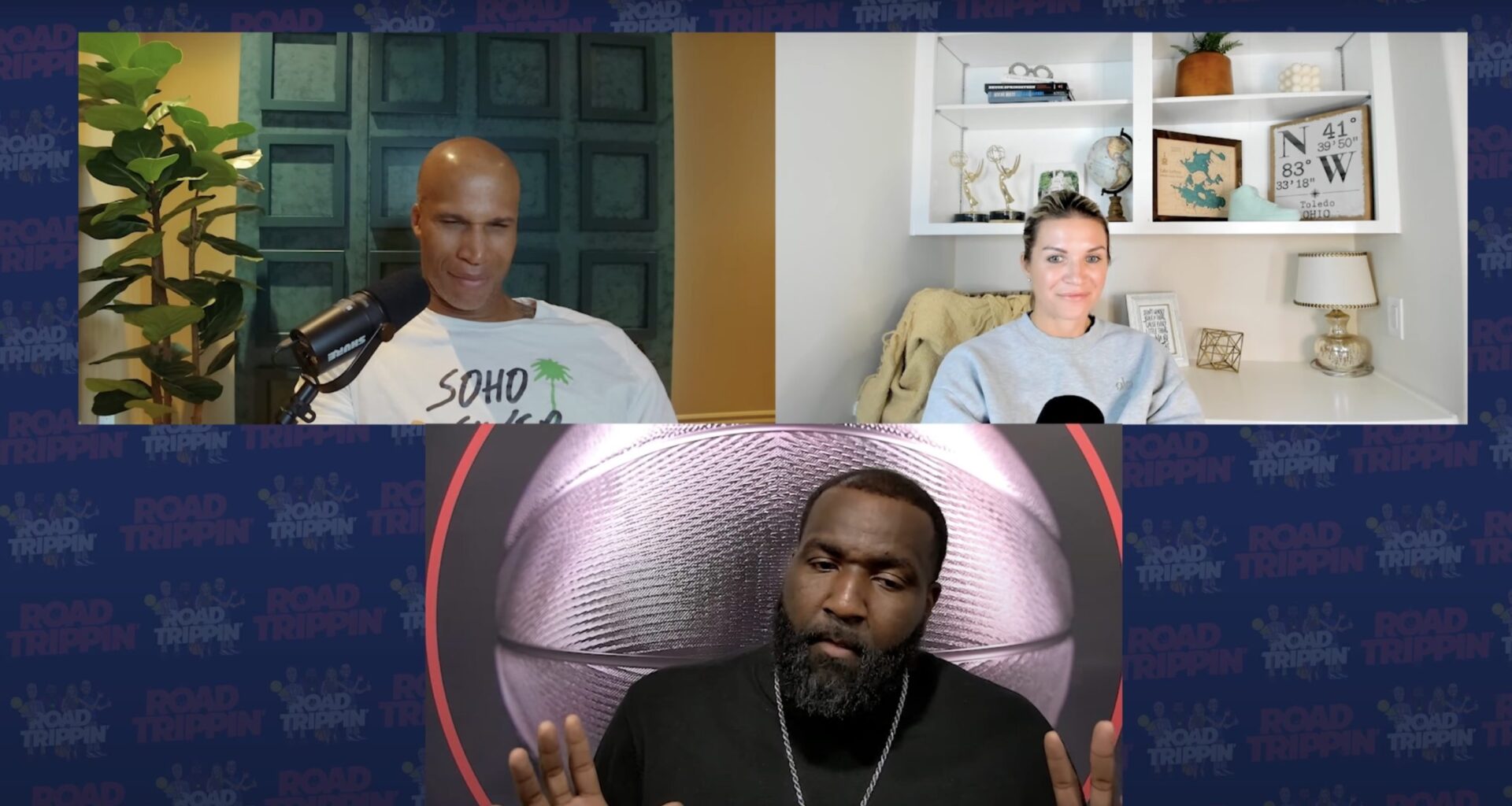
NBA GOAT debates are officially off the rails, and today’s conductor of the fateful train is Kendrick Perkins.
In the process of disagreeing with a recent Washington Post column arguing for Bill Russell as the best player in NBA history because of what he faced off the court, Perkins took things a step further on the latest episode of Road Trippin’.
Rather than simply argue that off-court challenges should not factor into a player’s greatness or that someone like Michael Jordan still accomplished enough on the court to supersede Russell’s historic racial advocacy, Perkins took Russell down a peg by comparing his strength in the face of racism to modern players dealing with haters on social media.
“I would never take what the guys, Bill Russells, and what they had to go through for us to be able to perform at a high level … or even be in the NBA, for the NBA to even exist. I wasn’t there,” Perkins said on his Road Trippin’ podcast. “But I will say everyone’s had their own form of adversity. Back then, it was racism and death threats. But having to battle through the adversity of f*cking social media as a player elevates right up into there, when you talk about mental toughness.”
Today’s athletes certainly have a lot to take in. Social media is not only a cesspool of criticism and personal attacks, but it is also a place where doxxers share athletes’ personal information, and they can receive credible threats of violence. Sometimes, the hate speech posted toward athletes online is not altogether different than the rhetoric around Black athletes like Russell in the 1950s and 60s, during the height of the Civil Rights movement in the U.S.
Still, Russell’s life and career were directly impacted by racial abuse as the first Black superstar in the NBA. Russell was refused a room at a segregated hotel in North Carolina in 1958. He was refused service at a Kentucky restaurant in 1961 and boycotted an exhibition game. When Russell was head coach, locals broke into his home and spray-painted it with racist graffiti. After retiring, Russell harbored ill will toward Boston, its community, and its press corps over the racial prejudice he experienced while playing for the Celtics.
When cohost Richard Jefferson scrunched his face, questioning the take, Perkins clarified that he believes increasing rates of mental health issues among athletes creates a similarly challenging landscape in which modern athletes are expected to thrive.
“I get it. People’s lives were on the line. But mental health is a real thing, and we see so many guys logging off of social media,” Perkins said. “Everybody’s affected in a different way. I’m not trying to put the two together. I’m just trying to say this day and age, a lot of these guys are dealing with their own form of adversity. People can say they’re just soft or just stay off of social media, do you know how f*cking hard it is to stay off of social media?”
Perkins found the hole in his own argument. It is in fact possible to ignore hate on social media in a way that it was not for athletes, like Russell then and others like Vinicius Jr. today, who experience overt racism in their real lives. And even if we say that hateful communication online (and in general, the amount of time we spend online) can be a vicious spiral toward depression and anxiety, Russell would undoubtedly also have faced mental health trouble as a byproduct of the racism he battled.
In the future, it is probably best to keep First Take-style GOAT debates separate from sociology and psychiatry.