
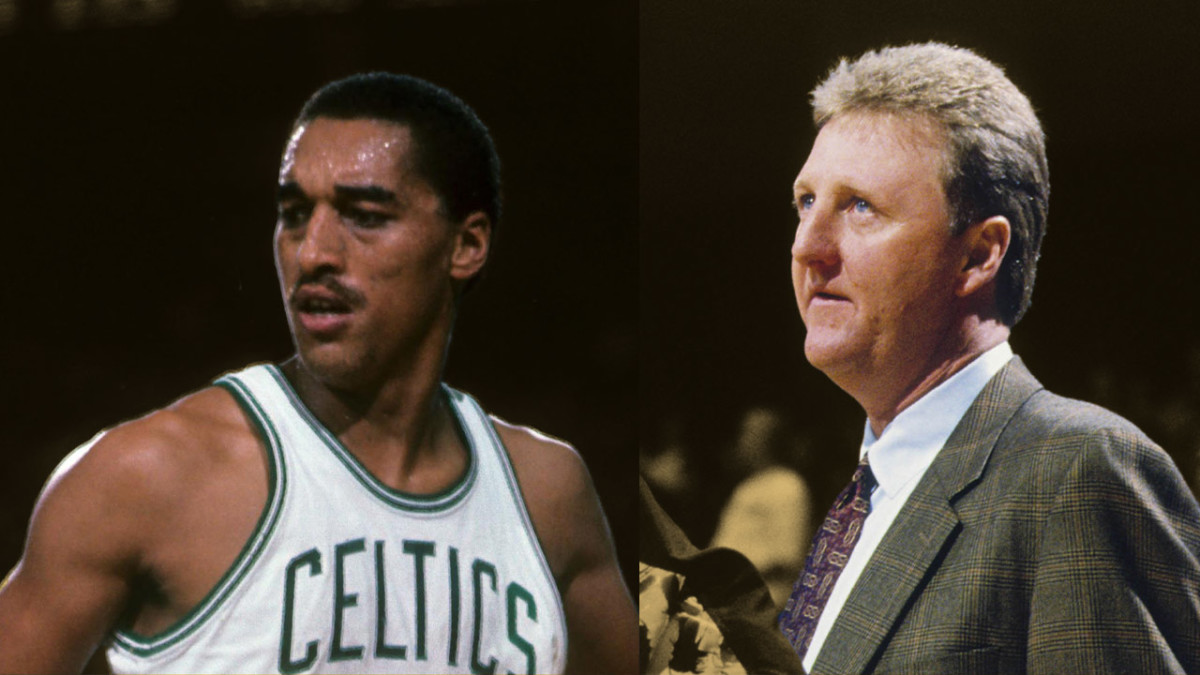
“D.J. was upset because I didn’t offer him an assistant’s job in Indiana” – Larry Bird on what caused his relationship with Dennis Johnson to fall apart originally appeared on Basketball Network.
In the short years that Larry Bird held a front office role with the Boston Celtics, he made several tough decisions and bypassed a good number of them too. The irony of the job was that it gave him the power to shape the direction of the team he once bled for on the hardwood, but it also chipped away at some of the personal bonds that had made that era of Celtics basketball so memorable.
Advertisement
In particular, his friendship with Dennis Johnson, a teammate from two title-winning runs in the 1980s, took a quiet but deep hit during that period.
Fractured bonds
When team owner Paul Gaston tapped Bird to compile a list of coaching candidates in 1997 as part of a rebuild, the implications reached further than administrative paperwork.
“I found out later that D.J. was upset because I didn’t offer him an assistant’s job in Indiana, but I thought he was set in Boston,” Bird said. “I also thought he wanted to be a head coach. Besides, I had already made up my mind that I was going to use two assistants, not three. It was clear to me that Paul Gaston wanted Rick Pitino to be his coach, so I called up Pitino and asked him if he was interested.”
Advertisement
Bird’s omission wasn’t meant to be personal, but Johnson took it that way. For someone who had given his all to the Celtics, both as a player and now in a coaching role, not even getting a mention stung deeper than he could conceal.
Johnson had been with the Celtics since 1983, earning a reputation as a fierce competitor who never shied away from the big moment. In Game 4 of the 1987 Eastern Conference finals, it was his driving layup after Bird’s iconic steal that sealed a legendary victory. Those moments were not forgotten, but in the cold politics of front office moves, they did not carry the same weight.
The disappointment began to form cracks in the bond. Bird wasn’t known for his sentimental side, but even he admitted the damage. Johnson had given everything to Boston and being left off that coaching shortlist suggested, whether intended or not, that those contributions didn’t count toward the future.
Advertisement
Bird’s dilemma
While Johnson’s hurt lingered quietly in the background, the Celtics’ ownership had its sights on a bigger splash. Rick Pitino was the target and nothing was going to derail that plan. Bird, even as someone respected by the organization, understood where the power lay.
“I think D.J. would make a good coach, but I knew Gaston had someone a lot more high-profile in mind,” Bird said. “He had no intention of hiring D.J., that’s for sure. My understanding was that D.J. would be kept regardless of who the head coach was. That turned out not to be the case. He was fired later that year.”
Advertisement
Johnson’s name was passed over for the head role and, ultimately, removed from the coaching staff entirely. For Bird, the situation turned even more complicated when, shortly after, he began discussions with the Indiana Pacers about becoming their head coach. As it turned out, Johnson had hoped to be considered for a spot on that staff as well, maybe not as head coach but at least as an assistant.
But that was never on Bird’s mind. His view of the position had always been singular; if he were to coach, he’d do it with his own voice, not as a second in command. What may have seemed like a rational decision from Bird’s perspective added another layer of disappointment for Johnson.
In time, the silence between them grew, and perhaps that’s what made it all the more painful. This was the quiet undoing of one of the Celtics’ most effective partnerships.
Advertisement
This story was originally reported by Basketball Network on Aug 4, 2025, where it first appeared.