
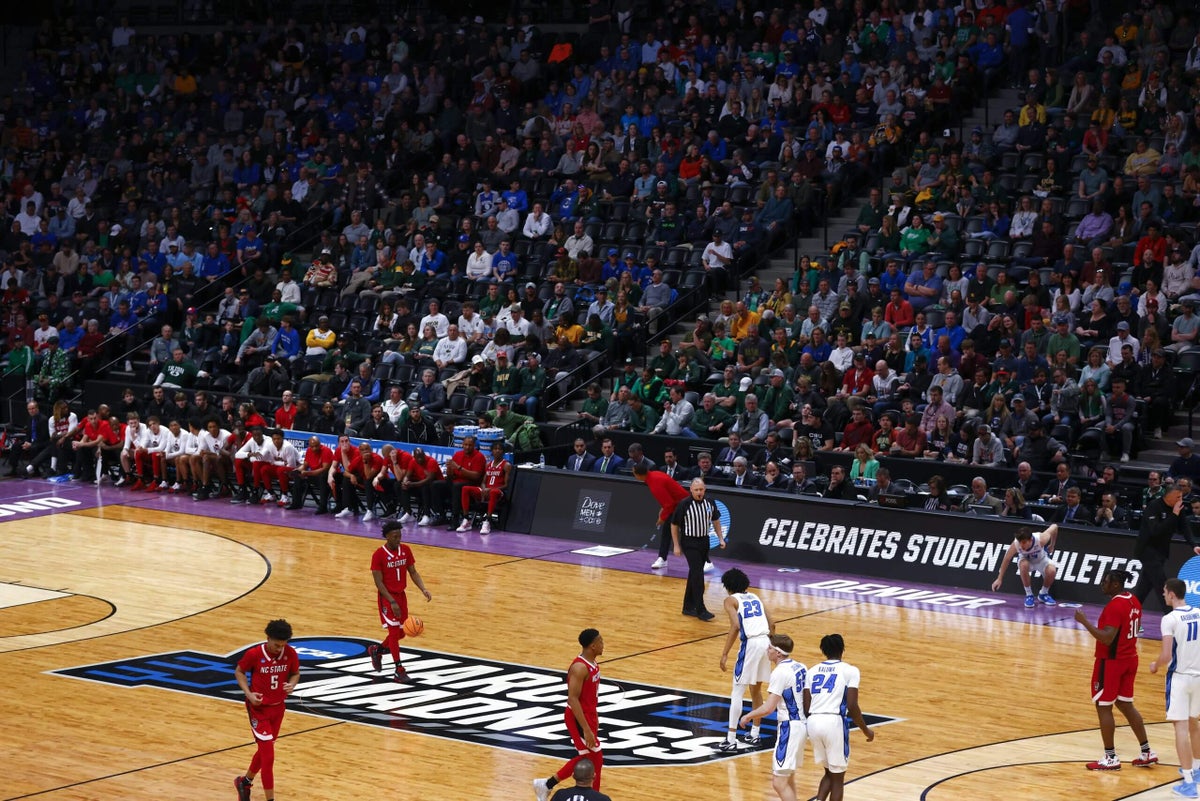
The main reason a majority of college basketball fans did not want the NCAA Tournament field expanded is that they did not see a need for more middling high-major teams getting additional at-large bids.
They got their wish on Monday, at least for now. The tournament will remain at 68 teams in 2026; however, conversations about whether to expand to 72 or 76 in 2027 will continue.
So the fight for the anti-expansion crowd is not over. But if expansion does come in 2027, those who do not want to see it might need to pick up a new fight: how the field is chosen.
Currently, the tournament selection committee uses a collection of different data sets — both resume and metric-based — to select and seed the field. How they weigh each is subjective. Ken Pomeroy, a leading analytic voice who runs the popular rankings site KenPom.com, believes there should be a more objective means of selecting the field and sees the Wins Above Bubble (WAB) metric as the fairest way to do so. Unlike his rankings and the NET, WAB does not factor in scoring margin.
Essentially, it’s a team’s record compared to the expected win total of a team on the bubble playing that team’s schedule.
Had the field been expanded to 76 last year, these would have been the eight teams added by WAB: West Virginia, Indiana, Wake Forest, San Francisco, Boise State, UC Irvine, Ohio State and George Mason. Four more places for power-conference teams, but four for mid-majors who did not win their conference tournaments as well.
“I don’t know if that’s perfect, but it’s much closer to perfection than the current process,” said Pomeroy, who added that the current setup dings a mid-major team that “racks up a bunch of wins that aren’t Quad 1 wins or aren’t Quad 2 wins.”
“They’re playing (more) Quad 3 teams on the road, and if you win 30 of those games, it’s actually pretty impressive,” he said.
Even if the selection committee continues to choose teams using its current criteria, an expanded tournament would present opportunities for mid-majors. I looked at the last five tournaments, using Bart Torvik’s sorting tool to pull the top eight non-tourney teams in the NET, the top eight with the highest average resume ranking and the top eight with the highest average quality rating.
YEARNETRESUMEQUALITY
2025
Ohio State
Indiana
Ohio State
2025
Boise State
West Virginia
West Virginia
2025
SMU
UC Irvine
SMU
2025
Cincinnati
George Mason
Cincinnati
2025
West Virginia
Wake Forest
Northwestern
2025
Northwestern
Boise State
Boise State
2025
Indiana
San Francisco
Villanova
2025
Villanova
Ohio State
Indiana
2024
Indiana State
Indiana State
Wake Forest
2024
St. John’s
Oklahoma
Cincinnati
2024
Cincinnati
Syracuse
Villanova
2024
Pittsburgh
Princeton
Pittsburgh
2024
Villanova
Seton Hall
Oklahoma
2024
Wake Forest
Pittsburgh
Indiana State
2024
Oklahoma
Ohio State
Ohio State
2024
Utah
Kansas State
Providence
2023
North Texas
Vanderbilt
Rutgers
2023
Rutgers
Oklahoma State
Oklahoma State
2023
Oklahoma State
North Carolina
North Carolina
2023
Liberty
North Texas
Oregon
2023
North Carolina
Rutgers
Michigan
2023
Oregon
Wisconsin
Texas Tech
2023
Ohio State
Clemson
Cincinnati
2023
New Mexico
Oklahoma
Clemson
2022
Oklahoma
VCU
Oklahoma
2022
Xavier
Texas A&M
Oklahoma State
2022
Texas A&M
SMU
Wake Forest
2022
SMU
North Texas
Mississippi State
2022
North Texas
Xavier
SMU
2022
Wake Forest
Oklahoma
Florida
2022
Oklahoma
St. Bonaventure
Texas A&M
2022
BYU
Wake Forest
Xavier
2021
Penn State
Louisville
Duke
2021
Saint Louis
Western Kentucky
Penn State
2021
Arizona
Arizona
Memphis
2021
Duke
Saint Mary’s
Saint Louis
2021
Boise State
Colorado State
Arizona
2021
Colorado State
Boise State
Mississippi
2021
Memphis
SMU
Indiana
2021
Mississippi
Xavier
Seton Hall
Every year, there were two to five teams outside of the power conferences that would have been in consideration. Most likely, one or two of those teams would have made an expanded field each season.
One negative of expansion could be forcing more of these mid-major at-large teams to the play-in round (currently known as the First Four), which has lacked the fanfare of the Round of 64 since its creation in 2011. In the past, the committee has pushed most conference tourney winners — with the exception of four 16 seeds — into the field of 64. I’d propose they take that a step further to protect the mid-majors who earn their way in with great regular seasons: If you won your conference’s regular-season title, you are also exempt from the play-in round.
Another argument against expansion is that it would devalue the regular season. Pomeroy argues it will have the opposite effect. With more teams on the bubble, more teams would play meaningful games down the stretch. In a 76-team tournament, only 52 teams would automatically make the field of 64, compared to 60 now. It makes it more difficult to get a bye to Thursday and Friday, so even some of the teams safely “in” will have more at stake.
The pro-expansion view is that it’s necessary because of the growth of the sport. Since 1985, when the field grew from 53 to 64, the number of Division I teams has expanded by almost 100. The counterargument is that adding teams to Division I should not mean adding teams to the tournament, because those teams are low- or mid-majors who aren’t competing for at-large spots.
But there have been breakthroughs. Florida Atlantic joined DI in 1993-94 and has made a Final Four. UC San Diego, in its first year of tourney eligibility in 2025, was a top-40 team at KenPom. Had the Tritons not won the Big West tournament, they likely would have been excluded from a 68-team field, similar to Indiana State’s snub in 2024. But with an expanded field, they likely would have made it.
Those of us who love college basketball see Selection Sunday and the first two days of the tournament as holidays, and the tournament captures the attention of the casual fan because almost everyone fills out a bracket. The sanctity of the 64-team bracket, a model that feels like perfection, likely wouldn’t actually go anywhere with expansion. Just like when the field expanded to 65 and then 68, 64 teams would likely still tip off Thursday and Friday.
Adding more teams would make it slightly harder to immediately fill out a bracket because of an expanded play-in round. But is that really going to stop people from filling out brackets?
And it’s the great games, moments and upsets that make the tournament so popular. It’s Valparaiso and Bryce Drew hitting a miracle shot to beat Ole Miss. It’s UMBC over Virginia. It’s George Mason and Florida Atlantic to the Final Four. It’s the parity!
“Teams that you’ve never heard of can beat really good teams on any given night, and that’s what makes it great,” Pomeroy said.
Now, if the presidents at the big schools and power-conference commissioners find a way to drive out those smaller schools altogether, then yes, they will be taking the soul of the NCAA Tournament. That’s worth fighting against.
But if it’s nostalgia that makes you hate expansion, that fight was lost when the first play-in games were created. And if you don’t like watching those games on Tuesday and Wednesday, then just ignore them and tune in on Thursday.
The magic wouldn’t go anywhere. A few more teams would just have a chance to make the field. The energy should be spent making sure the mid-majors have a fair crack at those spots.
(Top photo: Justin Edmonds / Getty Images)