
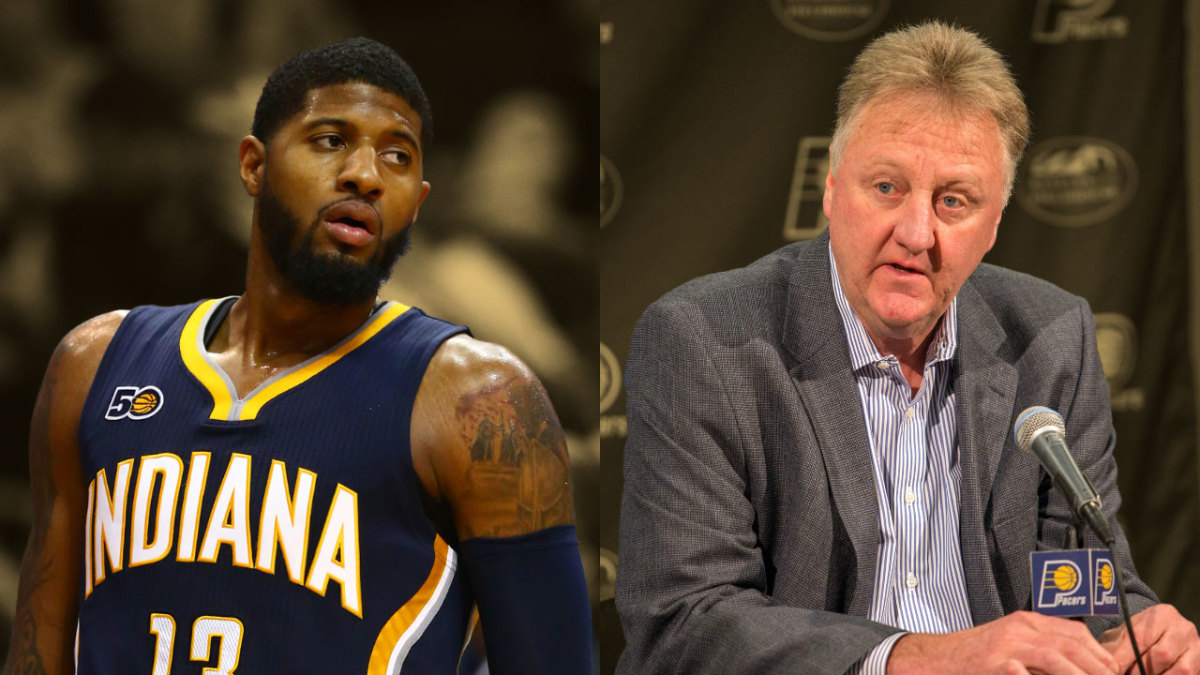
“You just knew it was going to take a couple of years” – Larry Bird admitted he didn’t think Paul George would become an immediate star for the Pacers originally appeared on Basketball Network.
Larry Bird saw many players come in and go as an executive for the Indiana Pacers. Some worked out well, others didn’t. Some, like Paul George, developed into stars. But even Bird, a Hall of Famer with a sharp eye for talent, didn’t peg George as an instant success when he first arrived in Indiana.
Advertisement
At the time, the Pacers were deep in a rebuild and desperately searching for a new cornerstone. What they found in the 10th pick of the 2010 draft was a skinny kid out of Fresno State, quiet, talented and very much a project.
Patience in George
When George walked across the stage on draft night in 2010, he didn’t carry the swagger or spotlight that other lottery picks might. He wasn’t seen as a surefire star. But Bird, then serving as president of basketball operations, saw something worth developing, just not something that would blossom overnight.
Advertisement
“Paul’s a nice young man and very pleasant to be around,” Bird said. “But you just knew it was going to take a couple of years, maybe more, to develop.”
The Pacers had been treading water for years following the Reggie Miller era. After the Malice at the Palace derailed a promising squad in the mid-2000s, the franchise slipped into a cycle of mediocrity, shuffling through rosters and coaching changes. Bird and the Pacers knew that patience would be more valuable than pressure.
George’s early years in Indiana were solid but unspectacular. He played behind veterans, absorbed the grind of the league and slowly picked up confidence. It wasn’t until his third season that the tide truly began to turn.
Advertisement
He stepped into the spotlight during the 2012-13 season, winning the NBA’s Most Improved Player award and leading the Pacers to the Eastern Conference finals. The year after, Indiana pushed the Miami Heat again in a rematch and George went toe-to-toe with LeBron James on national TV.
Those were the seasons that hardened him. The expectations rose. So did his performances. And just as Indiana looked like it was on the brink of becoming a real threat in the East, disaster struck. A gruesome leg injury during a Team USA scrimmage in 2014 halted everything. The images from that night in Las Vegas were chilling and the recovery ahead looked uncertain.
Developmental years
Though that freak injury reshaped his athleticism and shifted the team’s outlook, George returned to the court with purpose. The Pacers, however, were entering another phase of change and George, though still productive, was seeking a different challenge.
Advertisement
He spent two more seasons in Indiana, carrying the team to the playoffs but falling short of real contention. In 2017, he was traded to the Oklahoma City Thunder, closing out a seven-year run with the franchise that helped raise him. Bird’s early read was spot-on. George didn’t emerge instantly, but when he did, it was clear the Pacers had drafted a franchise-caliber player.
“You’re going to have to have patience when you take these young kids,” Bird said. “Think about it, 19 years old and they are in a new city and they don’t have their friends or family around. It can be really tough for them.”
In hindsight, George’s development arc in Indiana is a textbook case of how time, environment and belief can shape a raw prospect into an elite player. While he’s worn other jerseys since leaving Indianapolis, most notably forming star tandems in OKC and later with the Los Angeles Clippers, it was Indiana that gave him the room to fail, learn and ascend.
Advertisement
The deeper playoff runs, the All-Star nods and the defensive accolades, they were all rooted in the foundation built during those early seasons under Bird’s watch. George may not have looked like a star when he first arrived, but he left Indiana with a resume that made it clear that the Pacers cultivated a great one.
This story was originally reported by Basketball Network on Aug 5, 2025, where it first appeared.