
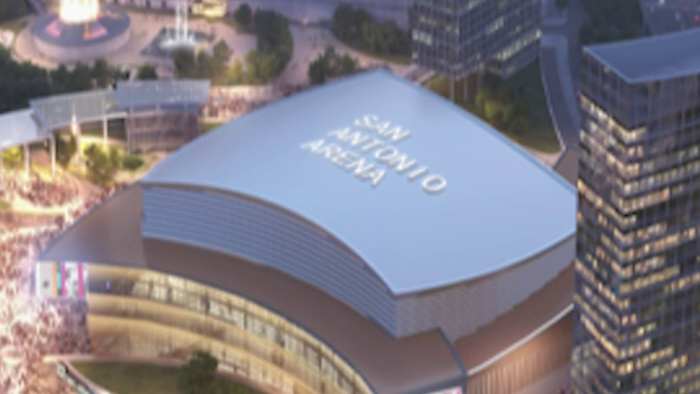
SAN ANTONIO – When Bexar County voters head to the polls in November, their decision on whether to help fund a new Spurs arena could carry larger consequences for the project.
The county, City of San Antonio, and Spurs Sports & Entertainment have been hammering out a deal to fund a new arena at Hemisfair, which could cost up to $1.5 billion. Most of the price tag would be covered by city and county financing, under the latest plans.
The county’s proposed contribution of 25% of the cost, up to a maximum $311 million, has already been put on the November ballot for voter approval, while the city and SS&E’s negotiations are still ongoing.
The most recent numbers, though, include between $350 million and $500 million of city financing and $500 million from the Spurs, who would also cover cost overruns.
To cover its share, the city plans to take on debt and pay it back through special tax capture zones and lease revenue from the arena and new development.
Supporters have argued that those funding sources would not directly affect San Antonio taxpayers. They also wouldn’t require taxpayer approval.
However, voters’ decisions in November would likely still determine if they get tapped.
“I would expect that in the (letter of intent), it will say the city’s participation is contingent upon a November passage of the county venue tax,” SS&E Chief Legal Officer Bobby Perez told council members at Wednesday’s meeting.
County voters passed the current venue tax — split between a 5% tax on short-term car rentals and a 1.75% hotel occupancy tax — in 1999 to fund the construction of the Spurs’ current home, the now-Frost Bank Center.
In 2008, voters agreed to use the tax for river improvements, sports facilities, performing arts facilities and community arenas.
On Nov. 4, they will be asked whether to bump the portion on hotel stays to 2% and tap the venue tax for a new arena.
Voters will also be asked to use the same tax increase to help fund a $240 million effort to maintain the Frost Bank Center and Freeman Coliseum while drastically upgrading the Coliseum grounds. That would include adding and renovating buildings, including a 2,800-seat arena, with the hopes of generating more year-round activity like Olympic event horse shows, horse auctions, an annual county fair or expanded expositions.
The two uses of the tax will appear next to each other on the ballot as separate questions.
It’s not entirely clear how the arena project might proceed if voters reject the use of the venue tax. Still, the question of whether the Spurs could move if they don’t secure a new arena has been an undercurrent of public discussions.
“I’ve never heard from them … either explicitly or hinted that their desire was to leave San Antonio. I think that their priority has always been to stay but to be part of the rebirth of a downtown corridor that needs to be kind of in the middle of the renaissance of downtown,” Bexar County Precinct 2 Commissioner Justin Rodriguez said Tuesday before he and other commissioners ordered the election.
“But I also think we ought to deal in reality, and that is that sports are competitive and there are probably other communities out there that would be salivating to have our Spurs go to their communities,” he continued. “But again, that’s not been part of the calculation. That’s just something I’m saying is in the back of my mind.”
After commissioners ordered the election on Tuesday, Perez dodged KSAT’s question about what it would mean if the venue tax were to fail at the ballot box.
“Today, we’re really excited about the opportunity to go in front of the voters, and we’re going to move forward with the campaign, a great message, and let the voters have a chance to voice their opinions,” Perez said.
You can share your opinion on whether you support the funding in a KSAT poll through GMSA on Friday, Aug. 8.
Read also:
Copyright 2025 by KSAT – All rights reserved.