
 This blog contains links from which we may earn a commission.Credit: Jerome Miron/Imagn Images
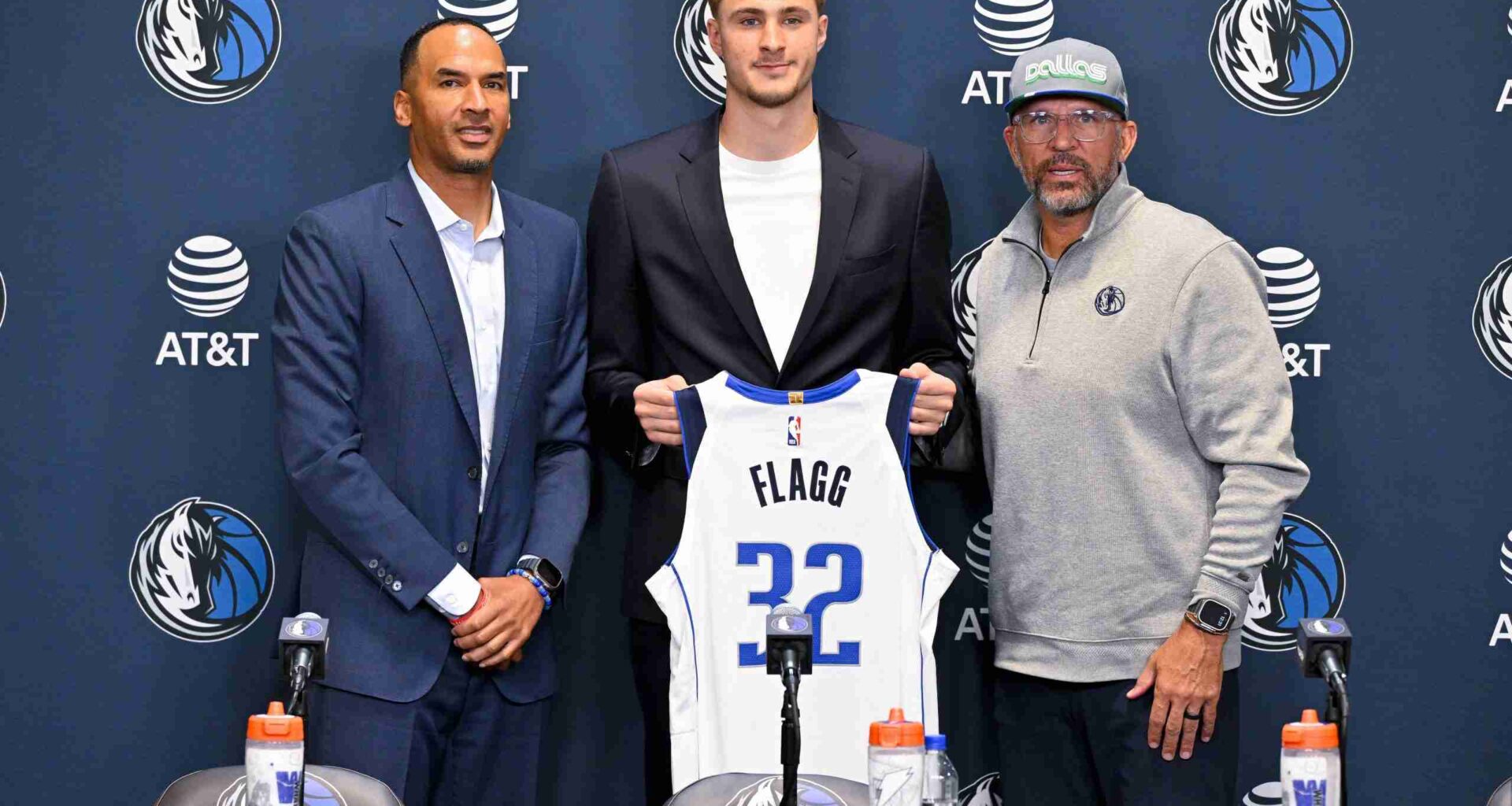
When Cooper Flagg slipped the crisp white Mavericks jersey over his shoulders for the first time, he didn’t beam or point skyward.
He didn’t mimic the choreography of seasoned draftees—no chest pounding, no shouting, no contrived hashtags.
He simply smoothed the front of the jersey down with both palms, revealing a bold navy blue “32” stitched above the word “Dallas.”It was quiet, sincere, and deliberate, much like Flagg himself.
At a glance, it looked like just another rookie photo op. But in this moment—unadorned and modest—there was a flicker of the personal. The number 32 wasn’t picked to sell jerseys, or as one basketball prediction site prematurely framed it, “a branding decision with legacy ambitions.”
Rather, it was the opposite: a nod to a quiet past, to long drives across icy Maine highways, to his mother’s old game tapes, and to a kind of inheritance that transcends stats and spreadsheets.
A Family Number Worn Proud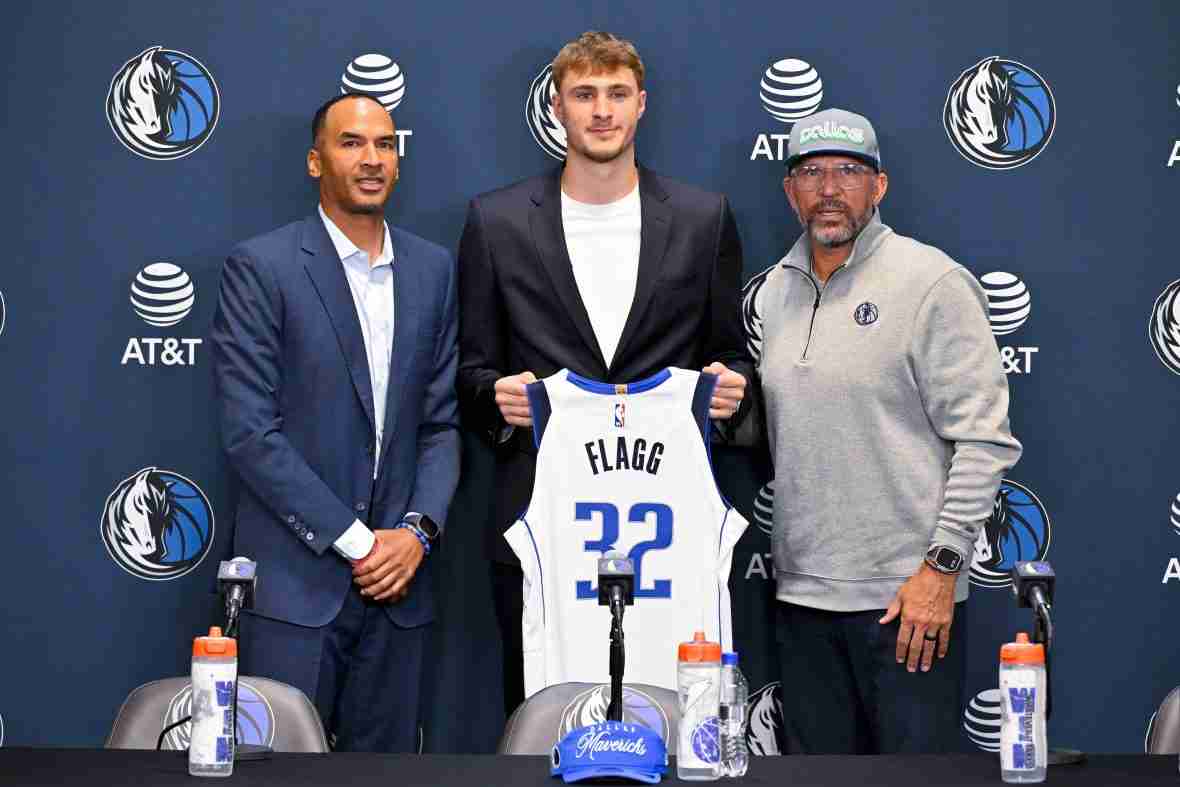 PHOTO: Jerome Miron/Imagn Images
In Newport, Maine, 32 was once the number worn by a high school standout named Kelly Flagg. Long before Cooper became a phenom at Montverde or a one-and-done star at Duke, he was just a boy idolizing the person who taught him to play. Kelly, his mother and early coach, passed along not just her defensive tenacity but her jersey number—a talisman that her son clung to from the time he could shoot.
Flagg wore 32 through high school. When he got to Duke, the number had already been retired in honor of Christian Laettner, so he temporarily switched to No. 2. He made headlines anyway, collecting accolades like ACC Player of the Year and leading Duke to a Final Four. But if you asked him what number he “really” was, the answer was always the same: thirty-two.
So when the Mavericks drafted Flagg first overall and No. 2 was already claimed by center Dereck Lively II, Flagg didn’t hesitate. The old number was waiting for him. “It felt like home,” he told reporters at his introductory press conference. Not fate. Not marketing. Home.
The Burden of Inheritance
Numbers, like names, carry weight. In the NBA, some numbers—23, 33, 34—are freighted with myth. Others, like 32, exist more quietly in the periphery: Magic Johnson wore it with joy, Karl Malone with fury, Shaquille O’Neal with force. For Flagg, 32 isn’t about mimicking greatness. It’s about continuity.
In Dallas, that continuity now carries expectations of transformation. Just weeks before drafting Flagg, the Mavericks shocked the league by trading Luka Dončić to the Los Angeles Lakers. It was an unthinkable move to some—a scorched-earth decision by a front office determined to reset—but the logic, if cold, was clear: build around youth, start from the roots, and find someone with not just talent, but soul.
Enter Flagg. Measured, even-tempered, and remarkably unshaken for someone not old enough to legally rent a car. His decision to reclaim his childhood number was, in its way, a quiet reclamation of identity amid the whirlwind of NBA business.
An Introvert in the Spotlight
Those who expected Cooper Flagg to stride into Summer League and drop 40 were greeted instead by a rookie who played through jitters, foul trouble, and the suffocating weight of expectation. His first game was forgettable. He called it “one of the worst games I’ve ever played.” His second? A polished, 31-point, seven-rebound, four-block masterclass that reasserted why scouts had salivated over his potential for two years.
It was that second performance that reignited the talk shows, the Twitter threads, the comparison machines. Could Flagg become the next great two-way forward? Is he a future MVP? What does his arrival mean for Kyrie Irving’s twilight years or Anthony Davis’s remaining knees?
And yet, through all of it, Flagg remained muted. He doesn’t talk like a savior. He talks like a student. And in today’s NBA, that might be his most radical act.
Style Rooted in Substance
Wearing 32 has also sparked new appreciation for Flagg’s throwback tendencies. He plays defense like it matters. He rarely complains to referees. He celebrates dunks with a glance to the bench, not a dance to the crowd. His midrange jumper is smooth and repeatable. His help defense rotates on time. If these traits sound boring, they are—but only until they win games.
In a league increasingly driven by personalities and highlight reels, Flagg seems, for now, uninterested in being a product. He wants to be a player.
The Mavericks, for their part, are betting that humility plus hunger equals championships. The front office has hedged its bets with veterans, re-signing Irving and acquiring pieces to buffer Flagg’s transition. But make no mistake: this team is his to grow into.
What a Number Can Become
Cooper Flagg’s 32 may one day hang in the rafters next to Dirk Nowitzki’s 41. Or it may not. That’s the gamble the Mavericks have made—and the one Flagg himself is only beginning to understand. Numbers in basketball are malleable. They change meaning over time.
But for now, 32 stands for something rare in professional sports: a sincere connection to origin. It’s about a mother’s legacy. A cold Maine gym. A teenager who still texts his old AAU coach. And a franchise trying, perhaps desperately, to believe again.
Flagg will wear 32 in arenas packed with strangers. He’ll wear it during blowouts and heartbreaks, during slumps and surges. And maybe, if all goes right, he’ll wear it one day as the last man standing in June, the number stitched in gold.
Until then, he wears it quietly.
Because that’s the only way he knows how.
Tags: 2025 NBA Draft Dallas Mavericks DALSN DALSportsNation Dirk Nowitzki Jason Kidd Luke Doncic Mavericks NBA NBA Draft Nico Harrison WegENT
Categorized:Mavericks WegENT Blog