
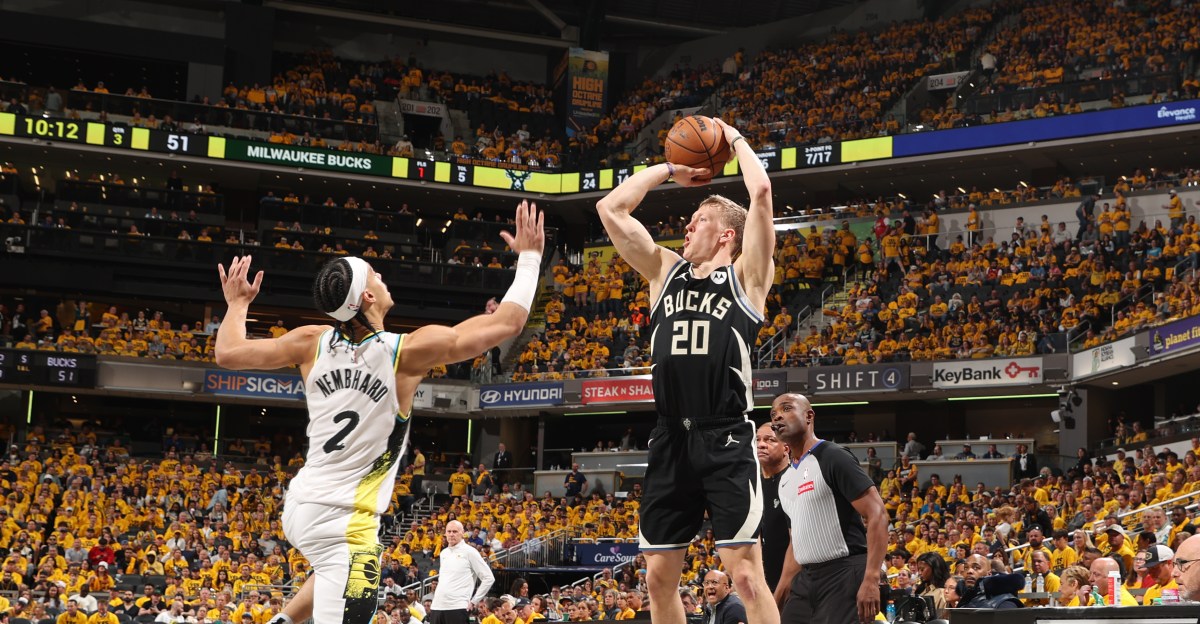
On Monday, January 13th, 2025, at 6:30 p.m., AJ Green and Stanley Umude were shooting hoops in Milwaukee. A normal night of practice after returning from playing the Knicks to prepare for the Kings coming to town? Far from it. Green and Umude were at the Froedtert & the Medical College of Wisconsin Sports Science Center with students from the Bruce-Guadalupe Community School and the Frank Lloyd Wright Intermediate School, and they were about to bring math to life.
Green and Umude were there for a live version of something called NBA Math Hoops. In the words of our managing editor: “I have no idea what NBA Math Hoops is but it made me think of Morgan.” It is here that I out myself: I was a math kid. I’ve matured, but I still only plug prime numbers into microwaves. It therefore came as no surprise that my immediate reaction was: “Trust me when I say that THIS GAME LOOKS SO FUN.” But trust me also when I say that you don’t need to be a math kid to join me in thinking that NBA Math Hoops is better than 2K.
So: what is NBA Math Hoops? How does one play? And what was it like to rekindle my old rivalry from the Lakeland Middle School Math Meet over three glitchy games of it? Buckle up, folks—it’s time for oFfSeAsOn CoNtEnT.
Where to begin. Okay: NBA Math Hoops is run by the nonprofit Learn Fresh in association with NBA Cares, the Association’s social impact program. Oriented toward elementary and middle schoolers (Grades 3 or 4 to 8, depending on the source), its goal is teaching math through basketball, with an emphasis on reducing achievement gaps based on race and class. To do that, it developed a game—also called NBA Math Hoops—and a digital equivalent of it.
But it’s not just a game. Like the NBA, NBA Math Hoops involves a full season, including:
Training camp to prepare educatorsSportsmanship contractsA draft of NBA and WNBA playersAn in-class math curriculum approved by the Boys & Girls Club of America and the YMCA, including banger videos like Odd and Even Numbers with Allan Houston, Measurement with Norman Powell, Percentages with Jarrett Allen, and Calculating the Mean with Chiney OgwumikeGameplayRegional tournamentsThe NBA Math Hoops Global Championship
Why global, you ask? The more than a million students who have participated in NBA Math Hoops since its inception in 2016–17 include kiddos from South Africa and—wait for it—Australia! Alas, only in Victoria, leaving Brew Hoop’s Adelaide Bureau out of the loop.
Here in Wisconsin (where it is sponsored by ATC), over 11,000 students participated in 2023–24, playing around 258,000 games and completing around 27 million math problems. And to wit: participating students improved their math scores by 27%.
How to play NBA Math Hoops
But let’s cut to the chase: how do you play? You can access it here or through the app. You’ll be given various log-in options: anonymous log-in works for a quick fix (and has reasonable memory if you log in again later), but it might be best to link to an Apple or Google account to keep your team over time (though I’ll discuss potential issues with that later).
When you start, you’ll be given a random team name (name of NBA or WNBA team + four random digits) and treated to an absolutely stacked lineup of NBA and WNBA players, color-coded to their positions. The players’ stats are purportedly updated in real-time, as are new players. In the settings, you can select from an impressive menu of languages. For this audience, I’ll highlight that Greek is among them.
To play games, you have three main options. There’s Head-to-Head if you want to plaster the middle schoolers playing this game for class. There’s Quick Play if you want to beat up on the computer. There’s League Play if you want to play with friends (more on that below, though). And before you begin, you can do the Tutorial, and win an award for it to boot. There are Weekly Challenges and Career Achievements!
It’s time to play! You can choose the shot clock, game length, and whether division is enabled (LOL). The game starts by rolling dice, with the highest going first and starting on the “even” side of the board. This being a math game, there are even and odd sides of the board, with players switching at halftime. The board itself is a bunch of numbers scattered around a court in colored circles indicating their corresponding player positions.
On your turn, you roll two dice. You then have to—get to!—add, subtract, multiply, and divide those numbers (0–8). If you do that correctly (and fair warning: division often requires rounding your decimals, and you leave it blank if dividing by zero), you get to select a number (i.e., shot) corresponding to one of the answers on your side of the court. You choose the shot with the best probability and spin a spinner to take it. If there is a shot, that is—if there are no matches on your (odd or even) side of the court, it’s a turnover. But if you roll double zeroes, you get to select any shot!
But watch out! Your opponent can steal the ball by calling out an incorrect answer. If they’re right, they get to take the same type of shot on their side of the board. But if they’re wrong, then you make your shot automatically! Your opponent can also choose to foul. Hard fouls only in NBA Math Hoops, so you automatically go to the line to shoot two or three shots.
When all is done and dusted, winners are rewarded with additional players, progress in challenges and achievements, and glory. If you still have questions, have I got the cringe (but helpful) nine-part YouTube tutorial for you! And rest assured: the instructions are the most boring part of any game. Let’s play!
A rivalry rekindled, eventually
To do my due diligence as a journalist, I needed to play the game myself. I first selected Head-to-Head, where I annihilated a likely middle schooler to score Nickeil Alexander-Walker. I then selected Quick Play, only to get pantsed by the computer thanks to shooting woes, especially as its math accuracy seemed to improve to my level as the game continued. But I knew to truly experience what NBA Math Hoops had to offer, I had to try League Play with a worthy competitor. So I rekindled my old rivalry from the Lakeland Middle School Math Meet for a face-off.
Immediate record scratch: we were unable to make League Play work. We tried different combinations of log-ins and devices to no avail. I received errors that literally said “Uh oh” and “Oops.” But eventually we stumbled on a combination that seemed to work: we logged in anonymously to the app and used Head-to-Head. Luckily, we were always matched with each other—it turns out that not many other folks were playing on a Tuesday evening in July.
Over the course of three games, yours truly was victorious twice, with a tie in Game 2 after one of us (not me!) left the game at the beginning of overtime not knowing we were tied. I was too stupidly locked in to the game to provide adequate play-by-play—a real shame, given my scintillating second-half comeback keyed by Thaddeus Young inexplicably turning into a premier marksman—but what follows are my insider tips on succeeding at NBA Math Hoops.
Every second counts in NBA Math Hoops; I recommend rolling the dice ASAP to buy yourself as much of the shot clock as possible.
Assuming that your opponent isn’t a middle schooler, I recommend against turning the ball over. That doesn’t sound like a hot take, but let’s walk through an example. Let’s say you’re on the odd end of the court and roll an 8 and a 2. Spoiler: that gives you no odds! (6, 10, 16, and 4, to be precise.) Instead of answering correctly and turning the ball over, give an (odd) incorrect answer on purpose. If that sounds weird in an educational math game, remember that math is like English: once you learn the rules, you get to break them. If your opponent steals, ah well; they’ll just get a shot attempt without having to math, which they would get anyway if they are a competent mathlete. Specifically, try to strike a balance: pick a number that gives you a good shot, but would give your opponent a bad shot if they steal, and ideally one that seems like a plausible answer to the equation in question. And if your opponent isn’t doing YOUR math like they should—NBA Math Hoops never sleeps—then you get an easy bucket!
With practice, you can probably marginally increase your shooting percentage by getting a feel for the spinner. You’ll want to spin it relatively slowly for more control, but note that you’ll have to respin if you spin too slowly, wasting precious seconds.
Shot clock dynamics are everything in NBA Math Hoops. You can’t foul an opponent until they pick a shot, so if you have a big lead, don’t shoot until the last second. Based on how fast you spin the spinner, don’t spin until you have 3–5 seconds left on the shot clock—in NBA Math Hoops, the shot doesn’t count if it hasn’t splashed before zero.
My titular question asks whether a glitchy basketball game for middle school math—NBA Math Hoops—is better than 2K. Let me make my final case. In the 1800s, the Impressionists were deemed heretical for painting the impressions of things rather than the things themselves. But they gained a devout following over time. It turned out that the impression of something is often more interesting than the thing itself.
Basketball is a wonderful thing. NBA 2K is a reasonable approximation of that wonderful thing. But NBA Math Hoops is a joyful impression of that wonderful thing. It’s the Claude Monet to 2K’s Albert Bierstadt: both paint glorious pictures of their subject matter, but Monet and NBA Math Hoops transcend their subject by making it subjective. NBA Math Hoops is not basketball, but it offers a glowing portrait of it through math-tinted glasses.