
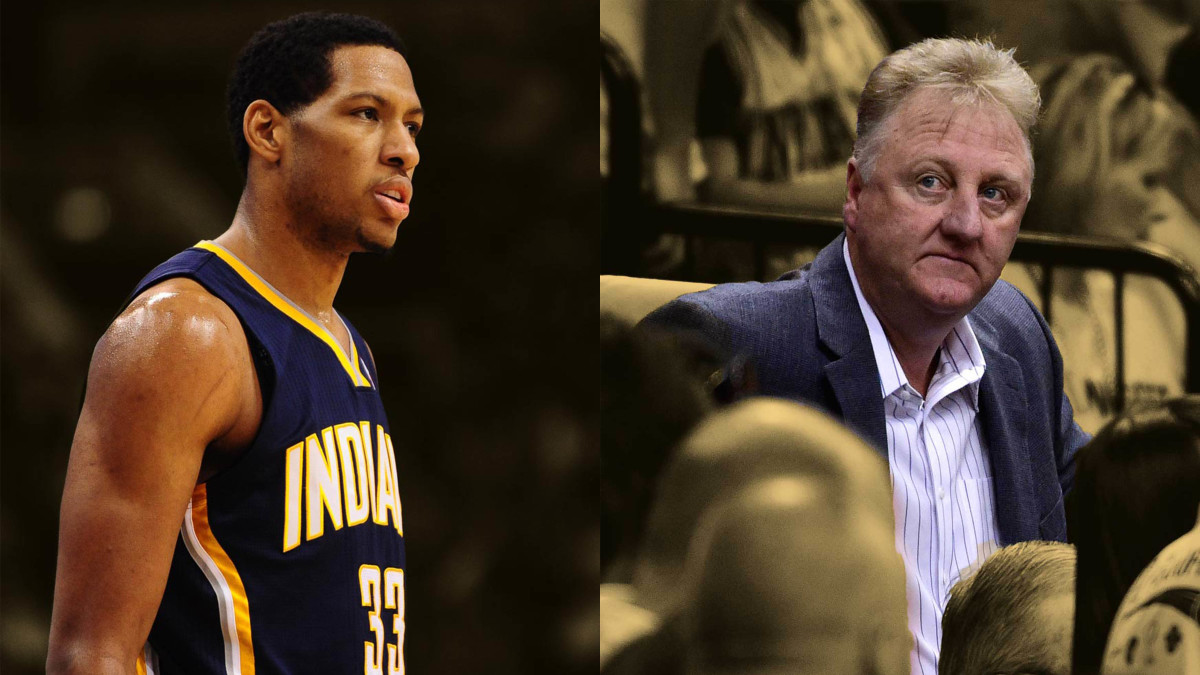
“I enjoy watching Danny Granger play in it” – Larry Bird explained why he didn’t want the NBA to retire his No. 33 jersey originally appeared on Basketball Network.
Larry Bird could have made a case for himself if he wanted to.
Advertisement
With three championships, three consecutive MVP awards and a legendary legacy, few players in NBA history have left behind a resume as complete as his.
But when the conversation turns toward jersey retirement league-wide, an honor that would place him among the rarest of icons, Bird doesn’t lean into nostalgia.
The number lives on
The fact that his No. 33 hangs high above the parquet floor in Boston Garden is, for him, more than enough. The idea of the NBA retiring 33 across the board is flattering, but unnecessary in his eyes.
Advertisement
“No,” Bird said on whether he wanted his jersey to be retired across the NBA. “I enjoy watching Danny Granger play in it. And I remember when I first got in the league, [Kareem-Abdul] Jabbar had 33 on. That made me feel good.”
Rather than demand the sanctification of his number, Bird preferred to see the number continue to breathe on younger shoulders, like Danny Granger, a player who emerged decades later, with Bird watching from a different seat.
Granger was drafted 17th overall in the 2005 NBA Draft by the Indiana Pacers, the very organization where Bird had stepped into the front office. At the time, Bird was president of basketball operations and helped guide a post-Malice-at-the-Palace franchise into a new era.
Advertisement
Granger, a lean, versatile forward out of New Mexico, became one of the key pieces in that rebuild.
Between 2007 and 2011, he quietly turned into one of the most efficient scorers in the league, even earning an All-Star nod in 2009 after averaging over 25 points per game. But like so many promising careers, Granger’s trajectory was cut short. Chronic knee injuries and lingering calf issues disrupted his rhythm and robbed him of his explosiveness.
By 2015, just a decade after entering the league, he was out of it. Bird had seen talent rise and fall throughout his life in basketball, but perhaps that’s why he respected players like Granger who wore 33 and gave everything they had to the game, even if the body couldn’t keep up.
Advertisement
A number shared, not retired
Bird’s viewpoint on jersey retirement mirrors the way he played, unselfish, team-oriented and fully aware of those who came before him. The No. 33 is part of the game’s history. To retire it across the NBA would mean erasing its future appearances from courts and box scores and Bird didn’t want that.
Advertisement
This is also a reflection of a deeper current that has always flowed through Bird’s relationship with basketball.
After the Boston legend made the No. 33 jersey iconic with the Celtics, retiring in 1992 as one of the greatest forwards ever, several other NBA legends also wore that number with pride, each leaving a unique mark on the game.
Kareem Abdul-Jabbar had already cemented No. 33 as legendary before Bird, dominating with the Bucks and Lakers. A six-time MVP, six-time champion and once the NBA’s all-time leading scorer.
Advertisement
Scottie Pippen, the ultimate sidekick-turned-star, rocked No. 33 during the Chicago Bulls’ dynasty years. Patrick Ewing wore No. 33 as the face of the New York Knicks.
Players like Grant Hill and Marc Gasol also wore No. 33. Gasol was a former Defensive Player of the Year, an All-Star and an NBA champion with the Toronto Raptors.
These players made the number iconic and not tied to a single player. However, we all know 33 starts and ends with the man himself. Who threw up his finger with his warm-up jacket blanketing his shoulders.
Advertisement
Enough said.
This story was originally reported by Basketball Network on Aug 9, 2025, where it first appeared.