
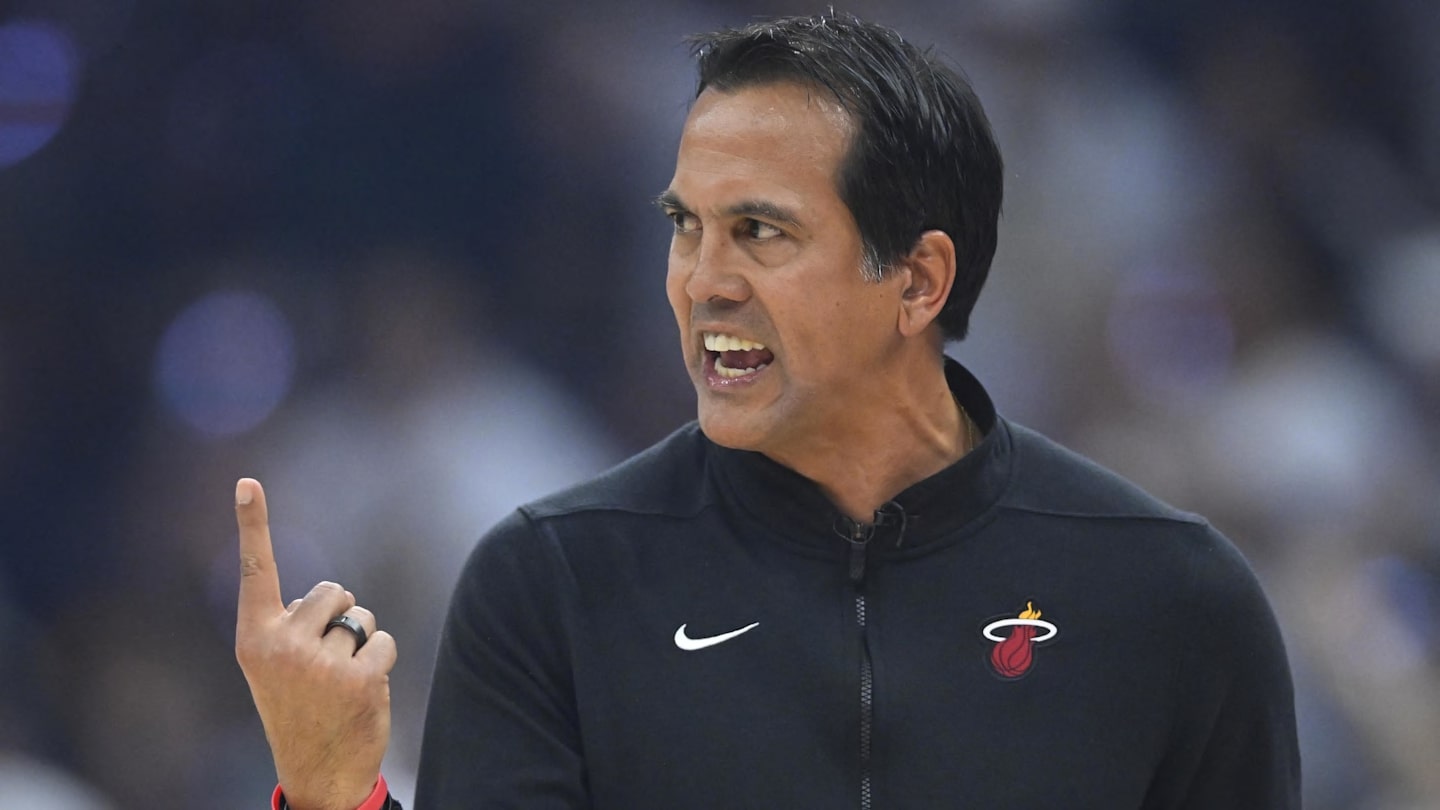
 The Miami Heat have been a bottom-third offense for each of the last three seasons. (Mandatory Credit: David Richard-Imagn Images)
The Miami Heat’s offense has struggled — significantly — each of the last three seasons.
Over that span, they have been a bottom-third offense each season, including finishing as the 21-st best a year ago, sandwiched between the Chicago Bulls and Portland Trail Blazers.
They were T-11 in 3-point shooting efficiency last year (36.7) while attempting the 13th-most threes on a per-possession basis. Yet, they were still behind the 8-ball in terms of not only process, but results.
Now that Jimmy Butler is no longer leading the charge offensively — instead, Tyler Herro and Bam Adebayo are — there must be a change in process to get this team back to an above-average offense. They brought in some more talent this offseason — namely Norman Powell, one of the league’s top 3-point marksmen.
But that doesn’t mean the results will change. Here are two concerning trends they must change for the results to (hopefully) follow.
Heat must get to the free-throw line more:
This is one I have talked about before, so I won’t spend too long on this.
The Heat lacked self-creation and weren’t able to generate many paint touches last year. They shot the sixth-fewest free throws per 100 possessions while recording the eighth-fewest paint touches. This goes beyond making 3-point shots, which is very important too.
Spoiler alert: You’re not going to get to the free-throw line often if you don’t drive to the rim. Powell, 32, has done a great job developing his all-around game, including his slashing ability.
But this will be a team-wide issue they must fix — the more free throws you take, the more compromised your opponent is not only from a foul-trouble perspective, but from a scoreboard perspective, too (they’re free points!!!).
Heat must push the pace:
Throughout Erik Spoelstra’s tenure, outside of the Big 3 era, the Heat have operated with one of the slowest paces in the entire NBA. They have finished among the bottom-four teams in pace each of the last six and in seven of the last nine seasons.
With Butler, who was excellent at creating advantages in the half-court at his own pace, they could afford to get away with that. But with Herro and Adebayo as two of the team’s top offensive players, no longer is that the case.
Speeding up the mojo won’t completely guarantee results. But it simply helps the Heat score more possessions; more bites at the apple are important. It also allows the Heat to create more — and perhaps easier — advantages, whether it’s early in the shot-clock or in transition. That’s important for generating beneficial offensive results.
Last season, the Heat placed in the bottom-eight in shots attempted in late shot clock (defined by attempts with 4-7s on the shot clock) and very late clock (0-4s) situations. They also finished T-2 in eight-second violations (4) and sixth in shot-clock violations (72).
The latter can still happen with more pace. But the Heat’s lack of self-creation should prompt them to be more proactive in generating as many possessions as possible. Its ability to get stops and be disruptive defensively plays a part, too.
Ultimately, making life for your best players easier, not harder, should always be the goal. And I don’t see how another slow-paced season generates different results — it’s the definition of insanity.
***
To check out our other content, click here.
Follow Hot Hot Hoops on Twitter/X here!
Follow Hot Hot Hoops on Instagram here!
Subscribe to our YouTube channel here!