
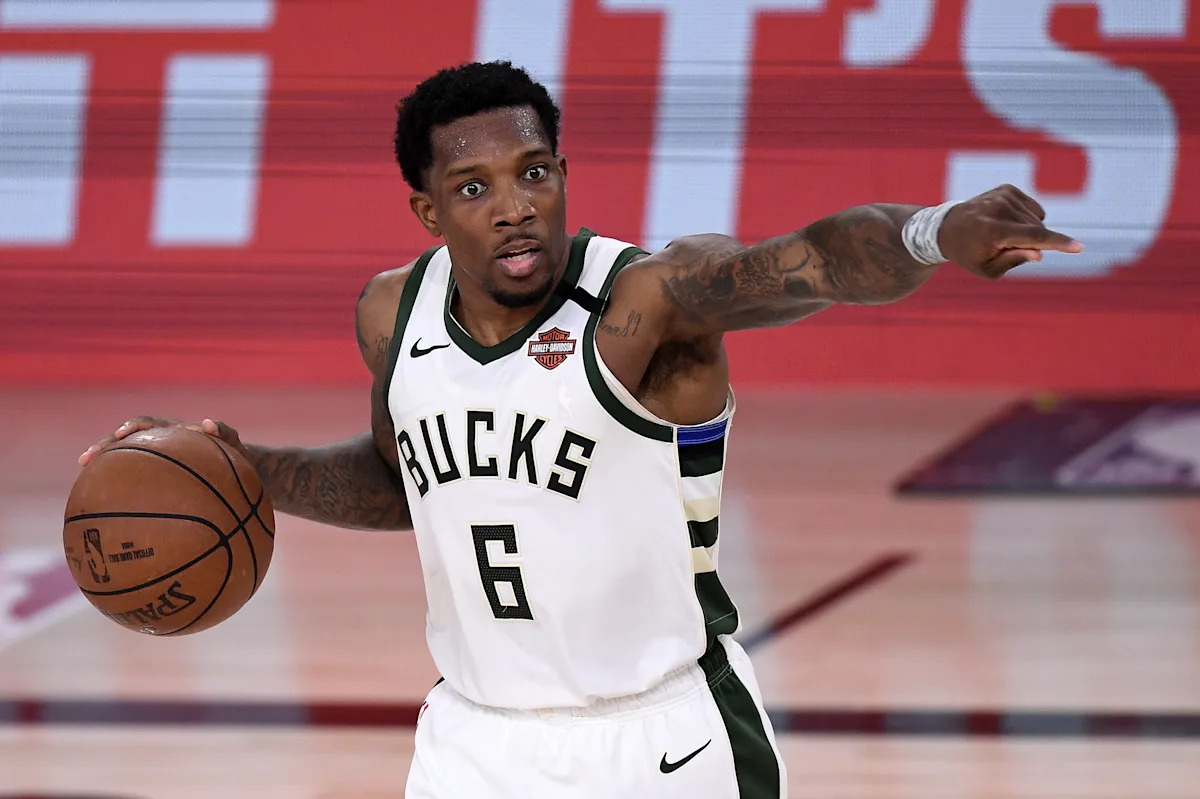
Ever since Giannis Antetokounmpo became a perennial MVP-level talent and the Milwaukee Bucks could realistically see themselves as contenders, they have been working with a point guard who has limited the team’s potential on one end of the court. For Eric Bledsoe and Jrue Holiday, that was on offence; for Damian Lillard, that was on defence. Ultimately, it’s hard not to think that these players’ pronounced weaknesses might have cost the team significantly.
In this series, I wrote three chapters, each with three sections. One section within each chapter will be a discussion about the point guard of that time (specifically, their pronounced weakness), and the other two will focus on topics connected with the events that occurred during that point guard’s tenure in Milwaukee. Combined, these three chapters will navigate the Bucks’ complicated journey from 2018 to now, (mostly) quantitatively analysing how each move at point guard impacted that journey.
Advertisement
Disclaimer: I approached writing this article exclusively from a basketball results-focused perspective when discussing front office decisions. For example, past reporting has indicated that what Giannis and GM Jon Horst have each wanted haven’t always coincided, but that Antetokounmpo has often won out, understandably. These moves might not have yielded the desired on-court success, but could be considered “successful moves” because they may have played a role in Giannis extending his contract. For this article, I deliberately did not take that angle into account.
I fully acknowledge that team building does not occur in a vacuum, and stress that this story should be read more as a thought exercise than a referendum on the past. For what it’s worth, my overriding belief is that the front office should always make decisions based solely on what they believe will bring the team the greatest on-court success—even if that happens to be incongruous with what Antetokounmpo thinks will achieve said success—because ultimately, it’s the front office’s job to figure out how to make the team win, and winning will be the biggest boon in keeping the two-time MVP anyway.
What is weak link theory, and where do its elements apply (and not apply) to Bledsoe, Holiday, and Lillard?
In writing about the years-long issue Milwaukee has had with one-way point guards, my mind immediately went to weak link theory. What is weak link theory? In essence, it is a theory that can be applied to many different sports, stating that the most positively influential players have less impact on team success than the most negatively influential players do. For those interested in a deeper explanation, Owen Phillips has written extensively about weak link theory on his Substack, The F5. Looking at it through a basketball lens, weak link theory states that a player who defends poorly or cannot shoot efficiently, for example, will do more to limit a team’s ceiling than a flawless player can do to raise it.
Advertisement
In fact, Caitlin Cooper—who writes about the Indiana Pacers on her excellent blog named Basketball, She Wrote—spoke on her podcast with Pacers head coach Rick Carlisle about a slew of topics centred around “playing random” (Coach Bud might’ve been onto something there). In that podcast, one of the topics discussed that related to playing random was the Pacers’ high-octane, chaotic tempo. Specifically, Carlisle got into why Indiana opts to guard 94 feet and the physical demand that places on his players, which dovetailed into the advantages of having lots of serviceable players without notable weaknesses who can rotate through and not miss a beat on either end, essentially discussing the increasing prevalence of weak link theory in today’s game without necessarily labelling it as much:
“The NBA game has now become a play-hard league. It’s not just being top-heavy with stars. Roster construction is changing. It’s become more important to have more good players than be top-heavy with two or three great players that get all the touches.”
Rick Carlisle
Now, if I’m discussing weak link theory through a Bucks lens, the position that I think it would apply to the most would be the ever-rotating cast of shooting guards. Andre Jackson Jr., Wesley Matthews, Grayson Allen, Malik Beasley, I can go on. The point is, none of those guys fit what the Bucks needed out of that position because, while they were solid players, they were too flawed to be starters on a championship team. They were “weak links” in the truest sense, I suppose. But I want to make a diversion in this article and discuss a slightly different idea: that the Bucks have spent the last seven seasons with starting point guards who ended up being severe weak links on just one end of the floor, while being elite at the other. This complicates things because these players, unlike the shooting guards I mentioned above, functionally cannot be taken off the court; you’re living and dying with their weaknesses. Now that I have that preamble out of the way, I want to dive deeply into how the Bucks got to the current moment, starting with the 2018–19 season.
Back to where it all began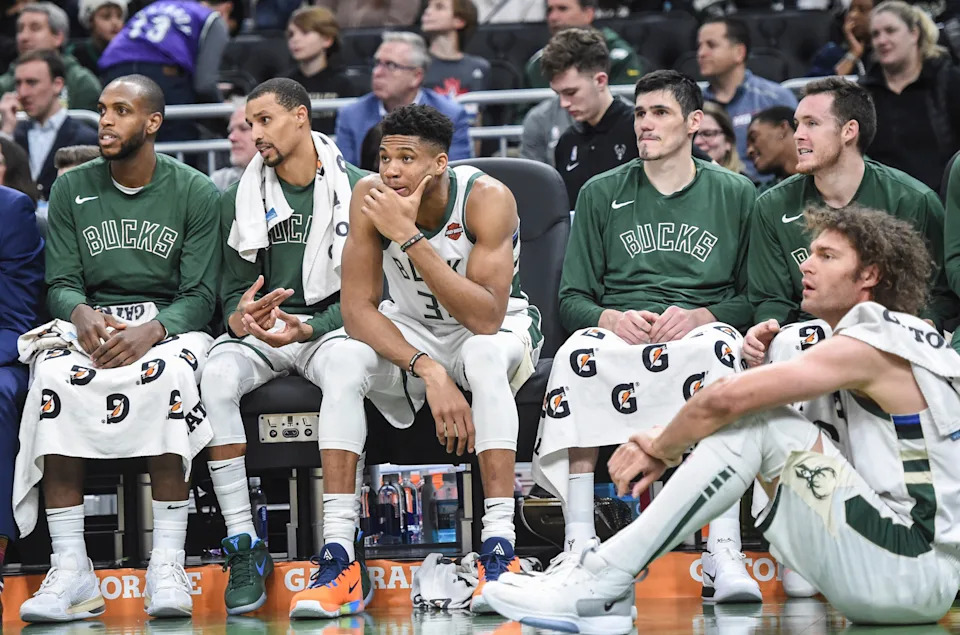
The Bucks became a dominant defensive team in the 2018–19 season, mainly due to Mike Budenholzer installing his analytics-based defensive system. But no matter how innovative a defensive system itself is, it still requires prolific individual defenders to bring it to life. Giannis was (and still is) a two-way machine, Eric Bledsoe made his bones as a point-of-attack pit bull, Brook Lopez developed into one of the better drop defenders in the league, and Ersan Ilyasova was seemingly the league’s most proficient charge taker! The Bucks became known that season for their ability to dominate games on defence (first in defensive rating). Additionally, Giannis led the team to the fourth-best offensive rating in the league.
Advertisement
Much of the reason Milwaukee was so potent on offence, despite not having many dynamic shot makers, was because of their stifling defence. By consistently forcing opponents into a bunch of missed shots, the Bucks were able to attack defences that weren’t set and regularly score in transition; having Giannis helps with that, for sure. The team ended the 2018–19 season tied for first in transition points. In fact, Milwaukee ranked within the top three teams for transition scoring in Budenholzer’s first four seasons at the helm, which is pretty remarkable. This defensive identity gave the team such a high floor, making them incredibly hard to beat from night to night. Side note: As I’ll get to in Chapter 3, that floor seemingly began to diminish in Bud’s final season in 2022–23 when the team finished ninth in transition scoring (despite their defence remaining elite at fourth). Now, given the fact that defence stayed steady, that dip in transition scoring may well have been an outlier, but it’s impossible to know for sure; there wasn’t another season with the same core to test that theory out. Then, as the team’s main pillars got shifted around the following season, the transition scoring decline continued, finishing 12th in 2023–24 and plummeting to 22nd last season.
But let’s get back to the 2018–19 season, where Milwaukee had seemingly struck the perfect balance on both ends entering the postseason, winning 60 games and earning the top seed in the Eastern Conference. Funnily enough, the Bucks had the same statistical profile in the playoffs (first on D and fourth on O) that they had in the regular season; as the NBA champion table later in this article shows, that statistical profile is safely within the realm of previous NBA title winners. I discussed the advantages of transition scoring in the above paragraph: it allows teams to attack defences that aren’t set. Well, attacking defences that aren’t set is especially preferable in the playoffs compared to going against the opponent’s half-court defence due to the extra time opponents have to prepare and the raised level of competition. Let’s just say Milwaukee took that advice to heart! This stat seems almost fake, but in addition to the regular season, the Bucks also led the league in transition scoring during the 2018–19 playoffs, averaging 29.9 points per game; the next highest transition scoring team averaged 21.7 points per game. No, that is not a typo. Absolutely bonkers.
Anyway, despite all of these positive statistical indicators, the team couldn’t get it done that postseason; I don’t need to do the play-by-play. Milwaukee lost that Eastern Conference Finals series for several reasons, one being that they played a great team in Toronto, another being the way the Raptors stymied Giannis to a degree that other opponents had not. However, an under-discussed reason was that the team’s starting point guard, Eric Bledsoe, struggled to shoot efficiently and was a weak link in Milwaukee’s offensive chain.
Weak link #1: Eric Bledsoe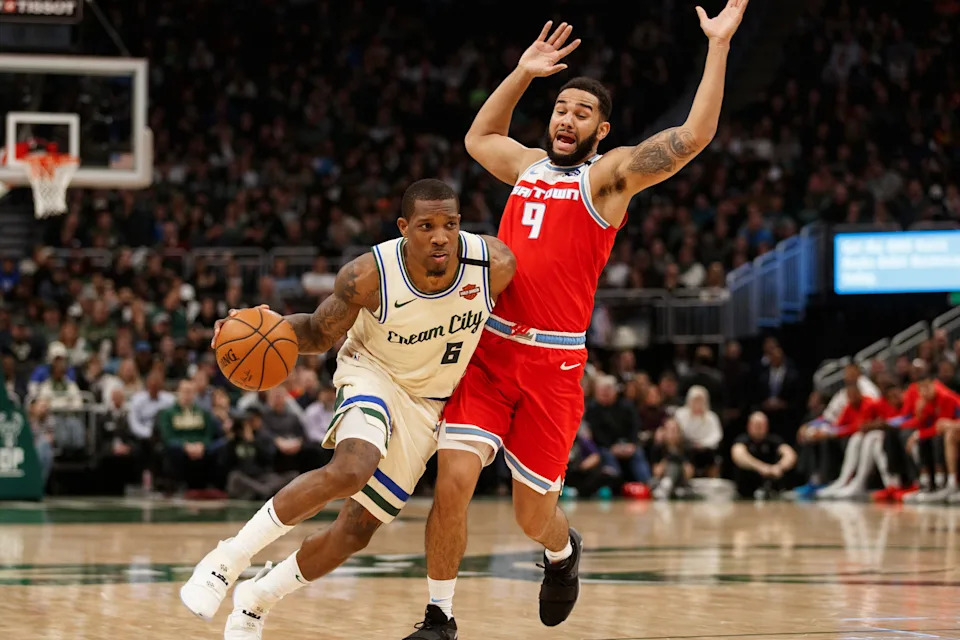
Key elements of weak link theory hit Milwaukee at the most inopportune time, in the form of Eric Bledsoe, whom the Bucks acquired from Phoenix the season prior in a trade for Greg “Moose” Monroe. Ironically, in ESPN’s write-up of the trade, they paraphrased an unnamed Eastern Conference head coach who believed Bledsoe would immediately become the Bucks’ best pick-and-roll player (swing and a miss there!) but, and I quote, “wondered how Bledsoe would assimilate away from the ball when Antetokounmpo is making plays.” An ominous harbinger for things to come, and boy, did they ever. Eric struggled in that series against the Raptors. In total, he shot 5/29 (17.2%) from three and 15/39 (38.5%) from two. The Bucks were so close to going up 3-0 against the Raptors and booking their ticket to the NBA Finals. If Bledsoe shot even marginally better, that might well have put them over the edge.
Advertisement
But those shooting struggles weren’t a one-time thing either. The Bucks again finished with the Eastern Conference’s top seed in the following season. They dismantled Orlando in the first round of the playoffs without much fuss and faced the Heat in the second round, eager to return to the Eastern Conference Finals. But it all came crashing down, and Milwaukee lost in five games to Miami (of course, ancillary factors such as the Covid “bubble” and the team’s stand for racial justice during that time played roles as well). In that series, Eric shot 3/14 (21.4%) from distance and 13/34 (38.2%) from two. Following that disappointing series loss, Jon Horst made a monumental move to trade Bledsoe for Jrue Holiday. The hope was that adding Jrue would allow the team to maintain or even improve its already elite defence while also being an upgrade on Eric’s offence. And to be clear, Jrue’s stats before getting traded to Milwaukee reinforced the idea that he could help achieve such two-way success for the team. Unfortunately, that theory did not play out in practice when it mattered most…
Chapter 2 of this series will be published next week, discussing Jrue Holiday’s offensive struggles in the playoffs with the Bucks, statistically analysing Milwaukee’s title and how it compares with prior champions, and if the trade for Holiday actually paid off. I know this chapter may have seemed a tad brief; including the introduction and obligatory preamble meant the Bledsoe section would be a little shorter. Expect more robust analysis in Chapters 2 and 3. Thanks!