
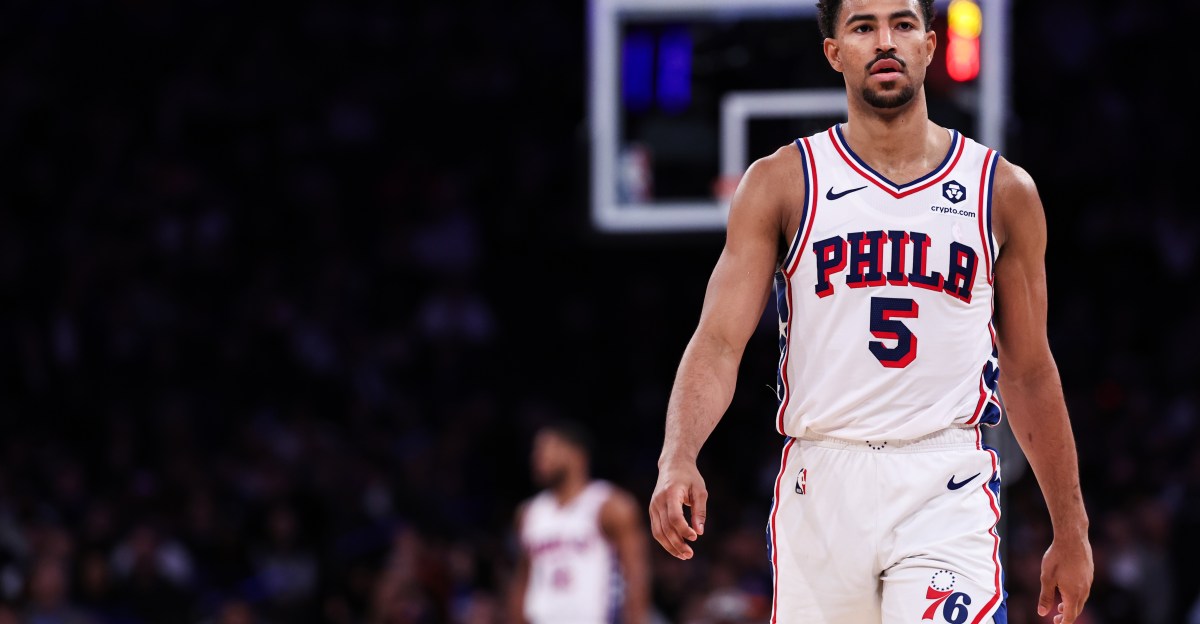
We’re deep into August, a period often known as the quietest time on the NBA calendar. By this point, most free agency moves are usually finalized, Summer League has become a distant memory, and aside from schedule updates, there is typically not much to discuss. I say usually because this year, things have been different.
The NBA’s new collective bargaining agreement has slowed many processes, especially in the restricted free agent market. While max contracts for players like Cade Cunningham, Evan Mobley, Scottie Barnes and Franz Wagner have been settled, many from the 2021 draft class are still struggling to finalize deals. This group includes Quentin Grimes along with other productive young talents such as Josh Giddey, Cam Thomas and Jonathan Kuminga.
Apart from scuttlebutt here and there, it’s been relative radio silence on the Grimes’ front. Nothing suggests things are closer now than they were at the opening of free agency. NBA Insider Jake Fischer recently touched on several restricted free agent updates, including Grimes:
“The Sixers continue to express confidence that they will re-sign Grimes despite the stalemate there.
My read is that the sides will ultimately see sufficient mutual benefit in a new deal to hash out something that starts above Grimes’ $8.7 million qualifying offer.
That said …
The Sixers are clearly in no rush to strike such an agreement with Grimes, like his fellow RFAs, unable to generate an offer sheet because no team other than Brooklyn has the salary cap space to present one.
Which means Grimes has his own thinking to do about taking the qualifying offer himself.“
For the most part, this isn’t much of a development. The Sixers have consistently expressed confidence in re-signing Grimes throughout the summer, and that stance likely won’t change now that Guerschon Yabusele, who was affected by those contract talks, has left the team. Fischer did mention the possibility of Grimes taking his qualifying offer, an idea he brought up a few days ago. It’s important to note, however, that Fischer did not report this as confirmed and referred to it more as “smoke” suggesting Grimes might consider that option.
A quick crash course for those unfamiliar with restricted free agency: teams can extend a qualifying offer to players coming off rookie-scale contracts at a specified rate. This qualifying offer makes the player “restricted,” meaning their current team has the right to match any offer sheet the player signs with another team, allowing them to retain the player. If the player does not receive an offer sheet from another team, they can choose to sign the qualifying offer. This pays them for one year and allows them to become an unrestricted free agent the following season, free to sign with any team they choose.
So, with Grimes’ free agency still unresolved, should you expect him to take the qualifying offer? The short answer is probably not.
If Grimes signs his qualifying offer, he would return to the Sixers on a one-year, $8.7 million deal. On paper, this might seem like a reasonable option if he wants to bet on himself. However, there are other implications to consider. By signing the qualifying offer, Grimes would receive a no-trade clause, which means he would stay with the Sixers for the year unless he requests a specific trade destination and works with the team.
Grimes could sign the qualifying offer and choose to waive the no-trade clause, but this would complicate things for him later on. Any team that acquires him without the no-trade clause would not receive his Bird rights. In short, unless the acquiring team has plenty of cap space, such as the Brooklyn Nets, they would likely be unable to offer him a lucrative long-term contract. Grimes is 25 years old and on the brink of entering his theoretical prime. Landing with a team likely to be in the lottery probably isn’t his top preference at this stage of his career.
You also have to consider that if he signs the qualifying offer, there’s a strong chance he would remain in Philadelphia, at least in the short term. Without any long-term guarantee, the Sixers could easily shift focus to their other talented young guards, which would reduce Grimes’ playing time, impact his stats, and ultimately hurt his chances for a bigger payday in the future.
As you can see, there are plenty of considerations for Grimes when it comes to actually taking the qualifying offer and betting on himself. So why are we still hearing about it despite the strong reasons against it? The answer is simple: it’s the only card Grimes and his camp can really play in negotiations. Restricted free agency is notorious for giving agents little to no leverage, and the current CBA — which penalizes teams for overspending — doesn’t help matters. With no serious suitors left to offer him a significant contract, this qualifying offer is essentially the only option Grimes and his agent can use to try to extract more money from the Sixers.
While fans might be frustrated with this and negotiations in general, Grimes’ agent is simply doing his job. NBA money can be unpredictable, but if his agent manages to squeeze out an extra $100,000 or even $1 million, that’s a win. Some might remember Charles Bassey, who, in a different situation, held out for an additional $50,000 in guaranteed money. It may seem small in the context of NBA contracts, but these kinds of wins matter a lot from an agent’s perspective.
All of these factors, and more, suggest that Grimes is unlikely to take the qualifying offer and will instead sign a new contract, as Fischer points out. Even if Grimes doesn’t see a long-term future in Philadelphia — especially given the team’s significant investment in younger guards — it makes more sense for him to agree to a two- or three-year deal that guarantees a payday above the qualifying offer. Such a contract is easier to trade, and teams will have more incentive to offer assets to acquire him. While sign-and-trade ideas have been mentioned, they are difficult to execute, especially in August. Trading Grimes mid-season would likely be a much simpler option for all parties involved.
That being said, there is little to suggest that Grimes is unhappy in Philadelphia. A few weeks ago, he even posted a picture of himself in a Sixers uniform. While many point to the crowded guard situation on the team, I would argue that Grimes and newly drafted VJ Edgecombe not only can play together but can be quite effective as a duo. Both are two-way players with the ability to defend multiple positions.
It’s also important to consider the context of Grimes’ career. He was the 25th overall pick and has earned around $11 million over his first four NBA seasons. Grimes has been somewhat of a journeyman, playing for four different teams during that time. At the end of the day, money matters, but players are human too; most benefit from planting roots at some point in their careers if the opportunity is there.
Assuming Fischer’s information is accurate, signing a deal above the qualifying offer could match Grimes’ total career earnings in just one season, potentially nearly doubling it. That’s a substantial pay increase. While his agent is likely arguing that Grimes is worth more based on his performance during the tank stretch, it’s important to remember that it was exactly that — a tank stretch. Grimes performed well, but those games were essentially meaningless, and the sample size is relatively small.
Early reports suggested that Grimes could earn the same or more than this year’s mid-level exception, which is valued at roughly $14.1 million per season. This would be a solid mid-level number for the Sixers to use in a trade if things don’t work out, especially considering their roster is loaded with large contracts for Tyrese Maxey, Joel Embiid and Paul George. On the other hand, Grimes would receive a healthy pay raise and wouldn’t have to worry about securing his bag in another free agency period.
I imagine both the Sixers and Grimes’ camp want this resolved before training camp begins. There’s a realistic path for Grimes to secure a solid payday and for the Sixers to sign him at a number that fits their roster, and it shouldn’t have to drag much longer. Whether the deal comes in late August, September or early October, the expectation is that the two sides will eventually find common ground. The question is whether they’ll wrap it up in time or if it will join the long list of Sixers contract disputes.