
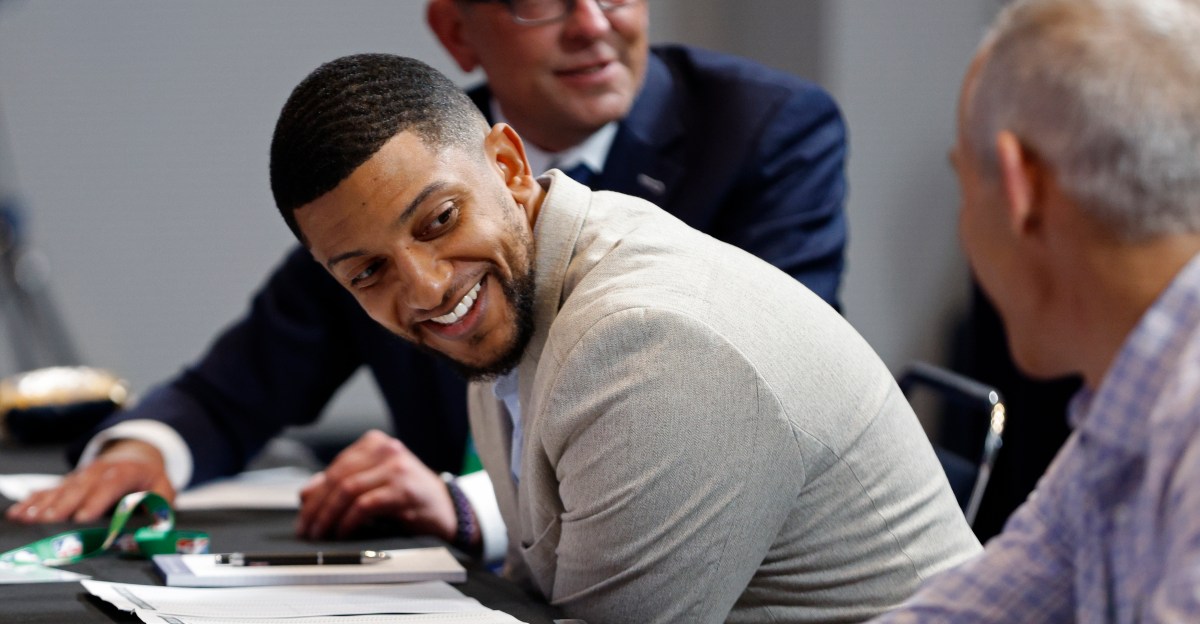

The end of tanking is near for Will Dawkins and the Washington Wizards NBAE via Getty Images
The Washington Wizards are going to be bad again this season. This is not breaking news. They need to lose because if their first round pick lands ninth or later, it goes to the New York Knicks. If the pick does not convey in 2026, it converts to two second rounders — one in 2026, the other in 2027.
This would mark final payment on the trade Tommy Sheppard made, which sent John Wall and the conditional pick to the Houston Rockets for Russell Westbrook. Westbrook played one season in Washington (2020-21) before he requested a trade and got sent to the Los Angeles Lakers along with a couple future second round picks in exchange for Kyle Kuzma, Kentavious Caldwell-Pope, and a first round pick in the 2021 draft. (On draft night, they traded that pick for Aaron Holiday and the opportunity to pick Isaiah Todd.)
This, by the way, was the last season Westbrook’s production rated average or better in my PPA metric. In other words, things did not go well for Westbrook and the Lakers.
But I digress. I’m not trying to rehash the past today or talk about the Lakers because the current front office is approaching a pivot point in their efforts to build a contending roster.
The dismantling is nearly complete. The only players remaining from the Sheppard era are Corey Kispert and Anthony Gill. Kispert is entering the first year of a four-year extension that declines in value. It’s doubtful he finishes that extension in Washington. My guess: he’ll be traded by the 2026 deadline.
Gill amounts to an assistant coach in uniform. The team waived and re-signed him as a cap maneuver to get him a higher salary and shift the cost of that extra money to the league. The NBA pays the difference between the two years of experience minimum and the minimum salary the player receives based on his additional years of service. It’s a cool move — Gill gets more money, which the team doesn’t have to pay. Win-win.
Their big move this offseason — aside from drafting Tre Johnson — was trading Jordan Poole for C.J. McCollum and other stuff, some of which they’ve already moved in other deals. The net-net was to create some trade exceptions and LOADS of cap space for the 2026 offseason. Barring trades, they’ll have eight players on rookie deals next summer and $90+ million in cap.
Now, cap space isn’t a panacea. Elite players rarely move in free agency anymore — they sign extensions with their existing teams and then request trades. Or, they get traded because their existing teams don’t want to pay the lucrative extensions they know the player will demand (and likely be offered by some other team).
Cap room provides flexibility though. It’ll enable Washington to trade for high-salary players without matching salaries, or take draft picks and young players in exchange for a year or two of bad salary from a contending team, or a team that simply needs to out of the luxury tax.
They could also use the money to sign several good-not-great players to provide depth and fill roles while banking on development of some of these youngsters into whatever they can become…and using their portfolio of draft resources to select fresh prospects.
The arsenal of player acquisition assets isn’t as well-stocked as those of some other rebuilding (or championship-winning) teams, but it’s also not as sparse as it was when Michael Winger and Will Dawkins took charge. They have extra first rounders in upcoming drafts and will likely obtain more with additional trades.
In other words, the current front office has done a solid job with the first part of the rebuild — turning an aging and declining roster into one with youth and potential while also clearing future financial obligations and adding draft assets. That’s the easy part, though.
Things get more difficult from here. They’re engaged in the messy work of investing time and resources in player development (hire a shooting coach, though). That could pay off big down the road…if the players do the work on their bodies, skills, and decision-making.
The next step — building a competitive team — is more difficult yet. The 2025-26 season should be the final free pass on a sub-20 win season. After that, ownership and fans should anticipate seeing youngsters maturing into good NBA players and the front office getting more aggressive in using the abundant cap space and draft picks to add to the rotation. And the Wizards should start competing for the playoffs and making progressive improvements from there.