
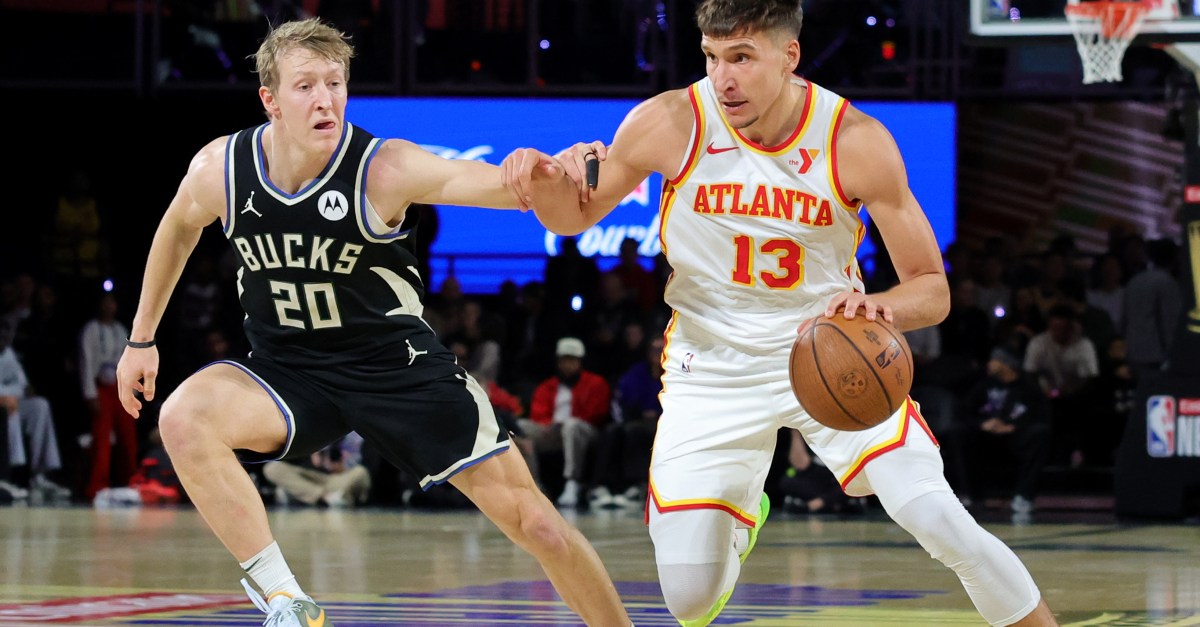
9. BogdanGate: the failed Bogdan Bogdanović trade (2020)
This was a story straight out of a crime movie: intrigues, information leaks, an NBA investigation, and a penalty. Unfortunately, the victims were the Milwaukee Bucks, specifically their reputation and plans to strengthen the roster. Let’s rewind to November 2020. The Bucks, fresh off a humiliating loss in the bubble (2020 playoffs, 1-4 defeat to Miami), were seeking reinforcements to convince Giannis Antetokounmpo to sign his contract extension (the supermax). Rumors circulated that the Bucks were determined—and indeed, on November 16, news broke of a major trade: Milwaukee acquiring Jrue Holiday from the New Orleans Pelicans for a package of players and picks. Fans celebrated—it was a significant positive move. But that wasn’t all—within hours, another bomb dropped: the Bucks had reportedly agreed to acquire Bogdan Bogdanović from the Sacramento Kings.
Bogdanović, a sharpshooter from Serbia, was then a restricted free agent. The plan involved a sign-and-trade: the Bucks were supposed to receive Bogdan and a certain wing (Justin James) in exchange for Donte DiVincenzo, Ersan Ilyasova, and DJ Wilson. Information about the transaction was spread by a top insider (Adrian Wojnarowski), so everyone took it as a certainty. Bucks fans went into euphoria: Holiday + Bogdanović? Close the arena, they have a title! The problem was that the official start of free agency was still a few days away. The NBA has strict rules: negotiations with free agents before the market opens are considered tampering—illegal activities. So it turns out someone from one of the parties involved agreed on the details too early and even leaked it to the press. Chaos erupted.
The league launched an investigation, and in the meantime, Bogdanović himself poured fuel on the fire by stating that he hadn’t agreed to anything and intended to test the market. Suddenly, the Bucks’ intricate plan began to crumble. On November 20, when free agency officially opened, it turned out that Bogdanović was meeting with other teams—meanwhile, Milwaukee had to watch helplessly. The result? Bogdan signed an offer sheet with the Atlanta Hawks (4 years for about $72m), which the Kings did not match—he became a Hawk. The Bucks were left with nothing. Well, almost—they were left with suspicions of manipulation. The NBA ultimately punished Milwaukee with the loss of a 2022 second-round draft pick, stating that there had been illegal talks (tampering) in the attempt to acquire Bogdanović.
This incident—let’s call it BogdanGate—is a mistake that might not have cost the Bucks a specific player from their roster (like other trades on the list), but it cost them lost potential. Imagine if this transfer had gone through legally: in the 2020–21 season, the Bucks would have had both Holiday and Bogdanović alongside Giannis and Middleton. This would have meant four players capable of scoring 15+ points in every game, including two very good outside shooters (Middleton and Bogdan) and an elite defender/playmaker (Holiday). In the real world, the Bucks still won the 2021 championship, but with great difficulty—they sometimes lacked a shooter in the rotation (let’s not forget that after the Bogdan fiasco, they had to quickly sign Bryn Forbes). Bogdanović landed in Atlanta… and coincidentally, the Hawks were the Bucks’ opponent in the Conference Finals that year. A small twist: Bogdan played that series with a knee injury and didn’t shine, but the mere fact that a player who was supposed to be theirs happened to be fighting on the other side of the court was strange.
From the Bucks’ perspective, the situation was triply frustrating:
Firstly, they lost the chance for a great player at a relatively moderate price (they were only supposed to give up DiVincenzo and two backups).
Secondly, they were publicly humiliated—in the eyes of the league and fans, they came across as amateurs who couldn’t even close a transfer according to the rules. Other teams also tamper (it’s an open secret), but here it was done so poorly that it caused a huge uproar.
Thirdly, they had to live with the consequence: no Bogdan meant less firepower. True, they ultimately succeeded—they won the championship without him. So one might ask: was it even a mistake if they didn’t lack anything in 2021? In my opinion, yes, because although the ultimate goal was achieved, the path was winding and perhaps more bumpy than necessary. Having Bogdanović in those playoffs, for example, in the series against the Nets, where every three-point shooter was worth their weight in gold, would have been a luxury.
In the long run, Bogdanović with the Bucks could have extended their championship window. After the 2021 season, they lost Tucker (see previous point), and Forbes wasn’t the answer to anything. In Atlanta, Bogdan served as an important bench player in subsequent seasons, averaging ~15 points per game on ~39% from three—exactly the type of player the Bucks needed as support for Giannis and co.
It’s hard to understand who was to blame for BogdanGate. Perhaps the Kings’ front office talked too early, or someone from the Bucks wanted to make a splash and didn’t ensure discretion. One rumor said that Bogdanović himself wasn’t thrilled about the idea of joining Milwaukee without being consulted (after all, as a free agent, he expected to choose his destination). A Bucks’ front office source communicated to Brew Hoop in 2022 that Bogdanović‘s agent scuttled the deal. So when the news broke, he felt his pride was hurt and decided: “No way! I’ll test the market.” For the Bucks, it was a lesson: don’t count your chickens before they hatch—and keep your mouth shut until the transfer is official.
BogdanGate, as a mistake, lands at number nine. Perhaps not as catastrophic sportingly as others, because ultimately the Bucks won the title, and we can’t say “this ruined them.” But as a PR blunder and a lost opportunity, it was outstanding. Every Bucks fan remembers those few rollercoaster days: first joy (“they got Bogdan!”), then consternation (“wait, is this illegal?”), then anger (“why did they mess this up?”), and finally relief mixed with regret (“Holiday is here, the championship is here, but Bogdan is gone and won’t be…”). For a long time, every mention of tampering will reference Milwaukee 2020 as a cautionary tale. And Bogdanović himself? Well, his name became synonymous with “what could have been, but wasn’t.”
8. Dismantling “Fear the Deer”: trading Brandon Knight for Michael Carter-Williams (2015)
It was January 2015, a season in which the young Milwaukee Bucks were starting to spark hope among fans. After a disastrous tank season in 2013–14 (15 wins), the team rebounded surprisingly quickly under the leadership of the aforementioned Jason Kidd and thanks to the development of players like Giannis, Middleton, and especially Brandon Knight. The latter, acquired two years earlier from Detroit, had finally grown into the team’s leading scorer. In the first half of the 2014/15 season, Knight was averaging nearly 18 points and 5 assists per game, hitting three triples per contest at 40% efficiency, and adding a couple of game-winners. The Bucks were playing above expectations—around the All-Star Game, their record was 30-23 and a solid sixth place in the East. People started calling them “Fear the Deer” (the slogan from the 2010 playoffs revived), and some journalists even thought Brandon Knight deserved consideration for the All-Star Game (he didn’t make it ultimately, but he was close).
And then something strange happened. The Bucks’ management—particularly GM John Hammond and reportedly, a heavily lobbying coach Kidd—decided to… dismantle this accelerating machine. On trade deadline day in February, they executed a complicated three-team trade with the Phoenix Suns and the Philadelphia 76ers. By its terms, Brandon Knight went to Phoenix, while Michael Carter-Williams (from Philly) and two young players: Tyler Ennis and Miles Plumlee (from Phoenix) arrived in Milwaukee. It was a complete surprise. After all, Knight was the best player on the Bucks that season, keeping the offense in check. He was expected to command a hefty salary in the summer (his rookie contract was expiring, he was heading for RFA status), but the Bucks had his rights—they could have kept him or at least negotiated. However, it was decided that: a) Knight would demand too much, b) he wasn’t a true point guard but a combo guard, and c) the team wasn’t going to win a championship right away anyway, so why not look long-term?
And here enters MCW, all in white (well, maybe a somewhat faded white, a Polish expression for a grand, often ironic, entrance). Michael Carter-Williams, the 2013–14 Rookie of the Year, came with a reputation as a talented, tall (6’6”) point guard who won that award under rather curious circumstances: his 76ers were hopeless (they were tanking), and he was putting up nice stats (ca. 17 PPG, six RPG, six APG) with horribly poor efficiency and a ton of turnovers. In his second season, MCW didn’t improve his shot—he still couldn’t shoot from distance (barely 25% from three for his career), so the Sixers were happy to trade him because they were collecting picks, and he was shedding a year off his rookie contract. The Bucks apparently saw something in him that fit their philosophy: long arms, defensive potential, ability to play fast breaks, and youth (23 years old).
However, as one might have expected, swapping Knight for MCW disrupted the chemistry. The Bucks, up until the trade, had a tolerable offense—Knight might not have been a classic playmaker, but he hit important shots and created for others at a decent level. After his departure, the offense stalled. Carter-Williams tried to step into the point guard role, but his limitations were immediately apparent. First and foremost, paired with Giannis or Middleton, a guard who could shoot from beyond the arc was needed. MCW absolutely did not provide that; opponents sagged off him on the perimeter by several feet. His drives to the basket often ended chaotically. Kidd tried to mask this, giving the ball more to Middleton, and MCW was supposed to focus on defense. Indeed, Michael showed flashes as a defender (height, long arms—he could rebound, block), but what good was that when he was like a headless horseman on offense?
The balance sheet? The Bucks, after the trade, saw a clear decline: from a team playing at ~57% winning percentage, they became a team winning perhaps every other game. They finished the season 41-41 (meaning they went 11-18 from the trade deadline). In the playoffs, even without Knight, they managed to scare the Bulls (lost 2-4 after an ambitious fight), but the offensive shortcomings were glaring. When it came to the decisive Game 6, the Bucks scored a miserable 66 points (the lowest in club history in the playoffs!) and suffered a 54-point defeat. Carter-Williams was a background player in that series—meanwhile, Knight watched from home, as Phoenix didn’t make the playoffs.
After the season, some Bucks fans were painfully convinced that MCW was not the answer. Nevertheless, the team gave him a chance the next season as a starter, which proved to be a failure: the Bucks had a terrible start to 2015–16, and MCW played inconsistently. Ultimately, in the very next season (2016–17), he lost his starting spot to then-rookie Malcolm Brogdon, and in February 2017, he was traded to Chicago for Tony Snell, ending this failed experiment. In other words: the Bucks got rid of their best player at that moment for someone they’d dump for peanuts two years later.
Moreover, though Knight didn’t become a star in Phoenix (he played a season and a half of decent basketball there, then had injuries), he still played better than MCW until his injuries. Phoenix, by the way, also regretted it, as in the summer of 2015, they gave Knight a big contract (five years, $70m), but he started having health problems and never fulfilled that deal. The Bucks, however, shot themselves in the foot, taking away their point guard during a good run. Who knows if that team couldn’t have achieved more if the chemistry hadn’t been disturbed? Of course, the 2015 Bucks wouldn’t have been champions—but maybe they would have won the series against Chicago? Maybe Knight would have become their point guard for years? We won’t know, because the club took a different path.
The economic context of this move was that Knight wanted roughly what he soon got from the Suns (around $14m annually). The Bucks decided that was too much for a guy they didn’t consider a top point guard. They preferred to get MCW on a cheap deal and develop him. In theory, logical: why overpay for an average star if you can cheaply raise a new one? The problem was that Carter-Williams never showed shooting promise, and his work ethic reportedly also suffered (it was rumored he wasn’t dedicated to improving his shot). Knight, however, was a hard worker, and though his ceiling was limited, he could have been a solid starting player for years.
Bucks fans were initially divided—some believed in the MCW project (especially since his Bucks debut was great when he nearly had a triple-double in one of his first games), others despaired over losing Knight, their guy. Over time, almost everyone agreed it was a mistake. In fact, Bucks players from that season were reportedly in shock. John Henson admitted years later that the team was completely surprised, and many guys were disappointed to lose Knight, who was their leader and friend. Such a sudden knock could have mentally derailed them.
On our list, this trade takes spot eight—high up, because it directly halted the momentum of a developing team. While previous mistakes were often a matter of poor talent evaluation or overpaying someone, here we have an example of self-sabotage: the Bucks themselves stopped a positive trend. Imagine the analogy: you’re driving a car at 120km/h on a straight road, and suddenly, seeing a bend 500 meters ahead, you say “I think it’s better to change the engine now for a different one, maybe slower, but potentially more economical”—and you stop on the side of the road, dismantle the engine. The result: competitors (other cars) pass you, and you stand there with parts in your hands.
That’s what the Bucks did in 2015. Carter-Williams turned out to be an engine with the wrong power. And yes, eventually they still planned to change the unit (because in the 2016 draft, they were hunting for someone, and later got Brogdon), but the timing and place were terrible. And all they had to do was crawl to the garage that summer with the old Knight engine.
From this lesson, Milwaukee seems to have concluded not to overcomplicate things with promising rosters. When they were a step away from the Finals in 2019, they didn’t immediately sell half the team—only the next season brought that kind of verification. In any case, the Knight-MCW trade is still remembered with a grimace: “why did they do that?”
7. The great bust: drafting Joe Alexander with the eighth pick (2008)
Every long-time Bucks fan has their favorite joke about Joe Alexander. That he probably jumps better than he plays, the fact that he was from Taiwan and spoke fluent Mandarin being more interesting than his game to some, or that “Joe Alexander” was a stage name, and his real name was “Who? Alexander.” Unfortunately, there’s a lot of bitterness in all of this, because the 2008 draft could have given the Bucks a very good player, and instead it gave them, well, a meme.
How did this happen? Let’s go back to the summer of 2008. The Bucks had just finished an average season and had the eighth pick in the draft. The general manager at the time was John Hammond, freshly hired from Detroit, where he was an architect (assistant GM) of the 2004 champion Pistons. Hammond wanted to inject new energy into Milwaukee. They had several young wings on their radar. When it was their turn, the list of best available players included Brook Lopez (center from Stanford), Joe Alexander (forward from West Virginia), DJ Augustin (point guard from Tcxas), and even promising center Roy Hibbert (from Georgetown). Hammond and his staff were captivated by Alexander: 6’9” tall, the athleticism of a leaping panther, blue eyes, and a six-pack—a Hollywood star, not a college kid. In the NCAA, he shone especially in the Big East conference tournament, leading his team to a title with several 30-point games and impressive athleticism: a 38.5-inch vertical and overall, a top athlete among players of that class. The Bucks probably sniffed out “another Shawn Kemp” or some other highlight machine. So they picked Joe at no. 8, hoping he would be a flashy and effective power forward (or small forward; at the time, he was thought to be able to play both forward positions).
The beginning might not have signaled tragedy—Alexander had a decent Summer League, signed his contract, and was full of enthusiasm. But when the season started, it quickly became clear that he had no grasp of the NBA. At first glance, he had everything: height, jumping ability, speed. Yet on the court, he looked like he was just learning how to play basketball. On defense, he lost his man; on offense, he either was afraid to shoot or threw up total bricks. Coach Scott Skiles, known for his harshness, had no trust in him whatsoever—it’s hard to blame him, as Joe reportedly didn’t impress even in practice with anything beyond dunks. Already in his rookie season, Skiles benched him. Alexander played in 59 games (mostly “garbage time”), averaging a modest 4.7 points and 1.9 rebounds per game. He shot 37% from the field. Zero starts, zero distinctions of any kind; even the dunk contest didn’t want him, although his athleticism would have been enough, but he needed to show something on the court first.
They tried to give him motivation and rhythm—the Bucks sent him to the D-League (today’s G-League) for a bit, which was rare for a lottery pick back then. Unfortunately, before a year had passed since the draft, the organization lost patience. In the summer of 2009, Joe Alexander suffered a hamstring injury, and the Bucks faced a decision about his third-year option. And something almost unheard of happened: the Bucks did not pick up the option. In other words, they admitted that the no. 8 pick was a bust before the guy even played his second season! This shows the scale of the disappointment—rarely does a club write off its high pick so quickly. In October 2009, it was announced that Alexander would become a free agent after the season because he would not have a guaranteed third year. This probably crushed him mentally.
He was soon used as financial filler in a trade: in February 2010, the Bucks packaged him and Hakim Warrick to acquire John Salmons from Chicago. Alexander thus ended his “career” in Milwaukee after 1.5 seasons, during which he scored a total of—we clutch our heads—less than 300 points in total. A guy from the top 10 of the draft scored a total of 292 points in a Bucks uniform (and then a dozen or so more in Bulls colors, but he barely played there at all). A superstar can sometimes do that in four games.
What went wrong? Alexander was an example of athlete ≠ basketball player. He learned the sport quite late (he had an unusual childhood in Asia, didn’t play AAU from a young age, etc.); in the NCAA, he compensated with energy but lacked a strong fundamental skill set. His basketball IQ was questionable, and his shot was erratic. In the NBA, he had no clear position: too physically weak for a power forward, too slow for a small forward. Defensively, he was easily beaten; offensively, he couldn’t utilize his athleticism, because what good is jumping highest if you can’t create position for a dunk? I remember in one game he got the ball one-on-one with the basket after a dribble and… tried to dunk from a running start, but forgot it wasn’t a warm-up, and the defender managed to knock it away. He looked like a lost boy among grown men.
An added twist: right after the 2008 draft, then-Bucks coach (Larry Krystkowiak) was fired and Skiles was hired. Skiles reportedly wasn’t a fan of Alexander from the start—he preferred tougher players. Maybe if the previous coach had stayed, Joe would have gotten more freedom? Or maybe not, because skills are skills.
The biggest pain for fans: who could they have had instead of him? A whole host of solid and great players went after no. 8 in 2008:
At the top of the list, probably Brook Lopez (no. 10)—true, the Bucks had Bogut at center then, but Lopez became an All-Star over the years and even finally joined the Bucks in 2018 as a key part of a championship team (imagine, they could have had him a decade earlier!).Roy Hibbert (no. 17), a top defensive center for a few years.Serge Ibaka (no. 24), also a top defender and champion with Toronto (coincidentally, he also ultimately played for Milwaukee later in his career, but he would have been useful while young).Nicolas Batum (no. 25), a good wing for years, still around today.George Hill (no. 26), a solid point guard (and another who later played for the Bucks, alas!).DeAndre Jordan (no. 35), a one of the top rebounders of all time and a thunderous dunker.Goran Dragić (no. 45)—a great point guard and All-Star in 2018 (also briefly a Buck!).
Even more modest players like Luc Richard Mbah a Moute (no. 37)—whom the Bucks picked in the second round— turned out to be 10 times more useful than Alexander! Yes, in the same 2008 draft, Milwaukee took LRMAM with the 37th pick, and he immediately became a good defender and starter. So they could hit, just not where they needed to. Joe Alexander became synonymous with a bust in Milwaukee. In rankings of the biggest NBA draft busts, he sometimes appears, though the competition is fierce. For the Bucks, he’s probably the worst pick since Dražen Dalipagić in 1977, but at least that one never showed up (because Yugoslavia wouldn’t let him go, so the Bucks couldn’t do anything). Joe came, he appeared on the court, but he never truly made an impact.
Jokingly, Alexander will always be remembered over a beer by fans of that era: “remember Joe? At least he could get off the bench—when Skiles told him to stand up and cheer for his teammates.” Ironic applause, because that’s one of the few things he actually did—cheer from the bench. Placed seventh on the list because it’s a classic draft-bust, meaning a lost opportunity to acquire real talent. Draft mistakes always hurt, and this one especially, because it occurred during a period when the Bucks were eager to bounce back. Instead, they caught a weight to sink with. The only positive? Perhaps that, thanks to Alexander’s bust and a few other mistakes from those years, the Bucks finally fell so low that in 2013 they could pick Giannis. But that’s another story.