
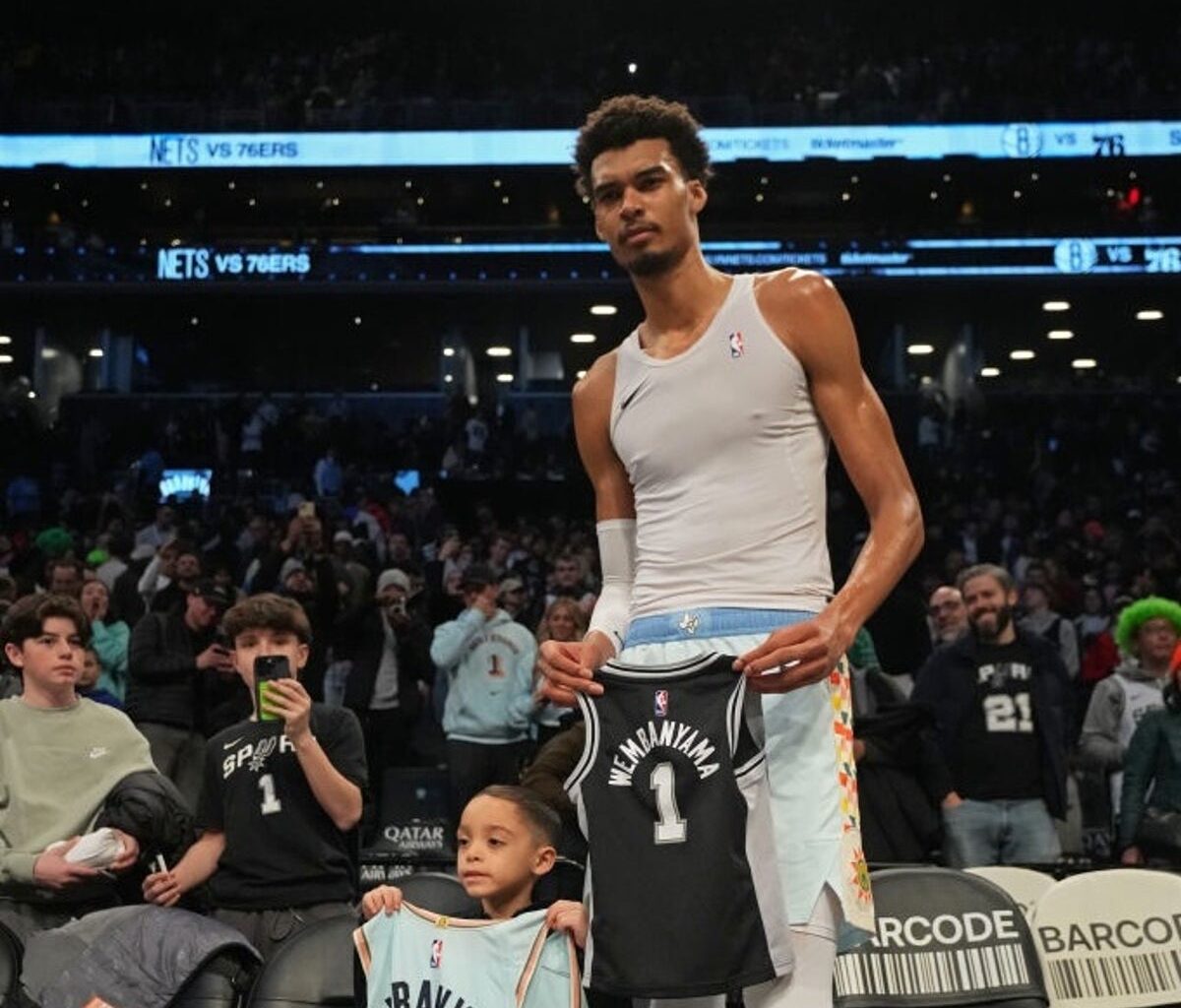
When Victor Wembanyama swapped jerseys with a young fan after the San Antonio Spurs’ 96-87 win over the Brooklyn Nets at the Barclays Center on Dec. 27, it created a viral image that delighted the internet.
What’s followed has turned a sweet interaction into a hotly debated issue that reached New York’s Supreme Court.
Here’s what we know about the situation.
How did the jersey swap happen?
The five-year-old boy, who was wearing a tiny Spurs Wembanyama jersey, and his father attended the game with a sign that read “Victor Wembanyama will you swap jerseys with me?” After the game, they were invited onto the court where the swap was carried out in front of cameras, with the boy getting Wembanyama’s game-worn City Edition top and the 7-foot-3 Wembanyama getting the comically small replica.
Best jersey swap ever 🥹 pic.twitter.com/mcJxJQXlJI
— San Antonio Spurs (@spurs) December 28, 2024
What happened to the game-used jersey after it was given to the boy?
On Jan. 14, it was announced the jersey would be a featured item in the Goldin 100 auction opening on Jan. 22, with a starting bid of $10,000. This sparked a public backlash. Many people who found the original interaction so endearing felt it was distasteful to cash in on the gifted jersey so quickly. However, those who defended the move pointed out that the jersey would likely bring in a significant amount of money for the family and potentially have a life-changing impact for the child.
What did Wembanyama think of his jersey going to auction?
The day after the auction was announced, Wemby quote tweeted the news and added a crying emoji. So he didn’t seem pleased by the decision.
— Wemby (@wemby) January 15, 2025
What did the jersey sell for?
On Feb. 22 — two days after it was announced that Wembanyama had suffered a season-ending injury — the auction concluded with the jersey selling for $73,200. While a significant sum, nine Wembanyama game-used jerseys have sold for more through the NBA’s official auction partner, Sotheby’s, including his first All-Star Game jersey, which sold for $228,600 on Feb. 24. The record sale for a Wembanyama game-used jersey remains one of the three jerseys he wore in his NBA regular-season debut, which sold for $762,000 in November 2023. While the swapped jersey was a part of a viral moment, there was nothing remarkable about his performance (19 points, seven rebounds, four assists, six blocks) nor was it a milestone game that night. Combine that with the negative public sentiment around the sale and his recent injury and the result was a value that fell short of the top-tier Wemby jerseys to date.
What did the seller think of the sale?
On Monday, after the auction had concluded, Frankie Desideri Sr., the father of the boy who swapped jerseys with Wembanyama, filed a lawsuit for a temporary restraining order against Goldin Auctions through the New York State Supreme Court to stop the sale, as first reported by Cllct. In the documents Desideri filed, he said that “multiple attempts to withdrawal from auction (sic)” were made. He also said Goldin used images of him and his son to promote the auction “despite clear, prior instructions that no images be attached to the sale,” which caused “widespread exposure and emotional harm” as a result of “public scrutiny and harassment” that led to his son suffering “severe emotional distress, avoiding basketball games and believing his favorite player dislikes him after he posted about the sale also.” Desideri said it was the use of their images that prompted him to revoke consent to the auction prior to it concluding. In addition, the filing said the jersey was gifted to the boy, making him sole owner of it and that “under New York law, contracts involving minors are voidable at the discretion of the legal guardian.”
In Goldin’s court filings in response, the company said Desideri contacted Goldin two days after the swap took place and “voluntarily and without solicitation” entered into a consignment agreement to auction the jersey. It also accused Desideri of “experiencing seller’s remorse.” The filing went on to say the jersey was “sold, paid for, and shipped to the buyer” before Goldin was made aware of the suit. It also contended the company should not be subject to New York law since it is based in New Jersey.
Goldin said that on Feb. 14, “Mr. Desideri texted his consignment director and expressed concern that the auction might not eclipse a $50,000 sale price.” A screenshot of that text was included in the company’s filings. It went on to say that Feb. 21, one day before the end of the auction, “Goldin received a letter from a lawyer representing Petitioners requesting that Goldin withdraw the jersey from its auction.
“It appears that Mr. Desideri changed his mind about the auction because he was concerned about the price of the jersey, as Mr. Desideri’s sudden change of heart came right on the heels of an announcement on the previous day that Victor Wembanyama had a blood clot and would miss the rest of the season,” Goldin alleged.
Where is the jersey now?
According to Goldin’s court filings, the buyer paid for the jersey on Feb. 23 and it was shipped to them the following day.
Who bought the jersey?
The identity of the buyer in auctions like this is never made public unless that person chooses to make themselves known. After the sale, a rumor spread on social media that Wembanyama bought the jersey back himself, but Goldin’s court filings say the jersey was shipped to the buyer in Maryland, which would seem to rule out the buyer being Wembanyama.
What happens next?
The court declined to grant the temporary restraining order at a hearing on Thursday, according to Jonathan Parente, partner at Alston & Bird and legal counsel to Goldin. The suit remains ongoing, however, and is scheduled to proceed in March, with dates set for the 12th and 13th.
UPDATE: On March 14, Cusano Smith PLLC, a law firm representing Desideri, submitted a letter to the judge in the case requesting to withdrawal the petition against Goldin. That will bring the case to an end.
Required reading
The Athletic maintains full editorial independence in all our coverage. When you click or make purchases through our links, we may earn a commission.
(Photo: Jesse D. Garrabrant / NBAE via Getty Images)